Factorizability
Erwin Schrödinger told
Albert Einstein that his
separability principle (his
Trennungsprinzip) would not apply to
entangled particles.
Schrödinger challenged Einstein's
EPR paper that two systems that had previously interacted can be treated as
separated systems, and that a two-particle wave function
ψ12 can be
factored into a
product of separated wave functions for each system, e.g.,
ψ12 →
ψ1 ψ2.
The particles cannot separate (become disentangled), Schrödinger knew, until another quantum interaction (a
measurement or environmental decoherence)
collapses the wave function ψ
12 and separates them.
Schrödinger wrote about disentanglement...
To disentangle them we must
gather further information by experiment, although we knew as much as anybody
could possibly know about all that happened. Of either system, taken
separately, all previous knowledge may be entirely lost, leaving us but one
privilege: to restrict the experiments to one only of the two systems. After reestablishing
one representative by observation, the other one can be inferred
simultaneously. In what follows the whole of this procedure will be called the
disentanglement...
Attention has recently [viz., EPR] been called to the obvious but very disconcerting fact
that even though we restrict the disentangling measurements to one system, the
representative obtained for the other system is by no means independent of the
particular choice of observations which we select for that purpose and which by
the way are entirely arbitrary. It is rather discomforting that the theory should
allow a system to be steered or piloted into one or the other type of state at the
experimenter's mercy in spite of his having no access to it. This paper does not
aim at a solution of the paradox, it rather adds to it, if possible.
The Collapse of the Two-Particle Wave Function
What happens actually is a realization of one of two possible quantum states which quantum mechanics describes as in a
superposition.
If ψ
+ (spin-up) and ψ
- (spin-down) are both solutions of the Schrödinger equation for a
single particle, then a linear combination of these is also a solution,
| ψ > = 1/√2 | ψ+ > ± 1/√2 | ψ- >,
with probability amplitude coefficients 1/√2. The probability of either state | ψ >
2 is 1/2.
When measured many times, such a superposed state will produce approximately 1/2 spin-up and 1/2 spin-down results.
But when it involves two particle widely
separated? in space, the indeterministic outcome of Schrödinger's two-particle wave function seems physically unacceptable to many.
We now have...
| ψ12 > = 1/√2 | ψ1+ ψ2- > ± 1/√2 | ψ1- ψ2+ >,
Notice the similarity with Schrödinger's famous
superposition of live and dead cats.
| ψ > = 1/√2 | atom decay dead cat> ± 1/√2 | no decay live cat >,
which simply means there is a fifty percent chance of finding the cat dead or alive!
In 2023
Christoph Lehner gave a
presentation at IQOQI Vienna on "The Prehistory of Entanglement: Schrödinger and the Development of the EPR Paradox."
It was based on a lengthy study of Schrödinger's many extensive notebooks, written in an old German shorthand.
In the summer of 1926, Schrödinger wrote...
the joint oscillating states...cannot be dissolved into states of the single systems.
Lehner thus showed that Schrödinger had discovered, nearly a decade before EPR,
the
nonseparability that disproved Einstein's separability principle (
Trennungsprinzip),
the core controversy of the
EPR paradox.
Schrödinger published the famous paper defining his idea of "
entanglement" in August of 1935. It began:
When two systems, of which we know the states by their respective representatives,
enter into temporary physical interaction due to known forces between
them, and when after a time of mutual influence the systems separate again, then
they can no longer be described in the same way as before, viz. by endowing each
of them with a representative of its own. I would not call that one but rather the
characteristic trait of quantum mechanics, the one that enforces its entire
departure from classical lines of thought. By the interaction the two representatives
(or ψ-functions) have become entangled.
They can be disentangled by a measurement or
decohered by interaction with the environment (other particles). An experiment by a human observer is not necessary.
Bell on Factorization
In his final paper describing entanglement and his theorem, Bell provided a space-time diagram for his inequality derivation...
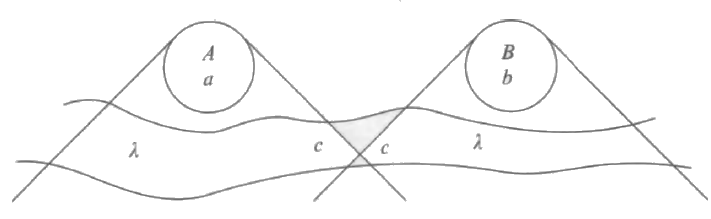 In the space-time diagram... we denote by A (=+ 1 or -1) the output
from the counter on the left ('yes' or 'no'). And B (=+ 1 or -1) is the
output from the counter on the right. We denote by a and b the angle
by which the polarizers are rotated from some standard positions in
which they are parallel...
We let λ denote any number of hypothetical
additional complementary variables needed to complete quantum
mechanics in the way envisaged by EPR.
Let
In the space-time diagram... we denote by A (=+ 1 or -1) the output
from the counter on the left ('yes' or 'no'). And B (=+ 1 or -1) is the
output from the counter on the right. We denote by a and b the angle
by which the polarizers are rotated from some standard positions in
which they are parallel...
We let λ denote any number of hypothetical
additional complementary variables needed to complete quantum
mechanics in the way envisaged by EPR.
Let
{A, B | a, b, c, λ}
denote the probability of particular values A and B given values of the
variables...
Here Bell factorizes {A, B} into {A} and {B}
By a standard rule, the joint probability can
be expressed in terms of conditional probabilities:
{A, B | a, b. c, λ} = {A | a, b, c, λ} {B | a, b, c, λ}
Because they are at a space-like
separation, Bell eliminates b from A, and a from B.
Invoking local causality...we declare redundant certain of
the conditional variables in the last expression, because they are at space-like
separation from the result in question. Then we have
{A, B | a, b. c, λ} = {A | a, c, λ} {B | b, c, λ}
Now this formulation has a very simple interpretation. It exhibits A
and B as having no dependence on one another, nor on the settings
of the remote polarizers
(b and a respectively)...
Bell has factorized
{A,B} into
{A} {B}, something Schrödinger said cannot be done with entangled states, since they are
not separable.
"La Nouvelle Cuisine", in Speakable and Unspeakable in Quantum Mechanics 1988, p.242
Normal |
Teacher |
Scholar

 |
|


