Bell's Two Theorems?
For the last thirty years there has been a great deal of controversy among philosophers of science over what exactly
John Bell said about
nonlocality,
nonseparability,
determinism,
hidden variables, and the idea of a
common_cause producing perfectly correlated outcomes in widely separated experiments.
In general, the papers have minimal discussion of the quantum physics, especially
Erwin Schrödinger's two-particle wave function Ψ
12 and his amazing prediction of perfect measurement correlations for widely separated
entangled particles.
Instead the arguments are stated in verbal terms, with a few space-time diagrams and a famous "contraption" imagined by
David Mermin. Dozens of new terms are defined and some older terms are given conflicting definitions. We provide a glossary of the terms, individual web pages on the philosophers, and downloadable PDFs of their critical articles.
John Bell's work begins with the problem of hidden variables as suggested by the 1935
Einstein-Podolsky Paradox paper, but we trace its origins back as early as Einstein's 1905 photoelectric effect paper and Schrödinger's formulation of wave mechanics in 1926.
We date the beginning of vigorous philosophical discussions to 1984 at Harvard University, when
Abner Shimony invited philosopher of science
Jon Jarrett to discuss his 1983 thesis
Bell's Theorem, Quantum Mechanics, and Local Realism
Shimony, author of the landmark
Stanford Encyclopedia of Philosophy page on Bell's Theorem, inspired by Jarrett's thesis, began the creation of new terminology with his "parameter independence" and "outcome independence."
Parameter independence (PI) states that the probability of a measurement outcome for one observer (e.g., Alice) does not depend on the choice of measurement setting made by a distant observer (e.g., Bob) in a spacelike separated region.
[1] (
https://link.aps.org/doi/10.1103/PhysRevA.104.032205),
[2] (
https://www.bu.edu/cphs/about/abner-shimony/)
Outcome Independence (OI) states that the probability of a measurement outcome for one observer (e.g., Alice) does not depend on the measurement outcome of a distant (entangled) observer (e.g., Bob) in a spacelike separated region.
Outcome Independence follows Jarrett's decomposition of Bell’s "local causality" condition into two distinct logical requirements Jarrett calls "locality" and "completeness" to explain the nonlocality of quantum mechanics.
[1] (
https://arxiv.org/html/1010.3969v1),
[2] (
https://plato.stanford.edu/archives/fall2025/entries/bell-theorem/),
[3] (
https://www.bu.edu/philo/2015/08/11/professor-abner-shimony-1928-2015/)
By breaking Bell's theorem down into these two types of independence, Shimony hoped to provide a mathematical and logical framework for why quantum mechanics can violate Bell inequalities without violating Albert Einstein's special relativity—a state Shimony famously termed "peaceful coexistence" - a term borrowed from Cold War politics and famously reapplied by Shimony to describe a non-contradictory relationship between quantum mechanics and special relativity.
But of course special relativity prohibits instantaneous interactions between spacelike separated events (Einstein's "
spooky action-at-a-distance) thought to create the perfectly correlated outcomes in widely separated experiments performed at the same time.
Instead of instantaneous interactions there needs only to be a
common cause in the past light cone of the separated events, as
Travis Norsen found in one of Bell's last papers...
A theory can be said to be locally causal if the probabilities attached to values of local beables in a spacetime region 1 are unaltered by specification of values of local beables in a space-like
separated region 2, when what happens in the backward light cone
of 1 is already sufficiently specified, for example by a full specification
of local beables in a space-time region 3 (Fig. 4).
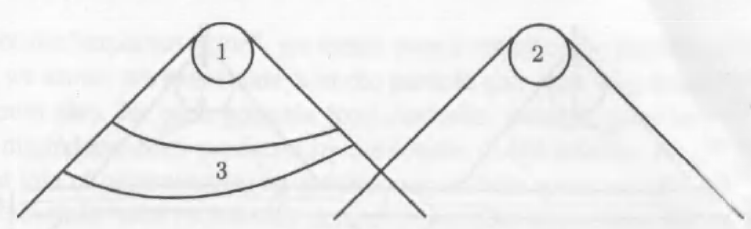 Fig. 4. Full specification of what happens in 3 makes events in 2 irrelevant for
predictions about 1 in a locally causal theory.
It is important that region 3 completely shields off from 1 the overlap
of the backward light cones of 1 and 2. And it is important that events
in 3 be specified completely. Otherwise the traces in region 2 of causes
of events in 1 could well supplement whatever else was being used for
calculating probabilities about 1. The hypothesis is that any such information
about 2 becomes redundant when 3 is specified completely.
Fig. 4. Full specification of what happens in 3 makes events in 2 irrelevant for
predictions about 1 in a locally causal theory.
It is important that region 3 completely shields off from 1 the overlap
of the backward light cones of 1 and 2. And it is important that events
in 3 be specified completely. Otherwise the traces in region 2 of causes
of events in 1 could well supplement whatever else was being used for
calculating probabilities about 1. The hypothesis is that any such information
about 2 becomes redundant when 3 is specified completely.
("La Nouvelle Cuisine," republished in Speakable and Unspeakable in Quantum Mechanics," 1987, p. 240)
But a
common cause from the initial entanglement is still in the past light cone of the "
separated" measurements at A and B, as shown by Norsen...
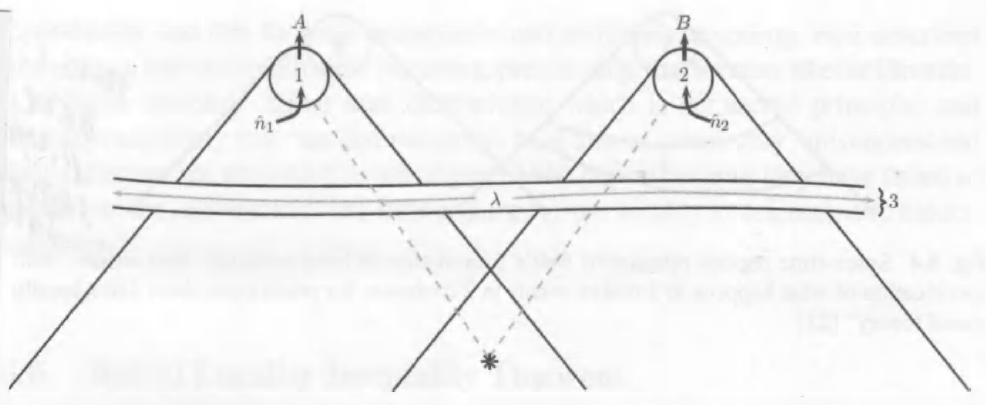
Foundations of Quantum Mechanics: An Exploration of the Physical Meaning of Quantum Theory, p.238.
As long as Bell's "local beables" (which he sometimes presents as "λ") either don't exist or do not interfere with the travelling particles, one particle will have spin-up and the other spin-down to conserve the total spin angular momentum's zero and preserve the symmetry of the original entanglement preparation state.
The initial entanglement of the two particles in the past light cone and a powerful conservation principle explains the
appearance of
nonlocality without any "
hidden variables" but with what we can call a "
hidden constant of the motion," the total spin zero!
Normal |
Teacher |
Scholar

 |
|


