
Follow infophilosopher:
 |
|

|
|
|
Topics
Introduction
Problems Freedom Knowledge Mind Life Chance Quantum Entanglement Scandals Philosophers Mortimer Adler Rogers Albritton Alexander of Aphrodisias Samuel Alexander William Alston Anaximander G.E.M.Anscombe Anselm Louise Antony Thomas Aquinas Aristotle David Armstrong Harald Atmanspacher Robert Audi Augustine J.L.Austin A.J.Ayer Alexander Bain Mark Balaguer Jeffrey Barrett William Barrett William Belsham Henri Bergson George Berkeley Isaiah Berlin Richard J. Bernstein Bernard Berofsky Robert Bishop Max Black Susan Blackmore Susanne Bobzien Emil du Bois-Reymond Hilary Bok Laurence BonJour George Boole Émile Boutroux Daniel Boyd F.H.Bradley C.D.Broad Michael Burke Jeremy Butterfield Lawrence Cahoone C.A.Campbell Joseph Keim Campbell Rudolf Carnap Carneades Nancy Cartwright Gregg Caruso Ernst Cassirer David Chalmers Roderick Chisholm Chrysippus Cicero Tom Clark Randolph Clarke Samuel Clarke Anthony Collins August Compte Antonella Corradini Diodorus Cronus Jonathan Dancy Donald Davidson Mario De Caro Democritus William Dembski Brendan Dempsey Daniel Dennett Jacques Derrida René Descartes John Dewey Richard Double Fred Dretske Curt Ducasse John Earman Laura Waddell Ekstrom Epictetus Epicurus Austin Farrer Herbert Feigl Arthur Fine John Martin Fischer Kuno Fischer Frederic Fitch Owen Flanagan Luciano Floridi Philippa Foot Alfred Fouilleé Harry Frankfurt Richard L. Franklin Bas van Fraassen Michael Frede Gottlob Frege Peter Geach Edmund Gettier Carl Ginet Alvin Goldman Gorgias Nicholas St. John Green Niels Henrik Gregersen H.Paul Grice Ian Hacking Ishtiyaque Haji Stuart Hampshire W.F.R.Hardie Sam Harris William Hasker R.M.Hare Georg W.F. Hegel Martin Heidegger Heraclitus R.E.Hobart Thomas Hobbes David Hodgson Shadsworth Hodgson Baron d'Holbach Ted Honderich Pamela Huby David Hume Ferenc Huoranszki Frank Jackson William James Jon Jarrett Lord Kames Robert Kane Immanuel Kant Tomis Kapitan Walter Kaufmann Jaegwon Kim William King Hilary Kornblith Christine Korsgaard Saul Kripke Thomas Kuhn Andrea Lavazza James Ladyman Christoph Lehner Keith Lehrer Gottfried Leibniz Jules Lequyer Leucippus Michael Levin Joseph Levine George Henry Lewes C.I.Lewis David Lewis Peter Lipton C. Lloyd Morgan John Locke Michael Lockwood Arthur O. Lovejoy E. Jonathan Lowe John R. Lucas Lucretius Alasdair MacIntyre Ruth Barcan Marcus Tim Maudlin James Martineau Nicholas Maxwell Storrs McCall Hugh McCann Colin McGinn Michael McKenna Brian McLaughlin John McTaggart Paul E. Meehl Uwe Meixner Alfred Mele Trenton Merricks John Stuart Mill Dickinson Miller G.E.Moore Ernest Nagel Thomas Nagel Otto Neurath Friedrich Nietzsche John Norton P.H.Nowell-Smith Robert Nozick William of Ockham Timothy O'Connor Parmenides David F. Pears Charles Sanders Peirce Derk Pereboom Gualtiero Piccinini Steven Pinker U.T.Place Plato Karl Popper Porphyry Huw Price H.A.Prichard Protagoras Hilary Putnam Willard van Orman Quine Frank Ramsey Ayn Rand Michael Rea Thomas Reid Charles Renouvier Nicholas Rescher C.W.Rietdijk Richard Rorty Josiah Royce Bertrand Russell Paul Russell Gilbert Ryle Jean-Paul Sartre Kenneth Sayre T.M.Scanlon Moritz Schlick John Duns Scotus Albert Schweitzer Arthur Schopenhauer John Searle Wilfrid Sellars David Shiang Alan Sidelle Ted Sider Henry Sidgwick Walter Sinnott-Armstrong Peter Slezak J.J.C.Smart Saul Smilansky Michael Smith Baruch Spinoza Allen Stairs L. Susan Stebbing Isabelle Stengers George F. Stout Galen Strawson Peter Strawson Eleonore Stump Francisco Suárez Richard Taylor Kevin Timpe Mark Twain Peter Unger Peter van Inwagen Manuel Vargas John Venn Kadri Vihvelin Voltaire G.H. von Wright David Foster Wallace R. Jay Wallace W.G.Ward Ted Warfield Roy Weatherford C.F. von Weizsäcker William Whewell Alfred North Whitehead David Widerker David Wiggins Bernard Williams Timothy Williamson Ludwig Wittgenstein Susan Wolf Xenophon Scientists Emily Adlam David Albert Philip W. Anderson Michael Arbib Bobby Azarian Walter Baade Bernard Baars Jeffrey Bada Guido Bacciagaluppi Leslie Ballentine Marcello Barbieri Jacob Barandes Julian Barbour Horace Barlow Gregory Bateson Jakob Bekenstein John S. Bell Mara Beller Charles Bennett Ludwig von Bertalanffy Susan Blackmore Margaret Boden David Bohm Niels Bohr Ludwig Boltzmann John Tyler Bonner Emile Borel Max Born Satyendra Nath Bose Walther Bothe Jean Bricmont Hans Briegel Leon Brillouin Daniel Brooks Stephen Brush Henry Thomas Buckle S. H. Burbury Melvin Calvin William Calvin Donald Campbell John O. Campbell Sadi Carnot Sean B. Carroll Anthony Cashmore Eric Cavalcanti Eric Chaisson Gregory Chaitin Jean-Pierre Changeux Rudolf Clausius Arthur Holly Compton John Conway Simon Conway-Morris Peter Corning George Cowan Jerry Coyne John Cramer Francis Crick E. P. Culverwell Antonio Damasio Olivier Darrigol Charles Darwin Paul Davies Richard Dawkins Terrence Deacon Lüder Deecke Richard Dedekind Louis de Broglie Stanislas Dehaene Max Delbrück Abraham de Moivre David Depew Bernard d'Espagnat Paul Dirac Theodosius Dobzhansky Hans Driesch John Dupré John Eccles Arthur Stanley Eddington Gerald Edelman Paul Ehrenfest Manfred Eigen Albert Einstein George F. R. Ellis Walter Elsasser Hugh Everett, III Franz Exner Richard Feynman R. A. Fisher David Foster Joseph Fourier George Fox Philipp Frank Steven Frautschi Edward Fredkin Augustin-Jean Fresnel Karl Friston Benjamin Gal-Or Howard Gardner Lila Gatlin Michael Gazzaniga Nicholas Georgescu-Roegen GianCarlo Ghirardi J. Willard Gibbs James J. Gibson Nicolas Gisin Paul Glimcher Thomas Gold A. O. Gomes Brian Goodwin Julian Gough Joshua Greene Dirk ter Haar Jacques Hadamard Mark Hadley Ernst Haeckel Patrick Haggard J. B. S. Haldane Stuart Hameroff Augustin Hamon Sam Harris Ralph Hartley Hyman Hartman Jeff Hawkins John-Dylan Haynes Donald Hebb Martin Heisenberg Werner Heisenberg Hermann von Helmholtz Grete Hermann John Herschel Francis Heylighen Basil Hiley Art Hobson Jesper Hoffmeyer John Holland Don Howard John H. Jackson Ray Jackendoff Roman Jakobson Jon Jarrett E. T. Jaynes William Stanley Jevons Pascual Jordan Eric Kandel Ruth E. Kastner Stuart Kauffman Martin J. Klein William R. Klemm Christof Koch Simon Kochen Hans Kornhuber Stephen Kosslyn Daniel Koshland Ladislav Kovàč Leopold Kronecker Bernd-Olaf Küppers Rolf Landauer Alfred Landé Pierre-Simon Laplace Karl Lashley David Layzer Joseph LeDoux Gerald Lettvin Michael Levin Gilbert Lewis Benjamin Libet David Lindley Seth Lloyd Werner Loewenstein Hendrik Lorentz Josef Loschmidt Alfred Lotka Ernst Mach Donald MacKay Henry Margenau Lynn Margulis Owen Maroney David Marr Lluis Masanes Humberto Maturana James Clerk Maxwell John Maynard Smith Ernst Mayr John McCarthy Barbara McClintock Warren McCulloch N. David Mermin George Miller Stanley Miller Ulrich Mohrhoff Jacques Monod Vernon Mountcastle Gerd B. Müller Markus P. Müller Emmy Noether Denis Noble Donald Norman Travis Norsen Howard T. Odum Alexander Oparin Abraham Pais Howard Pattee Wolfgang Pauli Massimo Pauri Wilder Penfield Roger Penrose Massimo Pigliucci Steven Pinker Colin Pittendrigh Walter Pitts Max Planck Susan Pockett Henri Poincaré Michael Polanyi Daniel Pollen Ilya Prigogine Hans Primas Giulio Prisco Zenon Pylyshyn Henry Quastler Adolphe Quételet Pasco Rakic Nicolas Rashevsky Lord Rayleigh Frederick Reif Jürgen Renn Giacomo Rizzolati A.A. Roback Emil Roduner Juan Roederer Robert Rosen Frank Rosenblatt Jerome Rothstein David Ruelle David Rumelhart Michael Ruse Stanley Salthe Robert Sapolsky Tilman Sauer Ferdinand de Saussure Jürgen Schmidhuber Erwin Schrödinger Aaron Schurger Sebastian Seung Thomas Sebeok Franco Selleri Claude Shannon James A. Shapiro Charles Sherrington Abner Shimony Herbert Simon Dean Keith Simonton Edmund Sinnott B. F. Skinner Lee Smolin Ray Solomonoff Herbert Spencer Roger Sperry John Stachel Kenneth Stanley Henry Stapp Ian Stewart Tom Stonier Antoine Suarez Leonard Susskind Leo Szilard Max Tegmark Teilhard de Chardin Libb Thims William Thomson (Kelvin) Richard Tolman Giulio Tononi Peter Tse Alan Turing Robert Ulanowicz C. S. Unnikrishnan Nico van Kampen Antony Valentini Francisco Varela Vlatko Vedral Vladimir Vernadsky Clément Vidal Mikhail Volkenstein Heinz von Foerster Richard von Mises John von Neumann Jakob von Uexküll C. H. Waddington Sara Imari Walker James D. Watson John B. Watson Daniel Wegner Steven Weinberg August Weismann Paul A. Weiss Herman Weyl John Wheeler Jeffrey Wicken Wilhelm Wien Norbert Wiener Eugene Wigner E. O. Wiley E. O. Wilson Günther Witzany Carl Woese Stephen Wolfram H. Dieter Zeh Semir Zeki Ernst Zermelo Wojciech Zurek Konrad Zuse Fritz Zwicky Presentations ABCD Harvard (ppt) Bhaktivedanta Institute Biosemiotics Free Will Mental Causation James Symposium CCS25 Talk Evo Devo September 12 Evo Devo October 2 Evo Devo Davies Nov12 |
Jacob Barandes
Jacob Barandes has joint faculty appointments in the physics and philosophy departments at Harvard University, and does research in the philosophy of physics.
"Stepping outside the wave function paradigm," Barandes says, he proposes a new formulation of quantum mechanics (not simply an interpretation) in terms of old-fashioned configuration spaces together with what he calls "unistochastic" laws.
Barandes' formulation replaces the abstract wave function of Erwin Schrödinger's wave mechanics formulation and the eigenfunctions, eigenvectors, and eigenstates of Werner Heisenberg's matrix mechanics formulation, and John von Neumann and P.A.M.Dirac's axiomatic formulation on Hilbert vector spaces.
In particular, Barandes replaces their transition probabilities between quantum states with "directed conditional probabilities" in stochastic processes. And he describes their time evolution with linear maps that describe the dynamics of a quantum system. In the realm
of quantum information theory these maps are referred to as quantum channels. These linear maps can be interpreted as a Hilbert space.
If the time evolution of a system from t=0 to t=2 can be divided into first t=0 to t=1, then t=1 to t=2, he calls it divisible, otherwise time evolution is indivisible.
In his 2025 paper The Stochastic-Quantum Correspondence, for the Philosophy and Physics Group at the London School of Economics, Barandes shows how his stochastic approach recovers the familiar Schrödinger wave equation, von Neumann's unitary time evolution, and other equations of standard quantum theory.
In his 2024 paper "New Prospects for a Causally Local Formulation of Quantum Theory," Barandes introduces a "new principle of causal locality" that is " intended to improve on [John] Bell's criteria."
Barandes first defines the terms "signal-local" and "signal-nonlocal."
In physical theories like Newtonian mechanics that involve forces, one can ask whether those forces are limited by the speed of light, or instead consist of faster-than-light action at a distance... In principle, there are no constraints in Newtonian mechanics that would preclude sending superluminal signals—say, by exploiting the action-at-a-distance features of Newtonian gravitational forces. Newtonian mechanics is therefore presumably signal-nonlocal.Einstein's special theory limits actions at a distance to light speed. Barandes then defines a type of locality he calls causal locality This paper will be concerned with a different type of locality, called causal locality, which will be taken to consist of the following statement: Causal influences should not be able to propagate faster than light.Finally, Barandes describes Bell as introducing a new principle of local causality. Bell’s principle of local causality is the assumption that the asserted common causes in question must specifically take the form of variables that can be conditioned on and then summed or integrated over... Bell’s principle of local causality...implicitly depends on an assumption that goes beyond questions of locality. That implicit assumption is called Reichenbach’s principle of common causes. Reichenbach’s principle of common causes states that if two variables A and B are correlated, in the sense that their joint probability P(A,B) fails to factorize as the product of their standalone probabilities P(A) and P(B),Barandes "especially thanks" Travis Norsen, who mentions Bell's formulation of local causality and illustrates Barandes' point about overlapping past light cones. 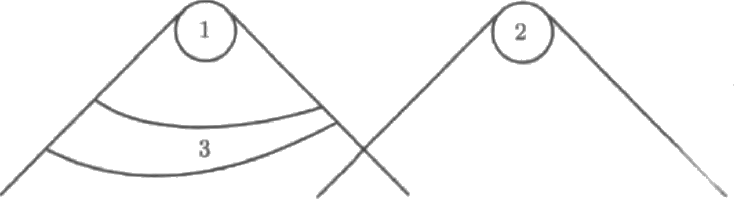
Fig. 8.4 Space-time regions relevant to Bell’s formulation of local causality. Bell writes: “Full specification of what happens in 3 makes events in 2 irrelevant for predictions about 1 in a locally causal theory”But Norsen then explicitly shows how a common cause from the initial entanglement is still in the past light cone of the "separated" measurements at A and B. 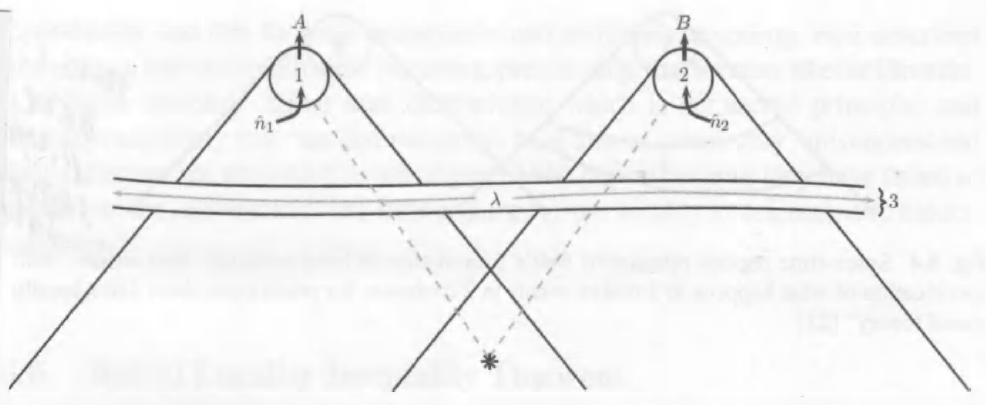
Fig. 8.5 Space-time diagram for the Bell experiment. The particle pair is emitted at the “flash’' at the bottom of the diagram; world-lines for the two individual particles flying apart in opposite directions are represented by the gray dashed lines. The (large!) region 3 encompasses both particles at some intermediate time and shields the two measurement regions, 1 and 2. from their overlapping past light cones in the way that is required in Bell's formulation of locality. 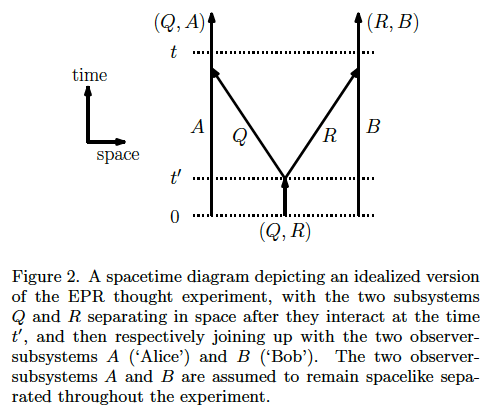
Suppose that the two subsystems Q and R are not kept at spacelike separation during the physical process in question, but locally interact at some intermediate time t′ between 0 and t. Then, again following standard textbook arguments, the overall system’s unitary time-evolution operator UQR(t) will fail to tensor-factorize at t′:
Note that the intermediate time t' is precisely the moment the particles Q and R are in contact and causally local entangled. These causally local influences do not propagate faster than light. Erwin Schrödinger said ΨAB cannot be represented as a simple product of two independent single-particle states ΨA ΨB.
Schrödinger's wave function ΨAB is in a linear combination or superposition of ΨA↑ ΨB↓ and ΨA⇵ ΨB↑. A measurement or a "collapse" of ΨAB produces either A-up and B-down or A-down and B-up. Either conserves total spin, and makes either outcome quantum random, as quantum encryption codes require.
UQR(t′) ≠ UQ(t′) ⊗ UR(t′). (59) Because the corresponding transition matrix ΓQR(t) encodes cumulative statistical effects starting at the initial time 0, the transition matrix will continue to fail to tensor-factorize for all times t ≥ t′ (at least until the next division event): ΓQR(t) ≠ ΓQ(t) ⊗ ΓR(t) [for t ≥ t′]. (60) The breakdown in tensor-factorization for t ≥ t′ is precisely entanglement, as manifested at the level of the underlying indivisible stochastic process... so one can conclude that the two subsystems Q and R exert causal influences on each other, stemming from their local interaction at the time t′.
The initial entanglement at t' is an initial casually local event that puts the particles in a spherically symmetric state with total spin zero.
During the time evolution from t' to t, the conservation of spin angular momentum is a condition or constraint on total spin (a "hidden constant" if not a hidden variable?) that will locally cause? the measurements at A and B to be perfectly correlated as long as Alice and Bob agree ahead of time t to measure at the same angle (maintaining planar symmetry)
If their measurements diverge by angle Θ, correlations will fall off by cos2Θ, as observed in all Bell experiments. (the "law of Malus")
Notice that this local interaction, despite being the ‘common cause’ of the correlations between Q and R, is not the sort of ‘variable’ that can be plugged into the unistochastic theory’s microphysical conditional probabilities. Reichenbach’s principle of common causes therefore does not hold.Barandes says The degrees of freedom have laws that are probabilistic,Barandes also says stochastic-quantum correspondence transition matrices failure to factorizeI-Phi hopes to show that Barandes' common cause in Norsen's past light cones above does qualify as a Reichenbach common cause. Schrödinger replied immediately to the 1935 EPR paper, telling Einstein that his "separation principle" (Trennungsprinzip) was incorrect. Following Dirac's principle of superposition, the "entangled particles" are in a linear combination (or superposition) of two-particle states... In general, a wave function of the system pair determines uniquely the pair of physical variables of the two systems - call them A1 and A2 - that satisfy the condition that each measurement of A1 on the first system allows a precise inference to the A2 of the second system, and vice versa. After re-establishing one representative by observation, the other one can be inferred simultaneously.As the particles travel away from the central apparatus C in opposite directions toward measurement devices at A and B the two-particle wave function is in a spherically symmetric singlet state with total spin angular momentum zero. Schrödinger said the wave function is a linear combination or superposition of ΨA ↑ΨB ↓ + ΨA ↓ΨB ↑.
ΨAB = 1/√2 (ΨA ↑ΨB ↓) - 1/√2 (ΨA ↓ΨB ↑)
In David Bohm's version of entangled particles, the molecular wave function of the dissociating hydrogen "quasi-molecule" is the spherically symmetric 1Σg ground state.
The total spin zero is conserved as a constant of the motion until a causally local interaction at either A or B collapses the two-particle wave function, decohering it into a product of single-particle states, either ΨA ↑ΨB ↓ or ΨA ↓ΨB ↑. The constant of the motion is not a causally local process like the initial entanglement and the separate final measurements, but it is a condition or constraint that puts limits on the measurement outcomes.
Schrödinger says the final measurement disentangles the particles. The particles remain correlated, but a later measurement of one will no longer affect the other.
Nevertheless, Schrödinger also said that after the measurement at A or (A1), something could still be learned (known) about the particle at B (or A2).
When two systems, of which we know the states by their respective representatives, enter into temporary physical interaction due to known forces between them, and when after a time of mutual influence the systems separate again, then they can no longer be described in the same way as before, viz. by endowing each of them with a representative of its own... After re-establishing one representative by observation, the other one can be inferred simultaneously.This is what we wish Einstein had called "Knowledge at a Distance" instead of Spooky Action at a Distance. Neither particle "acts" on the other as the measurement events are simultaneous in the reference frame of the central entanglement apparatus and the two observers. As long as final measurements are made at the same pre-agreed upon angle their planar symmetry will maintain the initial symmetry, conserving our constant of the motion total spin zero. The particles will produce perfectly correlated opposite spin states, either up-down or down-up. Individual spin states will be randomly up or down. However, should measurements at A and B not be made in the same plane, if measurement angles differ by angle θ, perfect correlations will be reduced by cos2θ, as quantum mechanics predicts. We note that no information is communicated (at any speed) between A and B. The two bits of information are created locally at A and at B, distally caused by the initial entanglement at C. These bits of information did not exist as the particles were in transit to A and B. They were proximally caused by the causally local measurements at A and at B. We propose that simultaneous measurement outcomes at two entangled particles widely separated in space are caused to be perfectly correlated as the result of 1) local causes at initial entanglement, 2) a conservation principle as the particles travel to the measurement devices which limits the measurement outcomes, and 3) measurements at A and B that are made in a (previously agreed upon arbitrary) single plane that replaces the spherical symmetry of the two-particle wave function with planar symmetry that conserves the perfectly correlated measurement outcomes. There is no superluminal action from A to B or vice versa. We regard this three-part "causal chain" of events as a "common cause" in the sense of Hans Reichenbach's Common Cause Principle If an improbable coincidence has occurred, then there must have been a common cause.3In our case, if events at A and B are perfectly correlated, then either A causes B, B causes A, or there is a common cause C coming to A and B. Since A and B occur simultaneously, neither can cause the other. Any cause from A to B or vice versa would need to travel faster than light. First, the Arguments Against a Common Cause.
The simplest idea of a common cause was described by John Bell in his famous article "Bertlmann's Socks." Just like a pair of matched socks, the particles could have had their correlated properties from the moment of initial entanglement.
The next idea was "local hidden variables" (LHV) that could be traveling with the particles to coordinate their outcomes. Bell proved that if the particles had fixed, hidden instructions (a common cause) all along, they could only match up to 75% of the time compared to quantum mechanics. Physical particles do not possess fixed, predetermined properties before they are measured.
Since the particles cannot communicate faster than light, their instantaneous agreement suggested "spooky action at a distance" to Albert Einstein in the 1935 Einstein-Podolsky-Rosen (EPR) paradox paper.
This concept of instantaneous connection or "action at a distance" between objects came to be called "nonlocality."
Let's see why the values of spin measured by Alice and Bob could not have been pre-determined at the moment of their original entanglement.
To be sure, the initial entanglement puts the two spins in opposing directions, with total spin zero. Let's say that the entanglement apparatus had an initial direction angle θ, and also say that Alice and Bob agree to measure at a different angle φ.
If by chance their angle φ was equal to the initial angle θ, Alice and Bob would get the perfectly correlated joint results and the perfectly random individual results that have been found in all the Bell theorem tests.
If however they measure at some other agreed upon angle (and there is no need for them to line up their measurement angle as we shall see) their correlations should fall off as the square of the difference in angles (θ - φ). This is the well-known "law of Malus" and it's the standard criticism that the spins that Alice and Bob measure cannot have been created at the original entanglement.
The Argument for a Kind of Common Cause
This "common cause" is actually a sequence of causes (from initial entanglement to final measurements) that can perfectly explain the appearance of nonlocal behavior.
The initial local causes in the causal center C do not create specific spin angles/directions for the particles.
Instead, the initial causes put the entangled particles in a spherically symmetric two-particle quantum state ΨAB. In his explanation of entanglement Erwin Schrödinger said this two-particle quantum state cannot be represented as a simple product of two independent single-particle states ΨA ΨB. As Barandes says, they "do not factorize."
Schrödinger said that ΨAB is a linear combination or superposition of ΨA ↑ΨB ↓ and ΨA ↓ΨB ↑.
ΨAB = 1/√2 (ΨA ↑ΨB ↓) - 1/√2 (ΨA ↓ΨB ↑)
Conservation of total spin zero maintains the spherical symmetry of this wave function ΨAB as the particles travel to A and B (provided no environmental interaction disturbs the symmetry). While this symmetry is not "causally local," it puts a "condition" or constraint on the final measurements. The condition is that total spin is conserved as zero. We can call it a constant of the motion.
This condition travels with the particles, at subluminal speeds for fermions (electrons) and at the speed of light for bosons (photons), just as the local hidden variables were thought to do.
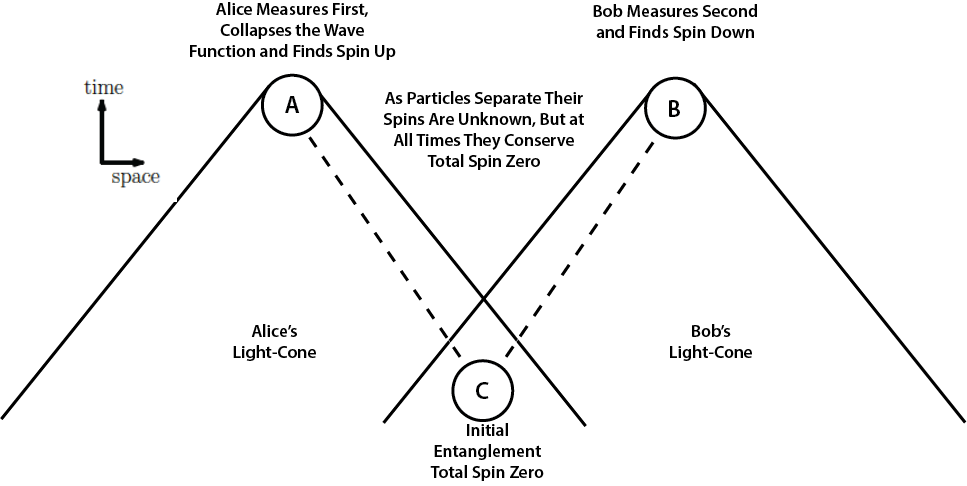 Travis Norsen and Jacob Barandes have drawn similar space-time diagrams. Barandes says there may be a "common cause, but not the kind of hidden variable proposed by John Bell."
The initial local causes are in the past light cone of the final measurement events, as is required for a common cause. We can call them distal causes. The proximal causes are the two causally local measurements at A and at B that create two bits of new information.
These final local causes produce outcomes that are perfectly correlated jointly and yet random individually, as observed.
But there is no faster-than-light communication or interaction between the separated measurement events at A and B. There is no "spooky action at a distance" and only the appearance of nonlocality.
As Einstein saw clearly, some moving inertial frames of reference exist in which A measures first, others in which B measures first. In our picture of a common cause, Alice and Bob at points A and B agree to measure at the same time in their common frame of reference (to measure the same particle pair) and at the same angle, but in practice one usually measures first, collapsing the wave function.
This model opposes the standard view, developed over five decades by Albert Einstein and many others, that some kind of faster-than-light instantaneous and nonlocal interaction between a particle and its wave function, or between the two particles, is needed to explain entanglement.
Instead, it is the instantaneous "collapse" of the wave function, in which nothing is actually moving, but in which values of the wave function ΨAB are instantly changed everywhere, specifically they are changed simultaneously at A and B whatever their separation in spacetime, at the moment one of them causes the two-particle wave function to "collapse."
Richard Feynman described a wave function "collapse" as the "one mystery in quantum mechanics" in his description of the two-slit experiment.
Einstein first saw an instantaneous (nonlocal) change across the spherical front of a light wave in his 1905 photoelectric effect work. He described what looked like the light wave energy all traveling instantly to a single point on the surface, collecting all the energy to eject a photoelectron. His description of energy collecting at one point sounds like a "collapse," perhaps the origin of describing Schrödinger's immaterial wave function as "collapsing."
In his later years, Einstein famously called two-particle entanglement "spooky action at a distance" (spukhafte Fernwirkung) in a March 3, 1947 letter to Max Born.
Although our focus is on experiments and their data correlations, we will also describe the mathematical quantum theory, its wave functions, and their superpositions or linear combinations of product states that perfectly predict the puzzling correlations.
Our model of a "common cause" explaining entanglement is a causal chain of events that begins with the local causes in the entangling apparatus C that establishes the initial symmetry of the entangled particles.
Travis Norsen and Jacob Barandes have drawn similar space-time diagrams. Barandes says there may be a "common cause, but not the kind of hidden variable proposed by John Bell."
The initial local causes are in the past light cone of the final measurement events, as is required for a common cause. We can call them distal causes. The proximal causes are the two causally local measurements at A and at B that create two bits of new information.
These final local causes produce outcomes that are perfectly correlated jointly and yet random individually, as observed.
But there is no faster-than-light communication or interaction between the separated measurement events at A and B. There is no "spooky action at a distance" and only the appearance of nonlocality.
As Einstein saw clearly, some moving inertial frames of reference exist in which A measures first, others in which B measures first. In our picture of a common cause, Alice and Bob at points A and B agree to measure at the same time in their common frame of reference (to measure the same particle pair) and at the same angle, but in practice one usually measures first, collapsing the wave function.
This model opposes the standard view, developed over five decades by Albert Einstein and many others, that some kind of faster-than-light instantaneous and nonlocal interaction between a particle and its wave function, or between the two particles, is needed to explain entanglement.
Instead, it is the instantaneous "collapse" of the wave function, in which nothing is actually moving, but in which values of the wave function ΨAB are instantly changed everywhere, specifically they are changed simultaneously at A and B whatever their separation in spacetime, at the moment one of them causes the two-particle wave function to "collapse."
Richard Feynman described a wave function "collapse" as the "one mystery in quantum mechanics" in his description of the two-slit experiment.
Einstein first saw an instantaneous (nonlocal) change across the spherical front of a light wave in his 1905 photoelectric effect work. He described what looked like the light wave energy all traveling instantly to a single point on the surface, collecting all the energy to eject a photoelectron. His description of energy collecting at one point sounds like a "collapse," perhaps the origin of describing Schrödinger's immaterial wave function as "collapsing."
In his later years, Einstein famously called two-particle entanglement "spooky action at a distance" (spukhafte Fernwirkung) in a March 3, 1947 letter to Max Born.
Although our focus is on experiments and their data correlations, we will also describe the mathematical quantum theory, its wave functions, and their superpositions or linear combinations of product states that perfectly predict the puzzling correlations.
Our model of a "common cause" explaining entanglement is a causal chain of events that begins with the local causes in the entangling apparatus C that establishes the initial symmetry of the entangled particles.
A ← C → B
As the particles travel away from the central apparatus C in opposite directions toward measurement devices at A and B the two-particle wave function ΨAB is in a spherically symmetric singlet state with total spin angular momentum zero. This total spin zero is conserved as a constant of the motion.
Emmy Noether's theorem on the fundamental relationship between symmetry and conservation principles is extremely simple:
For any property of a physical system that is symmetric, there is a corresponding conservation law.Conservation is thus not a causal process in the sense of a causal interaction. Indeed, it demands the lack of any causal interaction with the environment which might decohere the two-particle wave function. But we might say that the conserved property of total electron spin zero is also "local" in the sense that it is traveling along with each particle just as David Bohm's "hidden variables" or David Mermin's "instruction sets" were thought to do. Galileo's law of Inertia, which became Newton's first law of motion, is a conservation principle. If a particle experiences no causal interactions it will maintain its state of motion, including remaining at rest. The final causally local interactions in our "causal chain" of events are the two measurements at A and B, which create two bits of digital information. As long as local measurements are made at the same pre-agreed upon angle their planar symmetry will maintain total spin zero, the particles will have correlated opposite spin states up-down or down-up, and individual spin states will be randomly up or down. Should measurements at A and B differ by angle θ, perfect correlations will be reduced by cos2θ, as predicted by quantum mechanics and confirmed by all recent Bell tests. There is no physical mechanism or faster-than-light interaction between the particles that maintains the total angular momentum from moment to moment as they travel from initial state preparation to final measurements. Quantum mechanics cannot explain many "motions," e.g., the "jumps" of electrons between different shells or orbitals in atoms and molecules or their passage through the slits in the two-slit experiment. Richard Feynman says we can't find any "machinery" that explains what he called the one and only mystery in quantum mechanics. We criticize the claim by David Bohm1 that the three components of spin angular momentum must exist and be defined in all spatial directions, x, y, and z (which is impossible), in order for experiments to find the spins perfectly correlated and in opposite directions when measured. Similar is the claim by David Mermin2 that photon polarizations must exist in all directions. The correct requirement is that there be no preferred spin direction at all (spherical symmetry) in the initial entanglement and as the particles travel to A and B. It is the arbitrary but agreed upon angle chosen for the two final measurements that introduces the preferred direction. The planar symmetry of the measurement devices maintains the spin symmetry. Each final spin measurement creates a single bit of information. No information is communicated from A to B as Einstein feared. In our common cause picture, new information is created simultaneously at A and B. 1. Bohm, D. and Y. Aharonov, "Discussion of Experimental Proof for the Paradox of Einstein, Rosen, and Podolsky," Physical Review vol.108, no.4, Nov.15, 1957Normal | Teacher | Scholar |

