Emmy Noether is described as the most important female mathematician, but she also made a profound contribution to theoretical physics.
Her theorem on the fundamental relationship between symmetry and conservation principles is extremely simple:
For any property of a physical system that is symmetric, there is a corresponding conservation law.
Noether's theorem allows physicists to gain powerful insights into any general theory in physics, by just analyzing the various transformations that would make the form of the laws involved invariant.
For example, if a physical system is symmetric under rotations, its angular momentum is conserved. If it is symmetric in time, its energy is conserved. If it is symmetric in space, its momentum is conserved.
Note the connection between these symmetries and the various forms of
Heisenberg uncertainty principle.
ΔJ Δφ ≥ ℏ
ΔE Δt ≥ ℏ
Δp Δx ≥ ℏ
J and
φ are the "action-angle" variables that played a critical role in the development of the quantum theory of atomic structure.
A great deal of modern physics starts with symmetries and symmetry breaking.
Maintaining the Noether Symmetry of Entangled Particles
Consider this reframing of
Entanglement in the
Einstein-Podolsky-Rosen Paradox
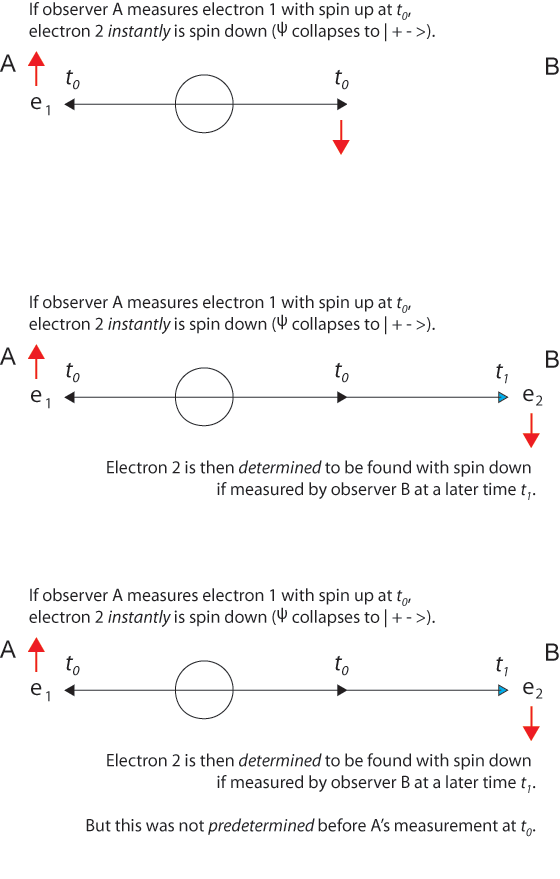
Alice's measurement collapses the two-particle wave function. The two indistinguishable particles simultaneously appear at locations in a space-like separation. The frame of reference in which the source of the two entangled particles and the two experimenters are at rest is a special frame in the following sense.
As Einstein knew very well, there are frames of reference moving with respect to the laboratory frame of the two observers in which the time order of the events can be reversed. In some moving frames Alice measures first, but in others Bob measures first.
If there is a special frame of reference (not a preferred frame in the relativistic sense), surely it is the one in which the origin of the two entangled particles is at rest. Assuming that Alice and Bob are also at rest in this special frame and equidistant from the origin, we arrive at the simple picture in which any symmetric measurement that causes the two-particle wave function to collapse makes both particles appear simultaneously at determinate places with fully correlated properties (just those that properties are needed to conserve energy, momentum, angular momentum, and spin).
In the two-particle case (instead of just one particle making an appearance), when either particle is measured, we know instantly those properties of the other particle that satisfy the conservation laws, including its location equidistant from, but on the opposite side of, the source, and its other properties such as spin.
We can also ask what happens if Bob is not at the same distance from the origin as Alice. This introduces a positional asymmetry. But there is still no time asymmetry from the point of view of the two-particle wave function collapse.
When Alice detects the particle (with say spin up), at that instant the other particle also becomes determinate (with spin down) at the same distance on the other side of the origin. It now continues, in that determinate state, to Bob's measuring apparatus.
In his search for an "objective reality," Einstein asked whether a particle has a determinate position just before it is measured. It may not, but we can say that before Bob's measurement, the electron spin he measures was determined from the moment the two-particle wave function collapsed. The two-particle wave function describing the indistinguishable particles cannot be separated into a product of two single-particle wave functions. When either particle is measured, they both become determinate instantaneously as viewed from our special frame.
When a physical system has a symmetry of some sort, Noether's theorem describes a generator of the (local) symmetry group. In the Standard Model of Particle Physics, a symmetry generator is described as a conserved current. The thing that "flows" in the current is called the "Noether charge." The word "charge" is used as a synonym for "generator" in referring to the generator of the (local) symmetry group.
The most important
asymmetry in information physics is the result of the
irreversibility of information creation, a consequence of the second law of thermodynamics, which demands that positive entropy greater than the negative entropy (information) created locally, be carried away if the local information is to be stable - and thus observable and possibly become a
measurement.
This asymmetry of information creation depends on the
cosmic asymmetry in the expansion of the universe. According to Noether's theorem, this asymmetry implies that information is not conserved (contrary to the opinions of many mathematical physicists and computer scientists).
The history of cosmic evolution, biological evolution, and cultural evolution is at every level a story of irreversible information creation by cosmic, biological, and human creative forces. Information philosophy shoes that we are co-creators of our universe.
A very important
symmetry in information physics helps to explain the puzzle of
entanglement, which was first described as a paradox in the 1935
Einstein-Podolsky-Rosen thought experiment.
The collapse of a two-particle wave function is symmetric in space and synchronous in time, for a
special frame in which the source of the entangled particles and their mean motions are at rest.
Almost every presentation of the EPR paradox begins with something like "Alice observes one particle..." and concludes with the question "How does the second particle get the information needed so that Bob's later measurements correlate perfectly with Alice?"
There is a fundamental asymmetry in this framing of the EPR experiment. It is a surprise that
Einstein, who was so good at seeing deep symmetries, did not consider how to remove the asymmetry.
See a symmetric reframing of the EPR paradox.
Noether Charges and the Standard Model of Particle Physics
The standard model introduces various charge quantum numbers. These are
examples of Noether symmetry generators (or currents of Noether charges). They include:
- The electric charge is the generator of the U(1) symmetry of electromagnetism. The conserved current is the electric current.
- The color charge of quarks. The color charge generates the SU(3) color symmetry of quantum chromodynamics.
- The weak isospin quantum numbers of the electroweak interaction. It generates the SU(2) part of the electroweak SU(2) × U(1) symmetry. Weak isospin is a local symmetry, whose gauge bosons are the W and Z bosons.
- The strong isospin charges. The symmetry groups is SU(2) flavor symmetry; the gauge bosons are the pions. The pions are not elementary particles, and the symmetry is only approximate. It is a special case of flavor symmetry.
- Other quark-flavor charges, such as strangeness or charm. Combined with the SU(2) up–down isospin, these generate the global SU(6) flavor symmetry of the fundamental particles; this symmetry is badly broken by the masses of the heavy quarks.
Gauge Fields
In the case of local, dynamical symmetries, associated with every charge (particle) is a gauge field (wave). When it is quantized, the gauge field becomes a gauge boson. The charges of the theory "radiate" the gauge field. The gauge field of electromagnetism is the electromagnetic field. The gauge boson is the photon. The gauge field is information about the possibilities of a gauge boson being in a particular location. The probabilistic gauge field moves deterministically. The motion of the gauge boson is probabilistic.
More precisely, when the symmetry group is a Lie group, then the charges are understood to correspond to the root system of the Lie group; the discreteness of the root system accounting for the quantization of the charge.

 |
|