Allen Stairs
(1950?)
Allen Stairs is a professor of the philosophy of religion at the University of Maryland.
In 1988 Stairs wrote the paper "
Jarrett's Locality Condition and Causal Paradox" in which he wrote...
In this paper, I want to present a family of results that may seem to add up to a new
proof of the impossibility of hidden variables. In fact, I very much doubt that that's really
what really emerges, but I think the results are nonetheless interesting because they help to
sharpen the discussion of Jon Jarrett's very useful decompostion theorem, in particular, of
the condition he calls locality. Jarrett (1984) and Ballentine and Jarrett (1987) have
suggested that the so-called condition of locality is the one that provides the conceptual
link between hidden variable theories and relativity: if locality is violated, so is relativity.
On the other hand, a theory may violate the condition Jarrett calls completeness without
running afoul of relativity. Now I agree with Jarrett and Ballentine about completeness,
but I strongly suspect that we have quite a way to go before we really understand what
would be involved in a violation of locality.
Jon Jarrett's "decomposition theorem" divides Bell’s "local causality" condition into two distinct logical requirements that Jarrett calls "locality" and "completeness" to explain the
nonlocality of quantum mechanics.
Abner Shimony subsequently recast Jarrett's "locality" and "completeness" as "parameter independence" and "outcome independence."
Parameter independence refers to the independent settings of the spacelike separated experiments in a Bell test. Actually, settings by Alice and Bob must be set at the same pre-agreed upon angle (in the same plane) to preserve symmetry and conserve total spin angular momentum zero as a
common cause. If their angles differed by angle θ their results would fall of as cos
2θ, the well-known "law of Malus."
Outcome independence refers to the fact that the left outcome cannot
instantaneously influence the right outcome and vice versa. Since Bell test experiments occur at the same time, any such
spooky action at a distance would violate special relativity.
But note that any
measurement or environmental interaction
"collapses" the two-particle wave function
| ψ12 > = 1/√2 | ψ1+ ψ2- > ± 1/√2 | ψ1- ψ2+ >
into one of the "product functions" | ψ
1+ ψ
2- > or | ψ
1- ψ
2+ > .
The probability of either the | ψ
1+ ψ
2- > or | ψ
1- ψ
2+ > state is 1/2.
In either outcome the total spin is zero,
conserving total spin angular momentum zero.
But the spin of each particle is completely random, up or down half the time.
This perfectly explains the outcomes of two-particle Bell tests, the joint outcome is always spin zero (no randomness), the individual outcomes are random, but perfect opposites!
The origin of "
hidden variables" was the
Einstein, Podolsky, Rosen paper's suggestion that additional parameters might be needed to explain what
Einstein later called
spooky action-at-a-distance.
That these hidden variables could be "local" is the idea that information about their outcomes might be traveling along with the particles (e.g.,
David Mermin's "instruction sets") or at least somewhere in the backward light cones of the particles as
John Bell's "beables."
In one of his last papers, Bell wrote...
A theory can be said to be locally causal if the probabilities attached to values of local beables in a spacetime region 1 are unaltered by specification of values of local beables in a space-like
separated region 2, when what happens in the backward light cone
of 1 is already sufficiently specified, for example by a full specification
of local beables in a space-time region 3 (Fig. 4).
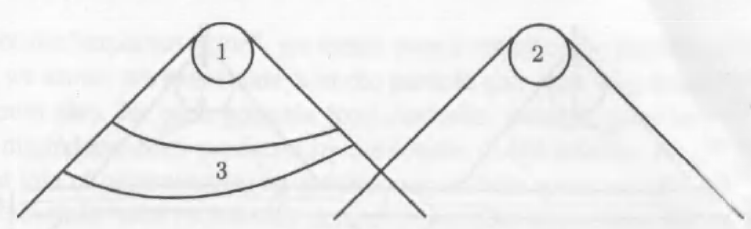 Fig. 4. Full specification of what happens in 3 makes events in 2 irrelevant for
predictions about 1 in a locally causal theory.
It is important that region 3 completely shields off from 1 the overlap
of the backward light cones of 1 and 2. And it is important that events
in 3 be specified completely. Otherwise the traces in region 2 of causes
of events in 1 could well supplement whatever else was being used for
calculating probabilities about 1. The hypothesis is that any such information
about 2 becomes redundant when 3 is specified completely.
Fig. 4. Full specification of what happens in 3 makes events in 2 irrelevant for
predictions about 1 in a locally causal theory.
It is important that region 3 completely shields off from 1 the overlap
of the backward light cones of 1 and 2. And it is important that events
in 3 be specified completely. Otherwise the traces in region 2 of causes
of events in 1 could well supplement whatever else was being used for
calculating probabilities about 1. The hypothesis is that any such information
about 2 becomes redundant when 3 is specified completely.
("La Nouvelle Cuisine," republished in Speakable and Unspeakable in Quantum Mechanics," 1987, p. 240)
But a
common cause from the initial entanglement is still in the past light cone of the "
separated" measurements at A and B, as shown by
Travis Norsen.
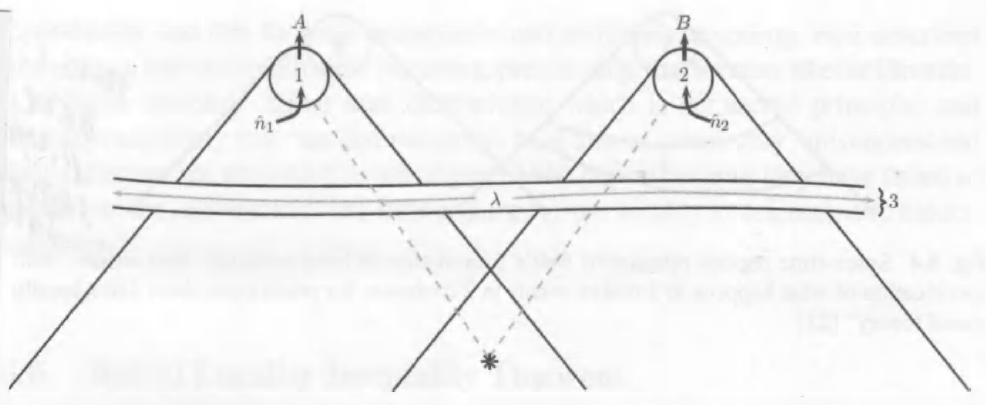
As long as Bell's "local beables" (which he sometimes presents as "λ") or "
hidden variables (which Stairs thinks don't exist) do not interfere with the traveling particles (any physical interaction would destroy coherence and
collapse the wave function), one particle will have spin-up and the other spin-down to conserve the total spin angular momentum's zero and preserve the symmetry of the original
entanglement preparation state.
The initial entanglement of the two particles in the past light cone and a powerful conservation principle as a
common cause explains the
appearance of
nonlocality without any "
hidden variables" but with what we can call a "
hidden constant of the motion," i.e., the total spin angular momentum zero!
Many philosophers of science, and some physicists, are skeptical of
Schrödinger's formulation of wave mechanics. And many are not aware that
Einstein saw "nonlocal" behavior many years before wave mechanics and Heisenberg's matrix mechanics.
Normal |
Teacher |
Scholar

 |
|


