The Meaning of the Wave Function
What is the Wave Function?
In his 1905 Photoelectric Effect paper, Einstein's wave was the energy in a light wave radiating out in all directions, but then
instantly gathering all its energy at one location to eject a photoelectron carrying all that energy.
Is this perhaps the origin of seeing the event as a
"collapse" of the wave function? Einstein already in 1905 saw something
nonlocal about the photon and that there is both a wave aspect and a particle aspect to electromagnetic radiation. He will make those aspects more clear and in 1909 describe the wave-particle relationship more clearly than it is usually presented today, with all the confusion about whether photons and electrons are waves or particles or both.
Louis de Broglie in 1924 suggested there is a matter wave associated with any material particle.
Two years later,
Erwin Schrodinger thought the wave was the distributed mass of the electron or perhaps its "smeared out" electrical charge?
In 1927, Einstein’s blackboard drawing at the fifth Solvay Conference, the wave function propagates in all directions like a light wave, but when the particle appears, it's found at a single point P.
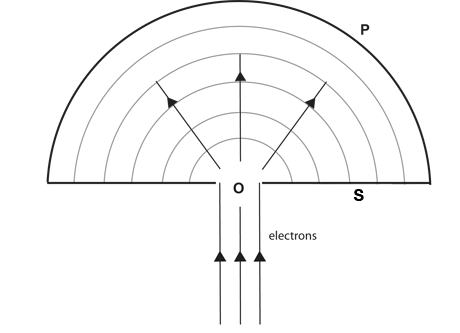
Today the wave is an abstract complex wave function Ψ whose square gives us the probability of finding a particle. Many locations have some probability of being the position until the moment when the particle is found somewhere. At that moment, the probability of its being anywhere else goes instantly to zero.

This abrupt change of probability to unity at one location and zero everywhere else has been interpreted as a “collapse.” If the wave had been carrying energy in all directions, or matter/charge as de Broglie and Schrödinger thought, energy and matter would indeed have had to “collapse” to the point.
But
nothing substantial is moving in the "collapse" of an abstract probability to one of many possibilities. Only
immaterial information (our
knowledge ) has changed.
Although we cannot say anything about the particle’s whereabouts, we might say that what goes through the two slits and interferes with itself is abstract
immaterial information - the mathematical solution of the Schrödinger wave equation.
Schrödinger's abstract wave function tells us the
probability of finding the particle somewhere. And the statistics of large numbers of identical experiments confirm that probability.
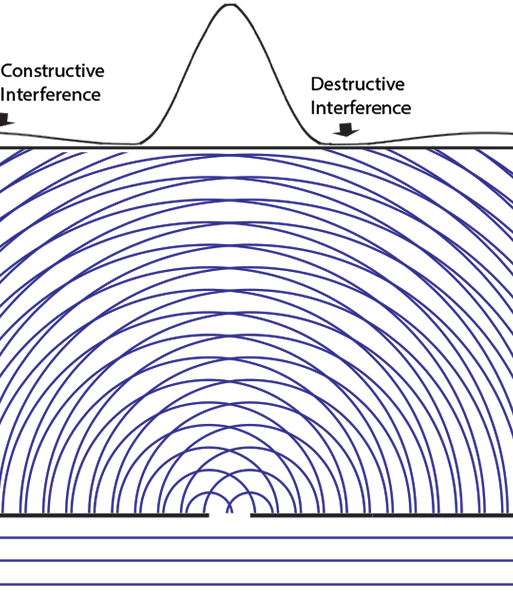
With one slit open, there is a broad Fraunhofer pattern of interference when the slit width is the about the same as the light wavelength. Those who say there is no interference with only one slit open do not understand this.
|
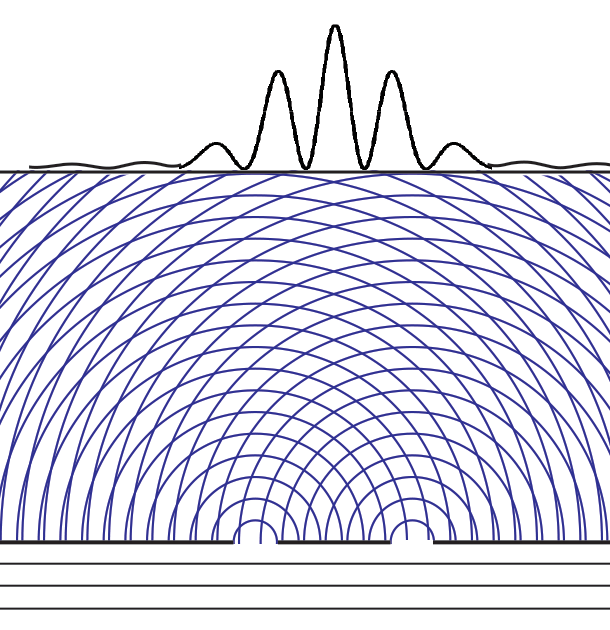
Opening a second slit, there are more interference minima and now the maximum is behind the wall between the slits. Some places where there was radiation detected now are null points! Any light coming in the second slit appears to be cancelling the light from the first slit!
|
Normal |
Teacher |
Scholar

 |
|


