Freedom
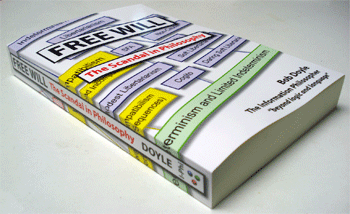
This Freedom section of Information Philosopher is an extensive
history and a critical study of the "
problem of free will."
From the original philosophical debates among the
ancient Greeks down to the current day, the arguments of hundreds of
philosophers and
scientists have been researched and are reported on web pages here, resources for use by students and scholars everywhere.
Dozens of critical concepts in the free will debates, frequently jargon-laden, are presented on individual web pages (linked to from the left-hand column of this Freedom section).
You will also find briefer definitions of some jargon in our extensive
glossary of terms.
Underlined blue hyperlinked words on every page let you jump to detailed explanations.
A Taxonomy of Views on Free Will
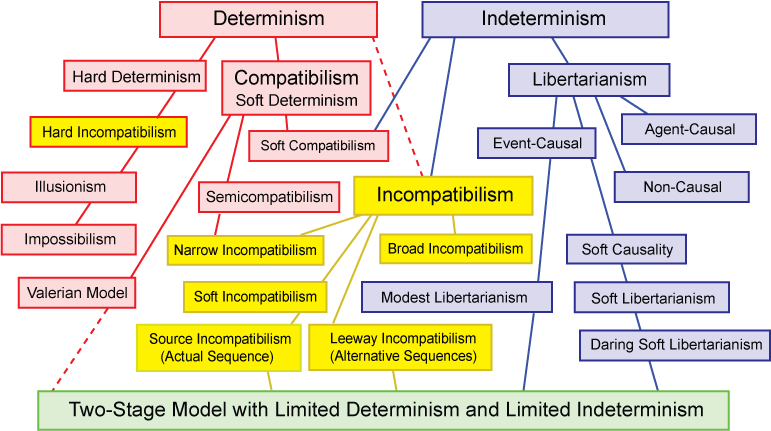
We arrange the arguments and positions in a
taxonomy of some two dozen currently popular views for and against libertarian free will.
Although the Information Philosopher attempts to present the most objective possible account of these philosophical arguments, we have identified two things that readers may want to study first and have in mind as they navigate the web site.
The first is a very strong logical argument
against libertarian free will that appears again and again in philosophical writings since ancient times. We call it the
standard argument against free will.
If you master it first, you will be more likely to recognize it in its various forms.
The second thing is what looks to be, after twenty-four centuries of sophisticated and often heated discussion, the most plausible and practical
solution to the free will problem. Some readers may want to keep this possible solution in mind when reading the various arguments. Most philosophers and scientists have preferred solutions to the problem that almost invariably bias their accounts. You almost certainly bring your own views to your reading and research.
Please read on to be aware of our views before you begin.
The standard argument is very simple and logical.
Either
determinism is true or
indeterminism is true.
If determinism (actually
pre-determinism) is true, we are not free.
If
indeterminism is true, our actions are random and we are not responsible for them.
No free will either way.
The first
requirement is some indeterminism, to break the causal chain of
determinism,
and to generate
creative thoughts and
alternative possibilities for action.
But this indeterminism must somehow not destroy our
moral responsibility.
Thus the second requirement is that our deliberations and evaluations are
"adequately" determined,
so that we can be
responsible for our choices, so that they are "
up to us."
"Adequate" determinism means that the indeterministic
alternative possibilities are not normally the
direct cause of our actions.
Objective
chance means that the
alternative possibilities are not causally determined by immediately preceding events, so they are unpredictable by any agency, including us.
They are the source of the
creativity that adds new
information to the universe.
Randomness gives us the "free" in free will.
Freedom also requires an adequately determined will that chooses or selects from those alternative possibilities. There is normally nothing uncertain about this choice.
Adequate determinism gives us the "will" in free will.
Random thoughts can lead to
adequately determined actions, for which we can take
moral responsibility.
Thoughts
come to us freely. Actions
come from us willfully.
We must admit indeterminism
but not permit it to produce random actions
as Determinists mistakenly fear.
We must also limit determinism
but not eliminate it
as Libertarians mistakenly think necessary.
Evaluation and careful deliberation of all the available possibilities, both ingrained habits and creative new ideas, must help us to "determine" and thus "cause" our actions.
But some
event acausality is a prerequisite for any kind of
agent causality that is not
pre-determined.
When philosophers in the 1920's looked at the newly discovered quantum uncertainty principle as a means of breaking the iron grip of
determinism (actually many
determinisms), they found it most unsatisfactory.
If my action is the
direct consequence of a random event, I cannot feel
responsibility. That would be mere
indeterminism, as unsatisfactory as determinism.
Determinism and
indeterminism are the two horns of the dilemma in the
standard argument against free will, a logical and philosophical argument that is seriously flawed, yet alarmingly ubiquitous in philosophy textbooks and classes.
For some philosophers, any indeterminism at all threatens
reason itself. Reason seems to require strict
causality and perfect
certainty for
truth.
Arthur Stanley Eddington, one of the first scientists to appreciate the implications of quantum mechanics, and who hoped quantum indeterminacy would throw light on the problem of free will, accepted the standard argument and declared "there is no halfway house" between randomness and determinism.
The Information Philosopher proposes a model of human freedom that
is indeed a halfway house between
chance and
necessity, one that involves
both, first
indeterminism to generate
free alternative possibilities, then
adequate determinism to choose, to
will one of those possibilities.
Without this freedom there can be no explanation for human
creativity, which brings unpredictable new information into the universe, "something new under the sun."
Our
mind model invokes quantum
indeterminacy to provide an "Agenda" of unpredictable thoughts and actions, critical to both freedom and creativity. We call this the "Micro Mind," but it is not in a particular
location in the brain. The Micro Mind describes the brain's information processing systems, the storage and retrieval of actionable information, communicated by structures small enough to be affected by quantum uncertainty, by quantum and thermal "
noise."
Note that the indeterminacy in a stored idea need not be
internal to the brain. It may come from an external event that the brain/mind notices.
And the indeterminacy need not be
contemporaneous with current decisions. It may be an internally-generated idea thought of first long ago, only now coming to mind as an option.
Finally, it is extremely unlikely that the indeterminacy can be the result of a specific quantum event that is amplified (as
Arthur Holly Compton mistakenly thought) to provide "randomness on demand" - to help with
Robert Kane's "torn decision," for example.
The "Macro Mind" examines the partially undetermined agenda and chooses what to do or say based on its character (the result of past actions and feelings about them), its
values, and its current feelings and desires. The Macro Mind has very likely
evolved to suppress the microscopic low-level noise. It averages over vast numbers of atoms and molecules in a large enough physical structure to be highly predictable -
adequately determined. Its choices are in practice unaffected by
quantum indeterminacy.
Our
Cogito mind model uses random noise when it needs it for imagination and creativity, but suppresses noise whenever it needs to for consistent behavior and responsibility.
soft causality, but no strict determinism
Our model eliminates the perfect certainty associated with many strict
determinisms. Nevertheless, we retain the very important concept of causality - despite the fact that some events are unpredictable from prior events. The world contains an irreducible quantum indeterminacy.
Each event, as an effect, still has its causes. But some causes are now what ancient philosophers called a
causa sui, a cause that includes itself among its causes. This modified or "soft" causality contains the mixture of unpredictability and predictability, of indeterminism and adequate determinism, of acausality and causality, that we need for freedom and creativity on the one hand and responsibility for our actions on the other.
In our
history of the free will problem, we have found several great thinkers who have anticipated this
two-stage solution to the classical problem, among them
William James,
Henri Poincaré,
Arthur Holly Compton,
Karl Popper,
Daniel Dennett,
Henry Margenau,
Robert Kane,
A. A. Long and David Sedley,
Julia Annas,
John Martin Fischer,
Alfred Mele,
Stephen Kosslyn,
Alfred Mele,
Bob Doyle, and
Martin Heisenberg.
Mele describes the importance of the
temporal sequence quite clearly, though he remains agnostic on the truth of determinism and does not see (as others could not see) any
location of indeterminism in the brain that does not compromise
agent control.
We also resolve the conundrum of how we
could have done otherwise in
identical situations.
We celebrate the first modern philosopher,
René Descartes, in naming our mind model, as other psychologists also have, the
Cogito. Descartes believed that the human body was a deterministic machine, governed by lawful reflexes of stimuli and responses. But he also believed that his mind could originate undetermined free actions (
indeterminata, he called them). Reconciling indeterminism and determinism is at the heart of the
mind-body problem.
Descartes thought (as did great theologians before him) that he could reason logically to truths about himself, the world, and God. His hubris about the power of
reason undermined reason and philosophy itself, leading to a great fall after
David Hume's criticism and
Immanuel Kant's desperate attempt to limit reason to make room for freedom, values, God, and immortality. Only today can we glimpse a path to recovery from this crisis of reason.
The ancient philosophers understood the need for a random element very well. From
Aristotle's "accidents" or
chance causes to
Epicurus' "swerve" (the
clinamen), they added the exceptional event that was
causa sui, the start of a new causal chain. The Latin word for thinking embodies our mind model in its etymology. Cogito derives from co-agitare, to "shake together." The key concept is that the resulting connections of ideas, and actions based on them, are as unpredictable as when we shake and then roll the dice.
But even in ancient times, chance, and any willed actions involving chance, were attacked as "obscure and unintelligible," terms still in use in the debates today. The Greeks called chance ἄδηλος (unclear, inscrutable, obscure), and ἄλογος (irrational, inexpressible). Aristotle said chance (τύχη) was "obscure to human reason (ἄδηλος ἀνθρωπίνῳ λογισμῷ - Metaphysics, Book XI, 1065a33)
Our Micro Mind is the undetermined source of
alternative possibilities, of human
creativity, of genuine novelty, something new under the sun, and when this unconscious runs out of control, we'll see it is the way to madness.
Our Macro Mind is the
adequately determined will that
de-liberates, and chooses among the alternative possibilities based on an individual’s character, values, past actions, and present circumstances. Every action of the Macro Mind creates new information in the mind.
Free will is a combination of microscopic
randomness and macroscopic
adequate determinism, in a
temporal sequence - first chance, then choice.
Determinists and
compatibilists have been right about the will, but wrong about freedom.
Libertarians have been right about freedom, but wrong about the will, which must be
adequately determined for us to accept
moral responsibility.
For Teachers
To hide this material, click on the Normal link.
For Scholars
To hide this material, click on the Teacher or Normal link.
Normal |
Teacher |
Scholar

 |
|