Martin Heisenberg is the son of
Werner Heisenberg, who formulated the
uncertainty principle.
Heisenberg has found evidence for
free will, in the elementary sense of
randomness followed by
lawful behavior, in fruit flies and even bacteria.
This is a
two-stage model of free will in the tradition of a small group of scientists and philosophers since the late nineteenth century, including
William James,
Henri Poincaré,
Arthur Holly Compton,
A.O. Gomes,
Karl Popper,
Henry Margenau,
Daniel Dennett,
Robert Kane, and
Alfred Mele.
In an essay in the May 14 2009 issue of Nature entitled "Is Free Will an Illusion" (the
illusion reference is to
Daniel Wegner) Heisenberg says that the debate on free will
has focused on humans and ‘conscious free will’. Yet when it comes to understanding how we initiate behaviour, we can learn a lot by looking at animals. Although we do not credit animals with anything like the consciousness in humans, researchers have
found that animal behaviour is not as involuntary as it may appear. The idea that animals act only in response to external stimuli has long been abandoned, and it is well established that they initiate behaviour on the basis of their internal states, as we do.
(Nature, vol. 459, 2009, p.164)
Heisenberg argues for some randomness even in unicellular bacteria, followed by more lawful behaviors such as moving toward food.
Evidence of randomly generated action — action that is distinct from reaction because it does not depend upon external stimuli —
can be found in unicellular organisms. Take the way the bacterium Escherichia coli moves. It has a flagellum that can rotate around its longitudinal axis in either direction: one way drives the bacterium forward, the other causes it to tumble at random so that it ends up facing in a new direction ready for the next phase of forward motion. This ‘random walk’ can be modulated by sensory receptors, enabling the bacterium to find food and the right temperature.
(ibid., p.165)
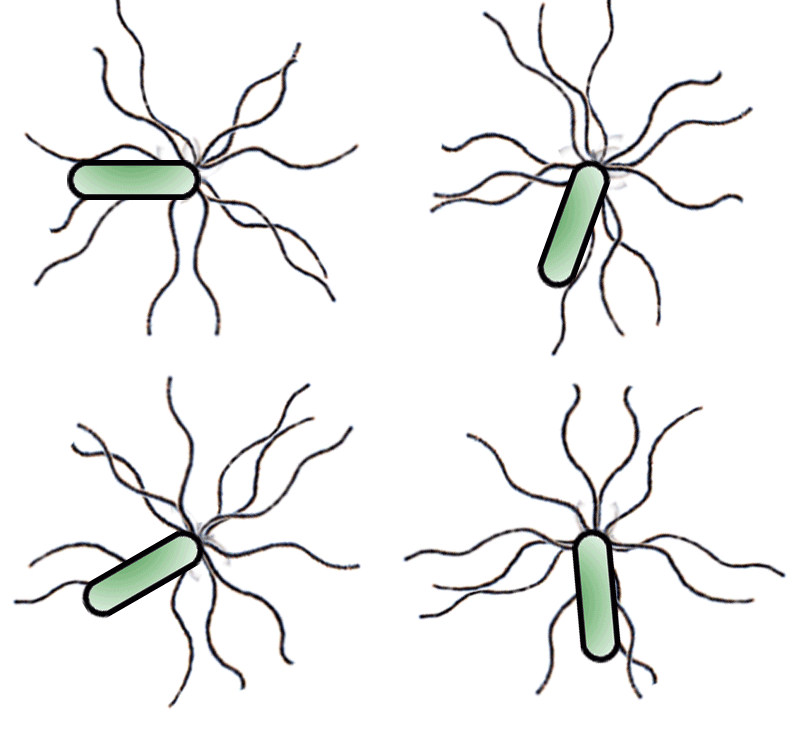
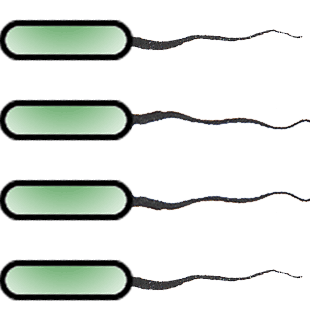
We can illustrate this behavior:
Heisenberg identifies two states for bacteria:
Random tumbling motion when the flagella rotate clockwise.
Lawful forward motion when the flagella rotate counter-clockwise and wrap together.
After a random tumble, which generates
alternative possibilities, the bacterium moves forward and evaluates the gradients of temperature, nutrients, toxins, etc, along its body.
If things look good, it "decides" to continue in that direction.
If not, it tumbles again.
When you combine some randomness with some "lawful" (i.e., evolved and
adequately determined) behaviors you get something like free will in higher animals and humans.
In higher organisms, the brain still may include elements that do a random walk among options for action.
As with a bacterium’s locomotion, the activation of behavioural modules is based on the interplay between chance and lawfulness in the brain. Insufficiently equipped, insufficiently informed and short of time, animals have to find a module that is adaptive. Their brains, in a kind of random walk, continuously preactivate, discard and reconfigure their options, and evaluate their possible short-term and long-term consequences.
The physiology of how this happens has been little investigated. But there is plenty of evidence that an animal’s behaviour cannot be reduced to responses. For example, my lab has demonstrated that fruit flies, in situations they have never encountered, can modify their expectations about the consequences of their actions. They can solve problems that no individual fly in the evolutionary history of the species has solved before. Our experiments show that they actively initiate behaviour.
(ibid., p.165)
References
Is Free Will an Illusion?, Nature, 14 May 2009
For Teachers
To hide this material, click on the Normal link.

 |
|