
Follow infophilosopher:
 |
|

|
|
|
Topics
Introduction
Problems Freedom Knowledge Mind Life Chance Quantum Entanglement Scandals Philosophers Mortimer Adler Rogers Albritton Alexander of Aphrodisias Samuel Alexander William Alston Anaximander G.E.M.Anscombe Anselm Louise Antony Thomas Aquinas Aristotle David Armstrong Harald Atmanspacher Robert Audi Augustine J.L.Austin A.J.Ayer Alexander Bain Mark Balaguer Jeffrey Barrett William Barrett William Belsham Henri Bergson George Berkeley Isaiah Berlin Richard J. Bernstein Bernard Berofsky Robert Bishop Max Black Susan Blackmore Susanne Bobzien Emil du Bois-Reymond Hilary Bok Laurence BonJour George Boole Émile Boutroux Daniel Boyd F.H.Bradley C.D.Broad Michael Burke Jeremy Butterfield Lawrence Cahoone C.A.Campbell Joseph Keim Campbell Rudolf Carnap Carneades Nancy Cartwright Gregg Caruso Ernst Cassirer David Chalmers Roderick Chisholm Chrysippus Cicero Tom Clark Randolph Clarke Samuel Clarke Anthony Collins August Compte Antonella Corradini Diodorus Cronus Jonathan Dancy Donald Davidson Mario De Caro Democritus William Dembski Brendan Dempsey Daniel Dennett Jacques Derrida René Descartes John Dewey Richard Double Fred Dretske Curt Ducasse John Earman Laura Waddell Ekstrom Epictetus Epicurus Austin Farrer Herbert Feigl Arthur Fine John Martin Fischer Kuno Fischer Frederic Fitch Owen Flanagan Luciano Floridi Philippa Foot Alfred Fouilleé Harry Frankfurt Richard L. Franklin Bas van Fraassen Michael Frede Gottlob Frege Peter Geach Edmund Gettier Carl Ginet Alvin Goldman Gorgias Nicholas St. John Green Niels Henrik Gregersen H.Paul Grice Ian Hacking Ishtiyaque Haji Stuart Hampshire W.F.R.Hardie Sam Harris William Hasker R.M.Hare Georg W.F. Hegel Martin Heidegger Heraclitus R.E.Hobart Thomas Hobbes David Hodgson Shadsworth Hodgson Baron d'Holbach Ted Honderich Pamela Huby David Hume Ferenc Huoranszki Frank Jackson William James Jon Jarrett Lord Kames Robert Kane Immanuel Kant Tomis Kapitan Walter Kaufmann Jaegwon Kim William King Hilary Kornblith Christine Korsgaard Saul Kripke Thomas Kuhn Andrea Lavazza James Ladyman Christoph Lehner Keith Lehrer Gottfried Leibniz Jules Lequyer Leucippus Michael Levin Joseph Levine George Henry Lewes C.I.Lewis David Lewis Peter Lipton C. Lloyd Morgan John Locke Michael Lockwood Arthur O. Lovejoy E. Jonathan Lowe John R. Lucas Lucretius Alasdair MacIntyre Ruth Barcan Marcus Tim Maudlin James Martineau Nicholas Maxwell Storrs McCall Hugh McCann Colin McGinn Michael McKenna Brian McLaughlin John McTaggart Paul E. Meehl Uwe Meixner Alfred Mele Trenton Merricks John Stuart Mill Dickinson Miller G.E.Moore Ernest Nagel Thomas Nagel Otto Neurath Friedrich Nietzsche John Norton P.H.Nowell-Smith Robert Nozick William of Ockham Timothy O'Connor Parmenides David F. Pears Charles Sanders Peirce Derk Pereboom Gualtiero Piccinini Steven Pinker U.T.Place Plato Karl Popper Porphyry Huw Price H.A.Prichard Protagoras Hilary Putnam Willard van Orman Quine Frank Ramsey Ayn Rand Michael Rea Thomas Reid Charles Renouvier Nicholas Rescher C.W.Rietdijk Richard Rorty Josiah Royce Bertrand Russell Paul Russell Gilbert Ryle Jean-Paul Sartre Kenneth Sayre T.M.Scanlon Moritz Schlick John Duns Scotus Albert Schweitzer Arthur Schopenhauer John Searle Wilfrid Sellars David Shiang Alan Sidelle Ted Sider Henry Sidgwick Walter Sinnott-Armstrong Peter Slezak J.J.C.Smart Saul Smilansky Michael Smith Baruch Spinoza Allen Stairs L. Susan Stebbing Isabelle Stengers George F. Stout Galen Strawson Peter Strawson Eleonore Stump Francisco Suárez Richard Taylor Kevin Timpe Mark Twain Peter Unger Peter van Inwagen Manuel Vargas John Venn Kadri Vihvelin Voltaire G.H. von Wright David Foster Wallace R. Jay Wallace W.G.Ward Ted Warfield Roy Weatherford C.F. von Weizsäcker William Whewell Alfred North Whitehead David Widerker David Wiggins Bernard Williams Timothy Williamson Ludwig Wittgenstein Susan Wolf Xenophon Scientists Emily Adlam David Albert Philip W. Anderson Michael Arbib Bobby Azarian Walter Baade Bernard Baars Jeffrey Bada Guido Bacciagaluppi Leslie Ballentine Marcello Barbieri Jacob Barandes Julian Barbour Horace Barlow Gregory Bateson Jakob Bekenstein John S. Bell Mara Beller Charles Bennett Ludwig von Bertalanffy Susan Blackmore Margaret Boden David Bohm Niels Bohr Ludwig Boltzmann John Tyler Bonner Emile Borel Max Born Satyendra Nath Bose Walther Bothe Jean Bricmont Hans Briegel Leon Brillouin Daniel Brooks Stephen Brush Henry Thomas Buckle S. H. Burbury Melvin Calvin William Calvin Donald Campbell John O. Campbell Sadi Carnot Sean B. Carroll Anthony Cashmore Eric Cavalcanti Eric Chaisson Gregory Chaitin Jean-Pierre Changeux Rudolf Clausius Arthur Holly Compton John Conway Simon Conway-Morris Peter Corning George Cowan Jerry Coyne John Cramer Francis Crick E. P. Culverwell Antonio Damasio Olivier Darrigol Charles Darwin Paul Davies Richard Dawkins Terrence Deacon Lüder Deecke Richard Dedekind Louis de Broglie Stanislas Dehaene Max Delbrück Abraham de Moivre David Depew Bernard d'Espagnat Paul Dirac Theodosius Dobzhansky Hans Driesch John Dupré John Eccles Arthur Stanley Eddington Gerald Edelman Paul Ehrenfest Manfred Eigen Albert Einstein George F. R. Ellis Walter Elsasser Hugh Everett, III Franz Exner Richard Feynman R. A. Fisher David Foster Joseph Fourier George Fox Philipp Frank Steven Frautschi Edward Fredkin Augustin-Jean Fresnel Karl Friston Benjamin Gal-Or Howard Gardner Lila Gatlin Michael Gazzaniga Nicholas Georgescu-Roegen GianCarlo Ghirardi J. Willard Gibbs James J. Gibson Nicolas Gisin Paul Glimcher Thomas Gold A. O. Gomes Brian Goodwin Julian Gough Joshua Greene Dirk ter Haar Jacques Hadamard Mark Hadley Ernst Haeckel Patrick Haggard J. B. S. Haldane Stuart Hameroff Augustin Hamon Sam Harris Ralph Hartley Hyman Hartman Jeff Hawkins John-Dylan Haynes Donald Hebb Martin Heisenberg Werner Heisenberg Hermann von Helmholtz Grete Hermann John Herschel Francis Heylighen Basil Hiley Art Hobson Jesper Hoffmeyer John Holland Don Howard John H. Jackson Ray Jackendoff Roman Jakobson Jon Jarrett E. T. Jaynes William Stanley Jevons Pascual Jordan Eric Kandel Ruth E. Kastner Stuart Kauffman Martin J. Klein William R. Klemm Christof Koch Simon Kochen Hans Kornhuber Stephen Kosslyn Daniel Koshland Ladislav Kovàč Leopold Kronecker Bernd-Olaf Küppers Rolf Landauer Alfred Landé Pierre-Simon Laplace Karl Lashley David Layzer Joseph LeDoux Gerald Lettvin Michael Levin Gilbert Lewis Benjamin Libet David Lindley Seth Lloyd Werner Loewenstein Hendrik Lorentz Josef Loschmidt Alfred Lotka Ernst Mach Donald MacKay Henry Margenau Lynn Margulis Owen Maroney David Marr Lluis Masanes Humberto Maturana James Clerk Maxwell John Maynard Smith Ernst Mayr John McCarthy Barbara McClintock Warren McCulloch N. David Mermin George Miller Stanley Miller Ulrich Mohrhoff Jacques Monod Vernon Mountcastle Gerd B. Müller Markus P. Müller Emmy Noether Denis Noble Donald Norman Travis Norsen Howard T. Odum Alexander Oparin Abraham Pais Howard Pattee Wolfgang Pauli Massimo Pauri Wilder Penfield Roger Penrose Massimo Pigliucci Steven Pinker Colin Pittendrigh Walter Pitts Max Planck Susan Pockett Henri Poincaré Michael Polanyi Daniel Pollen Ilya Prigogine Hans Primas Giulio Prisco Zenon Pylyshyn Henry Quastler Adolphe Quételet Pasco Rakic Nicolas Rashevsky Lord Rayleigh Frederick Reif Jürgen Renn Giacomo Rizzolati A.A. Roback Emil Roduner Juan Roederer Robert Rosen Frank Rosenblatt Jerome Rothstein David Ruelle David Rumelhart Michael Ruse Stanley Salthe Robert Sapolsky Tilman Sauer Ferdinand de Saussure Jürgen Schmidhuber Erwin Schrödinger Aaron Schurger Sebastian Seung Thomas Sebeok Franco Selleri Claude Shannon James A. Shapiro Charles Sherrington Abner Shimony Herbert Simon Dean Keith Simonton Edmund Sinnott B. F. Skinner Lee Smolin Ray Solomonoff Herbert Spencer Roger Sperry John Stachel Kenneth Stanley Henry Stapp Ian Stewart Tom Stonier Antoine Suarez Leonard Susskind Leo Szilard Max Tegmark Teilhard de Chardin Libb Thims William Thomson (Kelvin) Richard Tolman Giulio Tononi Peter Tse Alan Turing Robert Ulanowicz C. S. Unnikrishnan Nico van Kampen Antony Valentini Francisco Varela Vlatko Vedral Vladimir Vernadsky Clément Vidal Mikhail Volkenstein Heinz von Foerster Richard von Mises John von Neumann Jakob von Uexküll C. H. Waddington Sara Imari Walker James D. Watson John B. Watson Daniel Wegner Steven Weinberg August Weismann Paul A. Weiss Herman Weyl John Wheeler Jeffrey Wicken Wilhelm Wien Norbert Wiener Eugene Wigner E. O. Wiley E. O. Wilson Günther Witzany Carl Woese Stephen Wolfram H. Dieter Zeh Semir Zeki Ernst Zermelo Wojciech Zurek Konrad Zuse Fritz Zwicky Presentations ABCD Harvard (ppt) Bhaktivedanta Institute Biosemiotics Free Will Mental Causation James Symposium CCS25 Talk Evo Devo September 12 Evo Devo October 2 Evo Devo Davies Nov12 |
Robert Hilary Kane

Robert Kane was the acknowledged dean of the libertarian philosophers writing actively in the twentieth century on the free will problem. Before Kane, many Anglo-American philosophers had largely dismissed free will as a "pseudo-problem." Although, like many others, Kane did not find any traditional libertarian position "intelligible," he has developed a libertarian view according to which even if many of our actions are determined by our existing character, these actions can be free, if we at times in the past freely created our own character (and if we remain free to change it) with what he calls "self-forming actions" (SFAs). This resembles Aristotle's view of the formation of character and agrees in some respects with Indian ideas of Karma.
Kane's most original contribution to the free-will debates may be his account of decisions that involves some indeterminism, but for which the agent can properly claim responsibility. Compatibilists believe that any chance involved in the cause of an action compromises agent control and therefore responsibility. But in the case of what Kane calls a "torn decision" or "self-forming action" (SFA) the agent may have excellent reasons for choosing "either way." In such a case, indeterminism may be involved (Kane defends the possibility of irreducible quantum indeterminism), yet the agent may properly take responsibility for either option, as long as the final choice is a result of the agent's "efforts." Kane calls this "plural (or dual) rational control."
Kane's most careful articulation of his position was given in response to the Luck Objection, raised by several critics of Kane's inclusion of indeterminism in his Self-Forming Actions. Kane's critics who found indeterminism unhelpful in all cases included Galen Strawson, Alfred Mele, Bernard Berofsky, Richard Double, and Ishtiyaque Haji. Earlier works on Moral Luck by Thomas Nagel and Bernard Williams had similar implications.
His critics postulate an example where an agent has an identical person in a nearby possible world, with exactly the same past experience, but chooses A instead of B. Surely, the critics say, it is a matter of luck which the agent did, so it is unjust to hold the agent morally responsible for doing the wrong thing.
Kane replied to the critics in a 1999 paper, "Responsibility, Luck, and Chance." There he cited a 1977 article by Steven M. Cahn as the origin of the idea that compatibilists are wrong that any chance makes an agent irresponsible. ("Random Choices," Philosophy and Phenomenological Research,
vol. XXXVII, no. 4, 1977, p.549.) We can note that Daniel Dennett made even more specific defense of an agent's responsibility the choice between equal alternative possibilities in his 1978 book Brainstorms (p.294).
Kane claims that indeterminism in the brain makes it uncertain as to whether an agent's efforts will succeed. When those efforts do succeed, though indeterminism was involved (thus breaking the deterministic chain), the outcome was undetermined, though not uncaused - it was caused by the agent's efforts, he says.
Suppose two agents had exactly the same pasts up to the point where they were faced with a choice between distorting the truth for selfish gain or telling the truth at great personal cost. One agent lies and the other tells the truth... if the pasts of these two agents are really identical in every way up to the moment of choice, and the difference in their acts results from chance, would there be any grounds for distinguishing between them, for saying that one deserves censure for a selfish decision and the other deserves praise? Would it be just to reward the one and punish the other for what appears to be ultimately the luck of the draw? On the view just described, you cannot separate the indeterminism from the effort to overcome temptation in such a way that first the effort occurs followed by chance or luck (or vice versa). One must think of the effort and the indeterminism as fused; the effort is indeterminate and the indeterminism is a property of the effort, not something separate that occurs after or before the effort. The fact that the woman's effort of will has this property of being indeterminate does not make it any less her effort. And just as expressions like 'She chose by chance' can mislead us in these contexts, so can expressions like 'She got lucky'. Ask yourself this question: Why does the inference 'He got lucky, so he was not responsible' fail when it does fail? The first part of an answer goes back to the claim that 'luck', like 'chance', has question-begging implications in ordinary language which are not necessarily implications of "indeterminism" (which implies only the absence of deterministic causation). The core meaning of 'He got lucky', which is implied by indeterminism, I suggest, is that 'He succeeded despite the probability or chance of failure'; and this core meaning does not imply lack of responsibility, if he succeeds. The inference 'He got lucky, so he was not responsible' fails because what [the agents} succeeded in doing was what they were trying and wanting to do all along. When they succeeded, their reaction was not "Oh dear, that was a mistake, an accident—something that happened to me, not something I did." Rather, they endorsed the outcomes as something they were trying and wanting to do all along, that is to say, knowingly and purposefully, not by mistake or accident.To avoid the conclusion that the outcome is merely a product of chance, Kane says that one of the agent's efforts will be the cause of the choice that is made, although there was a chance that it might have failed. The reasons behind that choice causally influenced the making of the choice, but did not determine it. Thus we can say that "the agent chose for those reasons." In his 33rd thesis on free will, Kane says the agents (r1) will have had reasons for choosing as they did; (r2) they will have chosen for those reasons; and (r3) they will have made those reasons the ones they wanted to act on more than any others by choosing for them.When Kane puts the indeterminism earlier in the temporal sequence than the results of the agent's efforts, it becomes a two-stage decision process and is free for that reason. If the indeterminism is "centered" in the decision (as Clarke calls it), then it will be an example of the ancient liberty of indifference (or an undetermined liberty as we call it), but the agent can justifiably describe the decision as rational, as Cahn argued, and it is just for society to hold the agent morally responsible. For Kane, after the fact of indeterminism, to (1) redefine the indeterminism central to the efforts as merely singling out the reasons that the agent "will have chosen for," and to (2) claim that the indeterministic, statistically caused reasons have been (retrospectively) "made those reasons the ones they wanted to act on more by choosing them," seems to be an attempt to rewrite history simply to avoid the stigma associated with the notion of chance. Kane shares what William James called "antipathy to chance." Despite developing Cahn's insightful idea of randomness in the final decision as not invalidating responsibility, Kane is reluctant to use the argument for moral choices and his Self-Forming Actions. The equal weights of the alternatives suggests to Kane the liberty of indifference - the ass equidistant between two bales of hay. If the decision is simply a practical decision, something as unimportant as deciding between chocolate or vanilla, the mental equivalent of "flipping a coin" is acceptable, says Kane. But if it is a serious moral choice between acting ethically (for Kane, ethical means considering the interests of others) or acting in one's own self-interest, then he is appalled at the idea that such a choice should be made indeterministically, by randomly flipping a coin, for example. Serious moral choices do not deserve such flippancy, but Kane is hard pressed to identify why a free will model that explains practical responsibility should not also apply to moral responsibility. A moral free choice is then simply a free choice that has moral implications. The question of freedom (from determinism) is a question for physicists, physiologists, psychologists, and neuroscientists. The question of morality is one for ethicists and moral philosophers. The difficulty of articulating a difference beteen free practical choices and free moral choices is compounded because Kane relies on indeterminism to break the chain of determinism in both cases. And he specifically wants quantum indeterminism, which is notorously difficult to locate in the brain/mind. Notice that Kane has always accepted chance/indeterminism in the first "free" stage of a two-stage model. He agrees that chance in the first "deliberative" stage (as Randolph Clarke calls it) does provide other options for the (adequately determined) decision. But Kane accepts chance in the second "will" stage of free will only for practical choices. What Clarke calls chance "centered" in the decision is acceptable only for practical choices, not for moral choices. So the question for Kane is, as long as he agrees that indeterministic chance is involved in the final "torn" decision itself, how is that final-stage chance does not make a moral choice (and therefore a Self-Forming Action) random - if final-stage chance makes a practical choice random? And given that Kane agrees that despite the randomness in the decision, the agent is fully responsible for the choice, which ever way it turns out, why is this not an acceptable description for the responsibility in moral choices? Why does it not explain moral responsibility as well as it explains practical responsibility? Kane's answer is that a moral choice should not be an event that just happens to the agent, such as waiting for the outcome of a coin flip. Instead, the agent should be actively involved in the decision, which makes it more like agent-causality than event-causality, but Kane appears to oppose agent-causal views. And why shouldn't an agent be just as actively involved in practical decisions?
Aristotle and Epicurus said that decisions "in us" or that "depend on us" are a tertium quid, or third thing, that is neither chance nor necessity
Kane makes this type of torn decision central to his self-forming actions (SFAs), which form the basis for an agent's "ultimate responsibility" (UR). By ultimate responsibility Kane means that the sources or origins of our actions lie "in us" rather than in something else (such as decrees of fate, foreordained acts of God, or antecedent causes and laws of nature) which are outside us and beyond our control. We review Kane's work extensively below and conclude that his Self-Forming Action may be considered an act of self-determination, that it is adequately determined by the reasons the agent favors one choice over the other, and that it could be considered an example of agent causality by a mind defined as immaterial information in a material brain.
The Oxford Handbook of Free Will
In addition to his work to find some pathway through the "free will labyrinth" to an intelligible account of freedom, Kane has assembled in his massive 2002 sourcebook The Oxford Handbook of Free Will perhaps the best survey of modern positions on free will, from theology and fatalism to metaphysical libertarian perspectives.
The Handbook has contributions from over two dozen contemporary philosophers with strong ideas about free will. Sadly most continue to be wordy jargon-laden debates and attempts to logically refute one position or another. They reflect the fact that Peter Strawson changed the subject of the discussions from free will to moral responsibility and Harry Frankfurt changed the debate from free will to the existence of alternative possibilities (there are no such possibilities in a deterministic world).
That there is little new and that it is dismissive of freedom as unintelligible, makes the Oxford Handbook an accurate reflection of the current state of the free will problem. Kane insightfully remarks "One may legitimately wonder why worries about determinism persist at all in the twenty-first century, when the physical sciences - once the stronghold of determinist thinking - seem to have turned away from determinism."
Many of the Handbook authors tend to conflate the problems of free will and moral responsibility. They describe free will as the "control condition" of moral responsibility. This is a conceptual error. Free will is indeed a prerequisite for responsibility. But whether an action is moral is a question for ethicists, not for psychologists and neuroscientists who want to know the nature of the mind and its capacity for free creations, deliberations, decisions, intentions, and actions.
Ultimate Responsibility
For Kane, ultimate responsibility is the core idea in the traditional definition of free will. He says:
Free will, in the traditional sense I want to retrieve (and the sense in which the term will be used throughout this book), is the power of agents to be the ultimate creators (or originators) and sustainers of their own ends or purposes. This notion should be distinguished from free action, and not simply because free will is a power. To act freely is to be unhindered in the pursuit of your purposes (which are usually expressed by intentions); to will freely, in this traditional sense, is to be the ultimate creator (prime mover, so to speak) of your own purposes. Such a notion of ultimate creator of purposes is obscure, to be sure — many would say it is unintelligible - but there is little doubt that it has fueled intuitions about free will from the beginning. Its meaning can be captured initially by an image: when we trace the causal or explanatory chains of action back to their sources in the purposes of free agents, these causal chains must come to an end or terminate in the willings (choices, decisions, or efforts) of the agents, which cause or bring about their purposes. If these willings were in turn caused by something else, so that the explanatory chains could be traced back further to heredity or environment, to God, or fate, then the ultimacy would not lie with the agents but with something else. It is owing to such an image that free will has traditionally been associated with moral responsibility in a deep sense that entails, as Galen Strawson has put it, that we are "truly deserving of praise and blame" because it is "truly up to us" what we do, in the sense that we are the "ultimate, buck-stopping originator[s] of our actions. The idea is that the ultimate responsibility lies where the ultimate cause is — where the buck stops. This is the traditional image of free will (which Strawson, along with many others, finds problematic). Such an image also accounts for the association of free will with human dignity, expressed in the religious traditions by saying that humans are made in the image of God — being creators ab initio of at least some things in the universe, their own purposes and the actions issuing from those purposes — and by Kant when he inferred that humans are to be treated as "ends in themselves" because they are the originators of their own ends or purposes.Kane argues that the alternative possibilities (AP) generated in two-stage models of free will are not enough to make the case for incompatibilist free will. It is ultimate responsibility (UR) that he says is required for free will. Ultimate responsibility requires that some of our actions are self-forming actions (SFAs). In turn, our self-forming actions require plural rational control in our decisions. And it is the plural rational control that requires alternative possibilities (AP). UR is fundamentally prior to AP. Much of Kane's work has been to establish the role of quantum indeterminacy in making at least some of our actions undetermined. He describes the need for indeterminism as a thesis on UR that he calls the "Free Agency Principle": T16 (on UR) ("The Free Agency Principle"): In the attempt to formulate an incompatibilist or libertarian account of free agency that will satisfy the plurality conditions and UR, we shall not appeal to categories or kinds of entities (substances, properties, relations, events, states, etc.) that are not also needed by nonlibertarian (compatibilist or determinist) accounts of free agency satisfying the plurality conditions. The only difference allowed between libertarian and nonlibertarian accounts is the difference one might expect — that some of the events or processes involved in libertarian free agency will be indeterminate or undetermined events or processes. But these undetermined events or processes will not otherwise be of categories or ontological kinds that do not also play roles in nonlibertarian accounts of free agency (such as choices, decisions, efforts, practical judgments, and the like) — the difference being that in nonlibertarian theories, these events or processes need not be undetermined. Such differences as there are between libertarian and nonlibertarian theories should flow from this difference alone and the task will be to make sense of a libertarian freedom satisfying the plurality conditions, given this difference.In his 1985 book Free Will and Values, aware of earlier proposals by John Eccles, Karl Popper, and Daniel Dennett, but working independently, Kane proposed an ambitious amplifier model for a quantum randomizer in the brain - a spinning wheel of fortune (Alfred Mele later used the same analogy) with probability bubbles corresponding to alternative possibilities, in the massive switch amplifier (MSA) tradition of Arthur Holly Compton. Kane's work is squarely in the tradition of several other brain mechanisms proposed to underlie freedom of the will. Kane says (Free Will and Values, p.169): What I would like to do then, is to show how an MSA [massive switch amplifier] model, using Eccles' notion of critically poised neurons as a working hypothesis, might be adapted to the theory of practical, moral and prudential decision making. Keeping these points in mind, let us now suppose that there are neurons in the brain "critically poised" in Eccles' sense, whose probability of firing within a small interval of time is .5. (We shall tamper with this simplifying assumption in a moment.) For every n such neurons, there are 2n possible ordered combinations of firings and non-firings, which may be represented by sequences, such as (101... ), (01101... ), where the "1" 's indicate firings, the "0" 's non-firings, and the dots indicate that the sequences are continued with "0" 's up to n figures. A reasonably small number of such neurons, say a dozen, would yield ordered combinations, in the thousands, enough for the purposes of the theory. As indicated in 8.4, the exact number of possible alternatives or partitionings does not matter so long as it is large; it would likely depend on the exigencies of neurological programming rather than the demands of the theory. For practical choice, these ordered combinations of firings and non-firings of critically poised neurons would correspond to places on a spinning wheel, most of which would give rise to chance selected considerations, opening doors to consciousness of possibly relevant memories, triggering associations of ideas and/or images, focussing attention in various ways, etc. Some combinations of firings and non-firings might draw a blank. But the wheel would keep spinning until it hit something worth considering, so long as the practical reasoner or creative thinker were in a receptive, yet reflective, state of mind. Then the relevance of the consideration to deliberation would have to be assessed and the consideration either accepted or rejected.Kane introduces a probability bubble. Kane's model combines free will and values. Kane claimed his free choice is moral and made in accord with Kant's concept of duty versus one's self-interest or desires. This is the ethical fallacy. Freedom is merely a prerequisite for responsibility. And responsibility is a prerequisite for moral responsibility. Kane even relates equiprobability to a basis for human equality. "the succession of random selections among equiprobable alternatives is meant to be a continuing reminder (a mental or neurological representation) of the fact that the reason sets of other persons are to be treated equally."Kane's model is also "restrictive," a term coined by John Martin Fischer to describe Peter van Inwagen's claim that only a tiny fraction of our decisions and actions could be free actions. For van Inwagen, it is those which have closely balanced alternatives (the ancient problem of the liberty of indifference. For Kane, it is those rare and difficult decisions that are deeply moral. They are those moments in which are character is formed. Later decisions made consistent with our character and values can then be traced back to these "self-forming actions." This provides us with what Kane calls ultimate responsibility or UR. The first step in this rethinking is to note that indeterminism does not have to be involved in all acts done "of our own free wills" for which we are ultimately responsible. Not all acts done of our own free wills have to be undetermined, only those acts by which we made ourselves into the kinds of persons we are—namely, the "will-setting" or "self-forming actions" (SFAs) that are required for ultimate responsibility. Now I believe that these undetermined self-forming actions, or SFAs, occur at those difficult times of life when we are torn between competing visions of what we should do or become. Perhaps we are torn between doing the moral thing or acting from ambition, or between powerful present desires and long-term goals; or we may be faced with difficult tasks for which we have aversions. In all such cases of difficult self-forming choices in our lives, we are faced with competing motivations and have to make an effort to overcome the temptation to do something else we also strongly want. There is tension and uncertainty in our minds about what to do at such times, let us suppose, that is reflected in appropriate regions of our brains by movement away from thermodynamic equilibrium—in short, a kind of "stirring up of chaos" in the brain that makes it sensitive to micro-indeterminacies at the neuronal level. The uncertainty and inner tension we feel at such soul-searching moments of self-formation would thus be reflected in the indeterminacy of our neural processes themselves. What we experience internally as uncertainty about what to do on such occasions would correspond physically to the opening of a window of opportunity that temporarily screens off complete determination by influences of the past.Kane is not satisfied with his solution. He explains that the main reason for failure is "locating the master switch and the mechanism of amplification...We do not know if something similar goes on in the brains of cortically developed creatures like ourselves, but I suspect it must if libertarian theories are to succeed."Kane admits that the basic difficulty is the location of indeterminism in the decision process itself. Chance must not be the direct cause of action. Kane claims that the major criticism of all indeterminist libertarian models is explaining the power to choose or do otherwise in "exactly the same conditions," something he calls "dual rational self-control." Given that A was the rational choice, how can one defend doing B under exactly the same circumstances?" (p.59) Kane is concerned that such a "dual power" might be arbitrary, capricious, and irrational. Apart from the fact that information-rich systems with a history are never in the exact same conditions, and ignoring the fact that random alternative possibilities are unlikely to repeat, an adequately determined will would very likely make the same choice, for the same reasons, from the same set of alternative possibilities. But it might on the other hand exercise its irrational prerogative! We humans are unpredictable, which makes us occasionally capricious and arbitrary. So why the problem? In his 1985 book, Free Will and Values, Kane also considered the two-stage models of Karl Popper (as described by Popper in his Arthur Holly Compton memorial lecture, "Of Clouds and Clocks"), and Daniel Dennett (as presented in his Brainstorms chapter, "On Giving Libertarians What They Say They Want"). Kane described these two-stage models as a "significant piece in the overall puzzle of a libertarian freedom." (p.104) But he thought them limited to practical decision making, and not suitable for moral decision making, which require his dual rational control and chance in the decision itself to provide "ultimate responsibility" (UR). Given the randomly generated alternative possibilities in the first stage of the model, Kane thought that an agent would be determined in the second stage to choose the best available option. But note that the agent would not be pre-determined, even from moments just before deliberations began. As John Locke noted, the will itself can be determined, it need not itself be free in the sense of random. It is the man that is free, not the will, said Locke. In his 1996 book The Significance of Free Will Kane again invokes quantum events in the brain at the moment of decision: We now turn to the second part of an answer to the question of how prior reasons or motives can explain the effort to resist temptation without also explaining the choice that terminates the effort. We must now look at this "effort of will" (to resist moral of prudential temptation) that intervenes between prior reasons or motives, on the one hand, and the resulting choice, on the other.Kane next adds chaos to amplify the microscopic quantum indeterminacy up to the macroscopic neurons. This is dangerously close to making chance the direct cause of the decision.T24 (on FW): Let its suppose that the effort of will (to resist temptation) in moral and prudential choice situations of T22 and T23 is (an) indeterminate (event or process), thereby making the choice that terminates it undetermined.Consider a quantum analogue. Imagine an isolated particle, such as an electron, moving toward a thin atomic barrier. Whether or not the particle will penetrate the barrier is undetermined. There is a probability that it will penetrate, but not a certainty, because its position and momentum are not both determinate as it moves toward the barrier. Imagine that the choice (to overcome temptation) is like the penetration event. The choice one way or the other is undetermined because the process preceding it and potentially terminating in it (i.e., the effort of will to overcome temptation) is indeterminate. But this quantum analogy is merely that — an analogy. Our efforts of will most likely correspond to complex processes in our brains that are macro processes involving many neuron firings and connections. Since we know that the effects of quantum level fluctuations are usually negligible at the macro level, how can these efforts be indeterminate? One way to begin thinking about this issue is to imagine that the neural processes occurring when the efforts are being made are chaotic processes, in the sense of what is nowadays called "chaos theory." In chaotic systems, very minute changes in initial conditions grow exponentially into large differences in final outcome, a phenomenon called "sensitivity to initial conditions." The ubiquity of chaotic systems in nature is now widely recognized, and there is growing interest in the chaotic behavior of the brain at many levels, from the transmission of impulses along individual nerve fibers, to the functioning of neural networks, to general patterns of brain waves. But chaotic behavior, though unpredictable, is not necessarily indeterministic. In fact, chaos theory has shown that one can have determinism without predictability. Yet chaos theory may nonetheless be significant for discussions of human freedom, if quantum indeterminacy is also brought into the picture.Kane describes the tension during "torn" decisions as stirring up deterministic chaos. He makes the deterministic chaos sensitive to quantum indeterminacy at the neuronal level (in a way similar to John Eccles's ideas about critically poised neurons). T25 (on FW): Imagine that the indeterminate efforts of will of T24 are complex chaotic processes in the brain, involving neural networks that are globally sensitive to quantum indeterminacies at the neuronal level. Persons experience these complex processes phenomenologically as "efforts of will" they are making to resist temptation in moral and prudential situations. The efforts are provoked by the competing motives and conflicts within the wills of the persons described in T22 and T23.
Two Cosmological Mysteries
Kane describes consciousness and the indeterminacy needed for free will as "cosmological problems" that are equally "mysterious." He says that while free agency "does not require mind/body dualism
to account for free will, neither does it allow one to describe deliberations, efforts, choices, and other mental goings on merely as physico-chemical processes,
whether they are undetermined or determined." He asks
Kane is absolutely right about this. As long as there is doubt among physicists about quantum uncertainty, philosophers have every right to doubt its ability to help solve the problem of free will and determinism. Kane is one of many philosophers to suggest that the two mysteries - consciousness and indeterminate free will - must be connected. Although some say that is trying to solve one mystery with another, Kane notes that William Hasker suggested that we try"But now the suspicion arises that you are exchanging one mystery for another. In place of the usual libertarian stuff, such as agent-causes, noumenal selves, or mind/body dualism, you are giving us the mysteries of indeterministic efforts of will - described physically as indeterminate processes that are happening in the brain, but phenomenologically as something the agents are doing...Perhaps dual-aspect theories of this kind are an improvement over substance dualisms, but they are scarcely without their own mysteries. How can a physical process of the brain be at the same time a consciously experienced effort of will?" Well, this is a puzzle, all right, but it is part of the larger riddle of consciousness, ' which is troubling no matter what position is taken on free will: how can thoughts, sensations, perceptions, or any other conscious events — including efforts of will and choices — be at the same time physical processes of the brain? This is a problem whether you are a compatibilist or incompatibilist, or whether you think brain processes are determined or not. As I said earlier, the goal of these chapters is not to eliminate all mystery from free will. Rather, it is to eliminate mysteries that are created by taking a distinctively libertarian view of free will — as opposed to mysteries that confront everyone, no matter what their position on free will. Indeterministic efforts are mysterious because they partake of several deep cosmological problems that are problems for everyone, not just libertarians. One of these problems is "the mind/body problem," including at its core the "problem of consciousness": how can thoughts, perceptions, and other conscious experiences — including efforts of will — be brain processes? But this is a problem whether you are a compatibilist or incompatibilist, libertarian or nonlibertarian. It is no less mysterious how neural firings in the brain could be conscious mental events if they are determined than if they are undetermined, or if they involve undetermined chaotic processes than if they do not. I said that the view presented here does not attempt to eliminate all mystery from free will, but only such mysteries as are created by taking a distinctively libertarian view of it. And I added that the indeterministic efforts required by free will are mysterious because they partake of several deep cosmological problems that are problems for everyone, not just libertarians. I can now say that I think there are at least two such cosmological problems with which free will is deeply implicated, both of which have been central to philosophical discussions throughout much of this century. The first is the problem of consciousness already mentioned. I now add... "The Second Cosmological Problem" of which free will partakes is the problem of genuine indeterminacy-in-nature, which is pretty mysterious as well. How can wave/particles such as electrons have indeterminate trajectories in which their position and momentum cannot both be exact at the same time? How can physical systems in general have indeterminate properties? We know that great scientists, some of whom were in on the founding of quantum physics, such as Planck, Einstein, and De Broglie, could not accept the inexact trajectories, the indeterminacy, and other related mysteries of the quantum world, They hoped by way of hidden variables or some new theory to get back to the exactness and determinacy of the classical picture. I suggest that we should expect the same resistance and puzzlement over indeterminate efforts of within free will debates as indeterminate trajectories received from skeptical physicists when they were first introduced. Indeterminate efforts force us to view human actions and life histories in unaccustomed ways, just as indeterminate trajectories and properties force us to view the physical world in strange and novel ways. to understand the nature of conscious experience and its unity (our first cosmological problem), as well as to understand how consciousness and mind are related, if at all, to the indeterminacy of natural processes (our second cosmological problem). In other words, it is possible that the ultimate understanding [lies] in the connection between the two cosmological problems — between consciousness and quantum reality. So I concede that indeterminate efforts are mysterious. But I want to suggest that their mysteriousness partakes of the difficulties of understanding (i) consciousness and (ii) quantum indeterminacy — two of the central cosmological problems of the age. And these two problems, we should note, are problems for everyone; they are not problems specifically created by libertarian theories of freedom. Nor should it surprise us that free will (which Kant regarded as the central "cosmological" problem) should be intimately related to these two other cosmological enigmas. In 2005, Kane wrote a perceptive analysis of a two-stage solution for free will like our Cogito mind model and the suggestions of almost two-dozen other thinkers who have proposed two-stage models of free will. The final libertarian theory I want to consider in this chapter takes a very different approach to explaining libertarian free choices. This view rejects both simple indeterminism and agent-causation. Instead it focuses on the process of deliberation. When we deliberate, for example, about where to vacation or which law firm to join, many different thoughts, images, feelings, memories, imagined scenarios, and other considerations pass through our minds. Deliberation can be quite a complex process. When Mike thinks about Hawaii, he pictures himself surfing, walking on sunny beaches, eating in his favorite Hawaiian restaurants; and these various thoughts incline him to choose Hawaii. But he also thinks about skiing, sitting by a fireplace after a long day on the slopes, and visiting with friends he knows in Colorado; and he leans toward Colorado. Back and forth he goes, until after a period of time considerations on one side outweigh the others and he finally chooses one option. (Unless, of course he is one of those indecisive types who finds it hard to make up his mind.)It is unfortunate that Kane did not accept Dennett's ideas for "giving libertarians what they want." He might have reconciled many libertarians and compatibilists. Instead, Kane wants something more - an element of indeterminism in the decision itself, but (and this is unique to Kane) the indeterminism is not the proximate cause of the decision - so that our actions are not determined by our deliberations and evaluations of alternative possibilities, however much these are our own creations. Yet, as Dennett and Mele also admit, a causal indeterminist view of this deliberative kind does not give us everything libertarians have wanted from free will. For Mike does not have complete control over what chance images and other thoughts enter his mind or influence his deliberation. They simply come as they please. Mike does have some control after the chance considerations have occurred.Kane seems to want his freedom both ways. He wants the agent to "control which of the chance events occur" and he also wants chance to be involved at the decision stage to prevent its being "determined" - without chance being the cause of the decision. But the place for chance is in the first stage, where alternative possibilities are generated. And control is only needed in the second stage, where decisions and choices are made. Nevertheless, Kane adds randomness to our choices to produce what he calls "dual (or plural) rational control" over our actions. When we wonder about whether agents have freedom of will (rather than merely freedom of action), what interests us is not merely whether they could have done otherwise, even if the doing otherwise is undetermined, but whether they could have done otherwise voluntarily (or willingly), intentionally, and rationally. Or, more generally, we are interested in whether they could have acted in more than one way voluntarily, intentionally, and rationally, rather than only in one way voluntarily, and so on, and in other ways merely by accident or mistake, unintentionally or irrationally.Kane does accept that some of our thoughts "come to us" unbidden (undetermined) and that control, in the second stage, insures that our actions "come from us." Our willed actions "depend on us," as Aristotle required. Kane has an illustrated version of the standard argument against free will. He describes the usual determinism and randomness objections (the two horns of the Libertarian Dilemma) as the ascent and descent of what he calls "Incompatibilism Mountain." (A Contemporary Introduction to Free Will, p.34) 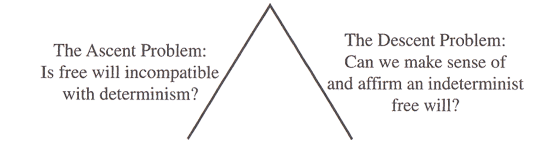 The ascent problem is to show free will is incompatible with determinism. The descent problem is to show that free will is compatible with indeterminism. In earlier works Kane described ascent as "the compatibility question" and descent as "the intelligibility problem."
This is similar to what we do in a critical analysis of the standard argument against free will, in our two-stage model for free will, and in our requirements for free will.
Free will is incompatible with strict causal determinism, but it actually requires an adequate determinism for moral responsibility.
And free will is compatible with an indeterminism that generates alternative possibilities without making chance the direct cause of actions.
In a recent work (Four Views on Free Will, 2007), Kane defends Libertarianism and
again suggests that his occasional self-forming actions might involve a tension and uncertainty in our minds that stirs up a "chaos" which is sensitive to micro-indeterminacies at the neuronal level.
The ascent problem is to show free will is incompatible with determinism. The descent problem is to show that free will is compatible with indeterminism. In earlier works Kane described ascent as "the compatibility question" and descent as "the intelligibility problem."
This is similar to what we do in a critical analysis of the standard argument against free will, in our two-stage model for free will, and in our requirements for free will.
Free will is incompatible with strict causal determinism, but it actually requires an adequate determinism for moral responsibility.
And free will is compatible with an indeterminism that generates alternative possibilities without making chance the direct cause of actions.
In a recent work (Four Views on Free Will, 2007), Kane defends Libertarianism and
again suggests that his occasional self-forming actions might involve a tension and uncertainty in our minds that stirs up a "chaos" which is sensitive to micro-indeterminacies at the neuronal level.
All free acts do not have to be undetermined on the libertarian view, but only those acts by which we made ourselves into the kinds of persons we are, namely the "will-setting" or "self-forming actions" (SFAs) that are required for ultimate responsibility.Kane says that the indeterminism arising from a tension-creating conflict in the will "would be reflected in appropriate regions of the brain by movement away from thermodynamic equilibrium. The result would be a stirring up of chaos in the neural networks involved. Chaos in physical systems is a phenomenon in which very small changes in initial conditions are magnified so that they lead to large and unpredictable changes in the subsequent behavior of a system.This is Kane's main contribution to the free will debate. The agent's choice itself, the result of the agent's efforts to overcome indeterminism, is a new causal element. The agent's efforts are the cause of the choice. Indeterministic chance is not a causal factor, merely an ingredient in a complex process."Now determinists are quick to point out that chaos, or chaotic behavior, in physical systems, though unpredictable, is usually deterministic and does not itself imply genuine indeterminism in nature. But some scientists have suggested that a combination of chaos and quantum physics might provide the genuine indeterminism one needs. If the processing of the brain does "make chaos in order to make sense of the world" (as one recent research paper puts it), then the resulting chaos might magnify quantum indeterminacies in the firings of individual neurons so that they would have large-scale indeterministic effects on the activity of neural networks in the brain as a whole. If chaotic behavior were thus enhanced in these neural networks by tension-creating conflict in the will, the result would be some significant indeterminism in the cognitive processing of each of the competing neural networks.""'indeterminism' is a technical term that merely rules out deterministic causation, though not causation altogether. Indeterminism is consistent with nondeterministic or probabilistic causation, where the outcome is not inevitable. "In a similar fashion, the idea is not to think of the indeterminism involved in free choices as a cause acting on its own, but as an ingredient in a larger goal-directed or teleological process or activity.Kane insightfully suggests that information theory may help understanding the problem of will. He proposes that the role of indeterminism is as an ingredient in the teleological process of will. But rather than making it the generator of possibilities and a creative force, Kane considers it a hindrance or obstacle to the attainment of the goal which raises the "level of effort.""What we need when we perform purposive activities, mental or physical, is rather macro-control of processes involving many neurons — complex processes that may succeed in achieving their goals despite the interfering effects of some recalcitrant neurons. We don't micro-manage our actions by controlling each individual neuron or muscle that might be involved. We don't know enough about neurology or physiology to do that; and it would be counterproductive to try. But that does not prevent us from macro-managing our purposive activities (whether they be mental activities such as practical reasoning, or physical activities, such as arm-swingings) and being responsible when those purposive activities attain their goals. "In summary, I think the key to understanding the role of chance in free will is not to think of chance as a causal factor by itself, but rather to think of chance as an interfering ingredient in larger goal-directed processes. Viewing chance in this way is related to a peculiarly modern scientific way of understanding human agency that also his its roots in the ancient view of Aristotle. Agents, according to this modern conception with ancient roots, are to be conceived as information-responsive complex dynamical systems. We should concede that indeterminism, wherever it occurs, does diminish control over what we are trying to do and is a hindrance or obstacle to the realization of our purposes.For Kane, indeterminism is not valued because it adds novelty and creativity, for example because "noise or static" in information transmission might garble messages that might be seen as potential new ideas (the parallel with Darwinian evolution is clear). He knows that the Cogito model considers indeterministic random noise (as Dennett considers deterministic pseudo-random noise) as a generator of alternative possibilities in a two-stage model. But Kane wants something more than freely generated alternative possibilities (AP), which are not enough for his notion of ultimate responsibility (UR). For Kane, the indeterministic noise is beneficial because it raises the level of effort needed for a moral decision. And the effort is itself the ultimate cause, not the particular reasons behind the specific choice in the "torn decision," although it is these reasons that makes the choice "rational." Kane addresses the implications of adding indeterministic chance, even as an ingredient in the decision itself. He knows that it threatens to make chance the cause of actions, to make the choice arbitrary (the standard compatibilist objection to any randomness). "Let me conclude with one final objection to the account of free will presented here, which is perhaps the most telling and has not yet been discussed. Even if one granted that persons, such as the businesswoman, could make genuine self-forming choices that were undetermined, isn't there something to the charge that such choices would be arbitrary? A residual arbitrariness seems to remain in all self-forming choices since the agents cannot in principle have sufficient or conclusive prior reasons for making one option and one set of reasons prevail over the other. "There is some truth to this objection also, but again I think it is a truth that tells us something important about free will. "Suppose we were to say to such persons: "But look, you didn't have sufficient or conclusive prior reasons for choosing as you did since you also had viable reasons for choosing the other way." They might reply. "True enough. But I did have good reasons for choosing as I did, which I'm willing to stand by and take responsibility for. If these reasons were not sufficient or conclusive reasons, that's because, like the heroine of the novel, I was not a fully formed person before I chose (and still am not, for that matter). Like the author of the novel, I am in the process of writing an unfinished story and forming an unfinished character who, in my case, is myself." Kane and the Cogito Model
Kane has found a way to avoid any determinism at all in some cases, not even determination by character and values, reasons and motives, feelings and desires, that I call self-determination (following Mortimer Adler). Compatibilists properly think that such self-determination is needed for moral responsibility.
Kane’s model is Self-Forming Actions (SFAs). He says the agent’s decision may not be determined by anything other than the agent’s choice, which can be rational (made for properly evaluated reasons), but nevertheless might have been otherwise and yet be equally rational.
This is because, in his character-forming cases, all the available alternative possibilities are equally determined by (consistent with) the agent's character and values, reasons and motives, feelings and desires. The agent is "torn" between these possibilities.
As we have seen, Kane calls this “dual (or plural) rational control.” I believe that this may constitute an acceptable extension of my Cogito model, one that adds still more libertarian freedom. Let’s see how it works.
To find a way around the (adequately) determined second stage, without invoking metaphysical agent-causality, Kane adds event-causal randomness in the decision itself. Randolph Clarke calls such randomness “centered” in the decision, as opposed to chance located earlier in the “deliberative” stage (part of my first “free” stage where alternative possibilities are generated).
Kane calls this The Indeterminist Condition:
“the agent should be able to act and act otherwise (choose different possible futures), given the same past circumstances and laws of nature.”Now in my Cogito model, the agent does have the capacity to “act otherwise” at the start of the first (“free”) stage of the two-stage model. The agent’s future is still “open” at this time. A decision is not determined by the “laws of nature” and the “fixed past,” as claimed by most contemporary compatibilists. This is because the agent can generate new possibilities during the deliberation stage. But in the second (“will”) stage, the choice, and the act may now be adequately determined. Kane says that “something more” is needed beyond the alternative possibilities (AP) of my two-stage model for his model of libertarian freedom. There are times, he says, when the deliberation and evaluation process is not at all simple and straightforward. The agent may be seriously conflicted, especially in difficult moral decisions, which Kane says define his Self-Forming Actions. In such cases, the agent has developed excellent reasons for more than one option. This conflict requires extra effort on the part of the agent to make the decision, which Kane says may generate noise in the brain’s neural circuitry. This noise may make the decision random and indeterminate, although it selects from among options that are all defended by reasons (and thus may as a group be adequately determined by them?). Kane deftly sidesteps the charge of critics who claim that the agent cannot be responsible for any decision involving randomness. In Kane’s model, the agent can claim responsibility, however the “torn” decision is made. To summarize, my two-stage Cogito model provides for undetermined new ideas that are the source of human creativity. These are the alternative possibilities that are the reason the future is open. These alternative possibilities explain how the agent "can do otherwise" than it might appear the agent was required to do just before the first, “free” stage begins. However, Kane is correct that the second, "will" stage in my two-stage model is normally adequately determined at the moment the last new possibility is generated. In this case we have a decision that was not pre-determined before deliberations began, that possibly contains entirely new and original ideas, that was consistent with the agent's character, values, motives and desires, and that can be described as an act of self-determination. This is not enough for Kane. To extend his model of libertarian free will into the second stage, Kane’s plural rational control adds indeterminism there. In this case, even the decision is not determined until just after it has been made. (Although Kane adds indeterminism, it is not the proximate cause of the decision, the agent's decision itself is.) Note the similarity to Kane’s criticism of the Frankfurt controller. The controller cannot know what the agent’s decision will be, because no information about the decision exists until it is actually made. In my philosophy, no event is ever determined until new information about the event is encoded in the universe. But my Cogito model does not exclude decisions that are made at random, when the reason (the non-reason?) is that the agent has no good reasons to prefer one option over others. More importantly, the agent has equally good reasons for each option and thus can take responsibility for each. I call these undetermined liberties, to distinguish them from the adequately determined decision or "de-liberation" that I now think is best called by the traditional name of self-determination. But Kane wants to consider these undetermined liberties mere liberties of indifference. Of course, language being as ambiguous as it is, we can say that the agent “deliberately” chose at random, chose to mentally "flip a coin." Or we can say that the decision to choose at random was adequately determined by the absence of reasons to choose one particular alternative possibility. This is the ancient liberty of indifference, but with the addition of the good reasons that allow the agent to take full moral responsibility for the "random" action. But this is to play the language game that has so far prevented us from making real progress in solving the problem of free will. So let’s continue to focus on what Kane is trying to achieve with his Self-Forming Actions (SFAs) and his Ultimate Responsibility (UR), which he says requires “something more” than the mere alternative possibilities (APs) that are provided by my Cogito model of free will. Kane’s Self-Forming Actions
Kane’s Self-Forming Action (SFA) locates randomness (true quantum indeterminacy) in the “torn decision” of an agent between multiple possible actions, each of which has excellent justifying reasons that allows the agent to take full moral responsibility for the choice, however the decision comes out. He calls this “plural rational control.”
Critics (of any decision that involves indeterminism) say that the agent has given up control, and consequently cannot be responsible. But Kane cleverly argues for exactly balanced and valid reasons for each action. There appears to be a kind of liberty of indifference about the decision, although Kane dislikes this connection. As I see it, Kane’s SFAs should be examples of my undetermined liberties.
But Kane disagrees, saying that my undetermined liberties are precisely liberties of indifference, which he rejects. He adds "something more" that results from increased efforts on the part of the agent needed to overcome tension caused by a rising indeterministic "noise" in the brain's neural circuitry.
"'indeterminism' is a technical term that merely rules out deterministic causation, though not causation altogether. Indeterminism is consistent with nondeterministic or probabilistic causation, where the outcome is not inevitable. It is therefore a mistake (in fact, one of the most common in debates about free will) to assume that "undetermined" means "uncaused" or "merely a matter of chance."Kane says that if there was any imbalance in favor of one of the options, that would “determine” the decision. This would just be the standard two-stage model of Dennett, Doyle, and Mele, which Kane thinks is inadequate, especially for a moral decision that would qualify for him as a Self-Forming Action. But why aren't the agent's efforts, the true cause of Kane's Self-Forming Action, effectively producing such an imbalance in the otherwise perfectly balanced "torn decision?" Kane distinguishes between moral decisions, prudential decisions (where strong personal interests are involved), and merely practical decisions. He says that he accepts the two-stage model as sufficient for practical reasoning. But he argues that it is insufficient to establish the “ultimate responsibility” (UR) needed for moral and prudential decisions."If indeterminism is involved in a process so that its outcome is undetermined, one might argue that the outcome must merely happen and therefore cannot be somebody's choice. But there is no reason to assume such a claim is true. A choice is the formation of an intention or purpose to do something. It resolves uncertainty and indecision in the mind about what to do. Nothing in such a description implies that there could not be some indeterminism in the deliberation and neural processes of an agent preceding choice corresponding to the agent's prior uncertainty about what to do. Recall from the preceding arguments that the presence of indeterminism does not mean the outcome happened merely by chance and not by the agent's effort. Self-forming choices are undetermined, but not uncaused. They are caused by the agent's efforts." Kane’s Businesswoman Example
Kane’s best-known case of an SFA is the busineswoman on the way to an important meeting when she witnesses an attack on a victim in an alley. She has to decide whether to stop and aid the victim (deontological moral choice) or continue on to her meeting (self-interest).
But now consider what my Cogito model offers her. Confronted with the uncertainty that Kane describes as part of his "torn decision," she could simply go back and generate more alternative possibilities in the first stage of my model. This indeed might be included in what Kane describes as the agent's extra efforts?
She might think to get out her cell phone and call 911 for an ambulance to help the victim (more real assistance than she can provide herself).
Or an external random event might occur. She sees another passerby and asks him to aid the victim.
I don’t mean to dismiss Kane’s example, which he means to restrict to the “torn” moral decisions he claims are the only truly free SFAs. But my variation on his example nicely puts the emphasis on the origination and creativity in my model of free will.
Kane in Barcelona
Kane and I were invited in October 2010 to an “Experts Meeting” in Barcelona, Spain at the Social Trends Institute (STI). The question debated was “Is Science Compatible with Our Desire for Freedom?” The meeting was organized by Antoine Suarez of The Center for Quantum Philosophy in Geneva.
Also invited was Alfred Mele, who directs the Big Questions in Free Will project at Florida State University, and Martin Heisenberg, the neurogeneticist and son of Werner Heisenberg, the founder of quantum mechanics.
There were animated exchanges between all of us. The proceedings were videotaped and are available on the STI website. I edited the discussion between Mele, Kane, myself, and remarks by Heisenberg.
In Kane’s presentation, he said of the current situation,
“As Bob Doyle also notes in his conference paper, my own first efforts at dealing with this problem in the 1970s was to formulate a two-stage model very much like the one he nicely presents in his paper. I thought from the beginning that a two-stage model must be a part of the solution to the free will problem. But I also believed that it could not be the complete solution. Hence I did not publish anything about it in the 1970s and was surprised to see that Daniel Dennett had come up with a similar idea in a 1978 paper. He also believed a two-stage model was not all that libertarians wanted, but thought it at least provided some of what they wanted, as did Al Mele who also later formulated such a view. I believe Dennett and Mele were correct in thinking the two-stage model could not be all of what libertarians wanted; and hence, while I made the two-stage model part of my own theory in my first book on free will in 1985, it was only a part of the theory and I also tried to go beyond it. “I am even more convinced today through the work of Martin Heisenberg as well as these others just mentioned and at this conference that not only is the two-stage model an important part of any adequate theory of free will, but that it is also an important, indeed a crucial, step in the evolution of human free will. The ability to randomize in lower organisms affords them flexibility and creativity as it does for humans. But I believe, as I did in the 70s, that a number of other steps are needed to get from this first crucial evolutionary step to the full evolution of free will in human beings, and that the two-stage model must be folded into a larger picture.”I am hopeful that Kane and I will come to agree that our combined efforts can strengthen the philosophical and scientific arguments for libertarian free will. These arguments are commonly dismissed by the compatibilist majority of philosophers as "unintelligible" and "incoherent." These are words that Kane has used to describe his own best efforts so far. In his standard lecture on his life's work (video at the top of this page), Kane cites P.F. Strawson's comment on "the obscure and panicky metaphysics of libertarianism." Kane says "if you were a libertarian about free will—believing in a free will that is incompatible with determinism—you must (in order to make sense of such a free will) inevitably appeal to uncaused causes, immaterial minds, noumenal selves, non-event agent causes, prime movers unmoved, or other examples of what P. F. Strawson called the “panicky metaphysics” of libertarianism". Information philosophy (and physics) demonstrates the existence of all these phenomena. Kane recently communicated his concerns about descriptions of his position on this webpage: You describe my self forming actions in such a way on your website and elsewhere that readers will assume they are merely random selections like coin flips and that they are examples of a liberty of indifference. But I have taken pains to make clear in many writings the differences between my self forming actions and merely random coin flip choices or examples of liberty of indifference. They are not merely random and coin flip choices because in random coin flip choices, the agent merely *waits to see* which way the coin flip comes out and then makes one choice or the other depending on how the coin flip came out. Whereas in my self forming choices, the agent doesn't merely wait to see how some random events come out. Rather the agent actively *makes* or *brings it about that* one of the choices occurs *rather than* the other choice by making an active effort to do so and succeeding in that effort. And this is true which ever of the choices is made. If you had to find an analogy for this in terms of coin flipping, it would amount to the agents not only flipping the coin and waiting to see what came up and choosing accordingly, but actually making one side come up rather than the other by making an effort to do so and succeeding. And this of course would make no sense in terms of coin flipping. It would be magical. But what that shows is that the coin flipping analogy is inappropriate for self forming actions. For I have shown that it does make sense in the context of self forming actions to say that the agent makes or brings it about that one of the choices occurs rather than the other by making an active effort to bring about that choice rather than the other, whichever choice is made. Moreover, the agent *makes* that particular choice for the reasons that favor that choice over the other one, hence not merely randomly or arbitrarily. It's difficult to believe how this could be if the choices are undetermined. But I believe I have shown how it could be.
A Fourth Way Forward
In 2021, Kane explained that the "event-causal" (EC) view of free will, while identified with his early works, had never been the fundamental idea underlying his concept of "self forming actions" (SFAs). He writes...
What have since come to be called event-causal (EC) views were not yet on the horizon in those days when I began... All libertarian views with such goals thereafter came to be designated “event-causal” (EC) libertarian views to distinguish them from traditional noncausal (NC) and agent-causal (AC) views. And since my view was one of the first of this new kind, it was often identified and discussed as a prime example of such an “event-causal” (EC) view. Yet I was never happy with this designation and did not use it myself in earlier writings, including The Significance of Free Will (1996)... I now think it necessary to go one step further and repudiate the simple designation “event-causal” altogether for my view because of its misleading implications.... I have come to believe that to avoid numerous potential misunderstandings in current debates about free will, we should distinguish at least four different kinds of libertarian theories, not merely three: to non-causal (NC), agent-causal (AC), and event-causal (EC) theories, we need to add a fourth kind, which might be called an agent-causal/event-causal (AC/EC) theory. My view has always been of this fourth kind. It differs from noncausal (NC) views in not requiring that basic libertarian free actions be uncaused. It differs from event-causal (EC) views in rejecting claims that libertarian free actions can be adequately explained merely by claiming they are indeterministically caused in appropriate ways by beliefs, desires, intentions, and other mental states of agents.Kane describes his new agent/causal (AC/EC) theory it is precisely because agents have the power to make such choices and the power to do otherwise, voluntarily, intentionally, and rationally either way, as this AC/EC view requires, that makes it possible for such choices to be will-setting rather than will-settled. Will-settled choices are those in which the agent’s will is already settled on making one choice rather than the other by prior reasons before the choice is made. Will-setting choices by contrast are those in which the agent’s will is set in one way rather than another only at the moment when one choice rather than another is made and not before. The power to make such will-setting choices at some points in our lives is what makes it possible for us to be makers or creators to some degree of our own wills rather than to be always acting from wills already formed.Kane emphasizes that agent choices made in his new theory are not determined by past events, but are the agent opting for a new possible path, based on one of the indeterministic events in the past, whether in the external world of experiences or "minute quantum indeterminacies occurred at the neural or synaptic levels of the brain" (p.7), “every undetermined self-forming choice is the initiation of a novel pathway into the future, whose justification lies partly in that future and is not fully explained by the past.” In making such a choice it is appropriate to say, “I am opting for this pathway. It is not required by my past reasons, but is consistent with my past reasons and is one branching pathway my life may now meaningfully take.”This view is completely consistent with the two-stage model of free will that Kane and many other philosophers and scientists have suggested. In the first stage alternative possibilities appear indeterministically. In the second stage, the agent deliberates and makes a choice that is adequately determined by those deliberations, not the consequence of chance events during the deliberations. For Teachers
|
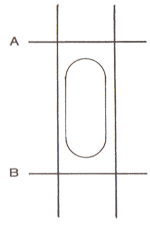 One might think of this as a picture of an air bubble in a glass tube filled with a liquid, with the lines A and B marked on the outside of the glass as on an ordinary carpenter's level. But this description is merely an aid to the imagination. We are going to give the bubble some extraordinary properties. The bubble may represent either the desire to choose to act from duty (out of equal respect) or the effort made to realize this desire in choice. The respective desire and effort are conceptually related because the desire is defined as the disposition to make the effort; and the intensity of the desire is measured by the intensity of the effort. The lines A and B in the figure represent choice thresholds. If the bubble passes above the line A, the choice is made to act from duty; if it passes below B, the choice is made to act on self interested motives. When the bubble is between the lines, as in the figure, no choice has yet been made. A downward pull of gravity in the figure may be thought to represent the natural pull of one's self interested motives, which must be counteracted by an effort to resist temptation.
There is an ambiguity, essential to our problem, about what it means to say that the bubble "passes above" the line A, or "below" the line B. If the bubble passes above A, or below B, then the choice is made to act from duty, or from self interest, respectively. But does this mean that the bubble must be wholly, or only partly, above A, or below B? It is here that we give the bubble some extraordinary properties. We imagine that the bubble represents a probability space, so that, when it is partly above A, there is a corresponding probability, but not certain that the choice is mate to act from duty, and when it is partly below B there is a corresponding probability, but not certainty, that the choice is made to act from self interest. When the bubble is wholly above A (or below B), it is certain that the choice is made to act from duty (or self interest). We then imagine a point particle in the
probability space (the bubble) that moves around randomly, while always remaining within the space. That is, it has an equal probability of appearing in any one of a number of equal sized regions in the space. (There will be further comment on this partitioning and its significance in a moment.) If part of the bubble is above the line A for a certain time and the point particle is in regions all of which are wholly above the line for the same length of time, then the choice is made to act from duty (and similarly for line B).
To complicate matters further, we want to assume that the bubble or probability space does not have an exact position vis a vis the thresholds at any given time and that this inexactness of position is also due to the undetermined movement of the point particle in the regions. There are a number of ways to represent this in the diagram, but the simplest way is the following.
Imagine, as in the following figure, that the choice thresholds A and B have indeterminate position so that they can be anywhere between (or on) the extremes A'-A" and B'-B" respectively:
One might think of this as a picture of an air bubble in a glass tube filled with a liquid, with the lines A and B marked on the outside of the glass as on an ordinary carpenter's level. But this description is merely an aid to the imagination. We are going to give the bubble some extraordinary properties. The bubble may represent either the desire to choose to act from duty (out of equal respect) or the effort made to realize this desire in choice. The respective desire and effort are conceptually related because the desire is defined as the disposition to make the effort; and the intensity of the desire is measured by the intensity of the effort. The lines A and B in the figure represent choice thresholds. If the bubble passes above the line A, the choice is made to act from duty; if it passes below B, the choice is made to act on self interested motives. When the bubble is between the lines, as in the figure, no choice has yet been made. A downward pull of gravity in the figure may be thought to represent the natural pull of one's self interested motives, which must be counteracted by an effort to resist temptation.
There is an ambiguity, essential to our problem, about what it means to say that the bubble "passes above" the line A, or "below" the line B. If the bubble passes above A, or below B, then the choice is made to act from duty, or from self interest, respectively. But does this mean that the bubble must be wholly, or only partly, above A, or below B? It is here that we give the bubble some extraordinary properties. We imagine that the bubble represents a probability space, so that, when it is partly above A, there is a corresponding probability, but not certain that the choice is mate to act from duty, and when it is partly below B there is a corresponding probability, but not certainty, that the choice is made to act from self interest. When the bubble is wholly above A (or below B), it is certain that the choice is made to act from duty (or self interest). We then imagine a point particle in the
probability space (the bubble) that moves around randomly, while always remaining within the space. That is, it has an equal probability of appearing in any one of a number of equal sized regions in the space. (There will be further comment on this partitioning and its significance in a moment.) If part of the bubble is above the line A for a certain time and the point particle is in regions all of which are wholly above the line for the same length of time, then the choice is made to act from duty (and similarly for line B).
To complicate matters further, we want to assume that the bubble or probability space does not have an exact position vis a vis the thresholds at any given time and that this inexactness of position is also due to the undetermined movement of the point particle in the regions. There are a number of ways to represent this in the diagram, but the simplest way is the following.
Imagine, as in the following figure, that the choice thresholds A and B have indeterminate position so that they can be anywhere between (or on) the extremes A'-A" and B'-B" respectively:
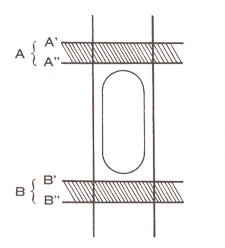 The distances between any two possible threshold positions for A (or any two for B) are equal and each possible threshold position corresponds to a region in the bubble such that, if the point particle is in that region, the threshold is at the corresponding position. But adjacent regions in the bubble need not correspond to adjacent positions of the thresholds and higher or lower regions of the bubble need not correspond to higher and lower threshold positions respectively.


