
Follow infophilosopher:
 |
|

|
|
|
Core Concepts
Actualism Adequate Determinism Agent-Causality Alternative Possibilities Causa Sui Causal Closure Causalism Causality Certainty Chance Chance Not Direct Cause Chaos Theory The Cogito Model Compatibilism Complexity Comprehensive Compatibilism Conceptual Analysis Contingency Control Could Do Otherwise Creativity Default Responsibility De-liberation Determination Determination Fallacy Determinism Disambiguation Double Effect Either Way Enlightenment Emergent Determinism Epistemic Freedom Ethical Fallacy Experimental Philosophy Extreme Libertarianism Event Has Many Causes Frankfurt Cases Free Choice Freedom of Action "Free Will" Free Will Axiom Free Will in Antiquity Free Will Mechanisms Free Will Requirements Free Will Theorem Future Contingency Hard Incompatibilism Idea of Freedom Illusion of Determinism Illusionism Impossibilism Incompatibilism Indeterminacy Indeterminism Infinities Laplace's Demon Libertarianism Liberty of Indifference Libet Experiments Luck Master Argument Modest Libertarianism Moral Necessity Moral Responsibility Moral Sentiments Mysteries Naturalism Necessity Noise Non-Causality Nonlocality Origination Paradigm Case Possibilism Possibilities Pre-determinism Predictability Probability Pseudo-Problem Random When?/Where? Rational Fallacy Reason Refutations Replay Responsibility Same Circumstances Scandal Science Advance Fallacy Second Thoughts Self-Determination Semicompatibilism Separability Soft Causality Special Relativity Standard Argument Supercompatibilism Superdeterminism Taxonomy Temporal Sequence Tertium Quid Torn Decision Two-Stage Models Ultimate Responsibility Uncertainty Up To Us Voluntarism What If Dennett and Kane Did Otherwise? Topics Introduction Problems Freedom Knowledge Mind Life Chance Quantum Entanglement Scandals Philosophers Mortimer Adler Rogers Albritton Alexander of Aphrodisias Samuel Alexander William Alston Anaximander G.E.M.Anscombe Anselm Louise Antony Thomas Aquinas Aristotle David Armstrong Harald Atmanspacher Robert Audi Augustine J.L.Austin A.J.Ayer Alexander Bain Mark Balaguer Jeffrey Barrett William Barrett William Belsham Henri Bergson George Berkeley Isaiah Berlin Richard J. Bernstein Bernard Berofsky Robert Bishop Max Black Susan Blackmore Susanne Bobzien Emil du Bois-Reymond Hilary Bok Laurence BonJour George Boole Émile Boutroux Daniel Boyd F.H.Bradley C.D.Broad Michael Burke Jeremy Butterfield Lawrence Cahoone C.A.Campbell Joseph Keim Campbell Rudolf Carnap Carneades Nancy Cartwright Gregg Caruso Ernst Cassirer David Chalmers Roderick Chisholm Chrysippus Cicero Tom Clark Randolph Clarke Samuel Clarke Anthony Collins August Compte Antonella Corradini Diodorus Cronus Jonathan Dancy Donald Davidson Mario De Caro Democritus William Dembski Brendan Dempsey Daniel Dennett Jacques Derrida René Descartes Richard Double Fred Dretske Curt Ducasse John Earman Laura Waddell Ekstrom Epictetus Epicurus Austin Farrer Herbert Feigl Arthur Fine John Martin Fischer Frederic Fitch Owen Flanagan Luciano Floridi Philippa Foot Alfred Fouilleé Harry Frankfurt Richard L. Franklin Bas van Fraassen Michael Frede Gottlob Frege Peter Geach Edmund Gettier Carl Ginet Alvin Goldman Gorgias Nicholas St. John Green Niels Henrik Gregersen H.Paul Grice Ian Hacking Ishtiyaque Haji Stuart Hampshire W.F.R.Hardie Sam Harris William Hasker R.M.Hare Georg W.F. Hegel Martin Heidegger Heraclitus R.E.Hobart Thomas Hobbes David Hodgson Shadsworth Hodgson Baron d'Holbach Ted Honderich Pamela Huby David Hume Ferenc Huoranszki Frank Jackson William James Lord Kames Robert Kane Immanuel Kant Tomis Kapitan Walter Kaufmann Jaegwon Kim William King Hilary Kornblith Christine Korsgaard Saul Kripke Thomas Kuhn Andrea Lavazza James Ladyman Christoph Lehner Keith Lehrer Gottfried Leibniz Jules Lequyer Leucippus Michael Levin Joseph Levine George Henry Lewes C.I.Lewis David Lewis Peter Lipton C. Lloyd Morgan John Locke Michael Lockwood Arthur O. Lovejoy E. Jonathan Lowe John R. Lucas Lucretius Alasdair MacIntyre Ruth Barcan Marcus Tim Maudlin James Martineau Nicholas Maxwell Storrs McCall Hugh McCann Colin McGinn Michael McKenna Brian McLaughlin John McTaggart Paul E. Meehl Uwe Meixner Alfred Mele Trenton Merricks John Stuart Mill Dickinson Miller G.E.Moore Ernest Nagel Thomas Nagel Otto Neurath Friedrich Nietzsche John Norton P.H.Nowell-Smith Robert Nozick William of Ockham Timothy O'Connor Parmenides David F. Pears Charles Sanders Peirce Derk Pereboom Gualtiero Piccinini Steven Pinker U.T.Place Plato Karl Popper Porphyry Huw Price H.A.Prichard Protagoras Hilary Putnam Willard van Orman Quine Frank Ramsey Ayn Rand Michael Rea Thomas Reid Charles Renouvier Nicholas Rescher C.W.Rietdijk Richard Rorty Josiah Royce Bertrand Russell Paul Russell Gilbert Ryle Jean-Paul Sartre Kenneth Sayre T.M.Scanlon Moritz Schlick John Duns Scotus Albert Schweitzer Arthur Schopenhauer John Searle Wilfrid Sellars David Shiang Alan Sidelle Ted Sider Henry Sidgwick Walter Sinnott-Armstrong Peter Slezak J.J.C.Smart Saul Smilansky Michael Smith Baruch Spinoza L. Susan Stebbing Isabelle Stengers George F. Stout Galen Strawson Peter Strawson Eleonore Stump Francisco Suárez Richard Taylor Kevin Timpe Mark Twain Peter Unger Peter van Inwagen Manuel Vargas John Venn Kadri Vihvelin Voltaire G.H. von Wright David Foster Wallace R. Jay Wallace W.G.Ward Ted Warfield Roy Weatherford C.F. von Weizsäcker William Whewell Alfred North Whitehead David Widerker David Wiggins Bernard Williams Timothy Williamson Ludwig Wittgenstein Susan Wolf Xenophon Scientists David Albert Philip W. Anderson Michael Arbib Bobby Azarian Walter Baade Bernard Baars Jeffrey Bada Leslie Ballentine Marcello Barbieri Jacob Barandes Julian Barbour Horace Barlow Gregory Bateson Jakob Bekenstein John S. Bell Mara Beller Charles Bennett Ludwig von Bertalanffy Susan Blackmore Margaret Boden David Bohm Niels Bohr Ludwig Boltzmann John Tyler Bonner Emile Borel Max Born Satyendra Nath Bose Walther Bothe Jean Bricmont Hans Briegel Leon Brillouin Daniel Brooks Stephen Brush Henry Thomas Buckle S. H. Burbury Melvin Calvin William Calvin Donald Campbell John O. Campbell Sadi Carnot Sean B. Carroll Anthony Cashmore Eric Chaisson Gregory Chaitin Jean-Pierre Changeux Rudolf Clausius Arthur Holly Compton John Conway Simon Conway-Morris Peter Corning George Cowan Jerry Coyne John Cramer Francis Crick E. P. Culverwell Antonio Damasio Olivier Darrigol Charles Darwin Paul Davies Richard Dawkins Terrence Deacon Lüder Deecke Richard Dedekind Louis de Broglie Stanislas Dehaene Max Delbrück Abraham de Moivre David Depew Bernard d'Espagnat Paul Dirac Theodosius Dobzhansky Hans Driesch John Dupré John Eccles Arthur Stanley Eddington Gerald Edelman Paul Ehrenfest Manfred Eigen Albert Einstein George F. R. Ellis Walter Elsasser Hugh Everett, III Franz Exner Richard Feynman R. A. Fisher David Foster Joseph Fourier George Fox Philipp Frank Steven Frautschi Edward Fredkin Augustin-Jean Fresnel Karl Friston Benjamin Gal-Or Howard Gardner Lila Gatlin Michael Gazzaniga Nicholas Georgescu-Roegen GianCarlo Ghirardi J. Willard Gibbs James J. Gibson Nicolas Gisin Paul Glimcher Thomas Gold A. O. Gomes Brian Goodwin Julian Gough Joshua Greene Dirk ter Haar Jacques Hadamard Mark Hadley Ernst Haeckel Patrick Haggard J. B. S. Haldane Stuart Hameroff Augustin Hamon Sam Harris Ralph Hartley Hyman Hartman Jeff Hawkins John-Dylan Haynes Donald Hebb Martin Heisenberg Werner Heisenberg Hermann von Helmholtz Grete Hermann John Herschel Francis Heylighen Basil Hiley Art Hobson Jesper Hoffmeyer John Holland Don Howard John H. Jackson Ray Jackendoff Roman Jakobson E. T. Jaynes William Stanley Jevons Pascual Jordan Eric Kandel Ruth E. Kastner Stuart Kauffman Martin J. Klein William R. Klemm Christof Koch Simon Kochen Hans Kornhuber Stephen Kosslyn Daniel Koshland Ladislav Kovàč Leopold Kronecker Bernd-Olaf Küppers Rolf Landauer Alfred Landé Pierre-Simon Laplace Karl Lashley David Layzer Joseph LeDoux Gerald Lettvin Michael Levin Gilbert Lewis Benjamin Libet David Lindley Seth Lloyd Werner Loewenstein Hendrik Lorentz Josef Loschmidt Alfred Lotka Ernst Mach Donald MacKay Henry Margenau Lynn Margulis Owen Maroney David Marr Humberto Maturana James Clerk Maxwell John Maynard Smith Ernst Mayr John McCarthy Barbara McClintock Warren McCulloch N. David Mermin George Miller Stanley Miller Ulrich Mohrhoff Jacques Monod Vernon Mountcastle Gerd B. Müller Emmy Noether Denis Noble Donald Norman Travis Norsen Howard T. Odum Alexander Oparin Abraham Pais Howard Pattee Wolfgang Pauli Massimo Pauri Wilder Penfield Roger Penrose Massimo Pigliucci Steven Pinker Colin Pittendrigh Walter Pitts Max Planck Susan Pockett Henri Poincaré Michael Polanyi Daniel Pollen Ilya Prigogine Hans Primas Giulio Prisco Zenon Pylyshyn Henry Quastler Adolphe Quételet Pasco Rakic Nicolas Rashevsky Lord Rayleigh Frederick Reif Jürgen Renn Giacomo Rizzolati A.A. Roback Emil Roduner Juan Roederer Robert Rosen Frank Rosenblatt Jerome Rothstein David Ruelle David Rumelhart Michael Ruse Stanley Salthe Robert Sapolsky Tilman Sauer Ferdinand de Saussure Jürgen Schmidhuber Erwin Schrödinger Aaron Schurger Sebastian Seung Thomas Sebeok Franco Selleri Claude Shannon James A. Shapiro Charles Sherrington Abner Shimony Herbert Simon Dean Keith Simonton Edmund Sinnott B. F. Skinner Lee Smolin Ray Solomonoff Herbert Spencer Roger Sperry John Stachel Kenneth Stanley Henry Stapp Ian Stewart Tom Stonier Antoine Suarez Leonard Susskind Leo Szilard Max Tegmark Teilhard de Chardin Libb Thims William Thomson (Kelvin) Richard Tolman Giulio Tononi Peter Tse Alan Turing Robert Ulanowicz C. S. Unnikrishnan Nico van Kampen Francisco Varela Vlatko Vedral Vladimir Vernadsky Clément Vidal Mikhail Volkenstein Heinz von Foerster Richard von Mises John von Neumann Jakob von Uexküll C. H. Waddington Sara Imari Walker James D. Watson John B. Watson Daniel Wegner Steven Weinberg August Weismann Paul A. Weiss Herman Weyl John Wheeler Jeffrey Wicken Wilhelm Wien Norbert Wiener Eugene Wigner E. O. Wiley E. O. Wilson Günther Witzany Carl Woese Stephen Wolfram H. Dieter Zeh Semir Zeki Ernst Zermelo Wojciech Zurek Konrad Zuse Fritz Zwicky Presentations ABCD Harvard (ppt) Bhaktivedanta Aug 2026 Biosemiotics Free Will Mental Causation James Symposium CCS25 Talk Evo Devo September 12 Evo Devo October 2 Evo Devo Davies Nov12 |
Free Will Mechanisms
Over the years, a number of philosophers and scientists have proposed specific brain mechanisms that could provide the unpredictability expected of "Freedom."
Most of these thinkers erroneously assumed that indeterministic chance could be the direct cause of our free actions.
And most imagined mechanisms so close to perfect balance that an infinitesimal amount of energy could make them go this way or that way. Inspired by the ancient liberum arbitrium indifferentiae, they wanted the mental effort involved to be nil, because the very idea of a mental substance affecting the material body was considered a problem.
In English and Romance languages, the term used to describe the decision process, deliberation, is normally assumed to be derived from the Latin verb delibrare, to balance (from libra, scale). This fits with the simple idea that judgments are always balancing two options.
But it is more likely that the options we face are extremely different in many ways that make them hard to evaluate. Difficult moral choices may not be properly characterized as "indifferent" decisions, nearly in balance (the liberum arbitrium indifferentiae).
And it is still more likely that we are always facing not two but multiple alternate possibilities. Our alternative etymology would be to derive deliberation from Latin deliberare, based on liberare, to liberate or set free.
Here are some of the mechanisms suggested to underlie the free will.
James Clerk Maxwell's "Singularities"
Maxwell looked for free will in physical conditions that were poised on a knife edge of going this way or that way and which the mind could push in either direction with minimal (ideally zero) energy required. Note that Maxwell anticipates the theory of modern deterministic "chaos" in which infinitesimal differences lead to massive global changes. This is a characteristic of most "amplifier" theories. They demonstrate that microscopic indeterminism can lead to macroscopic effects.
When the state of things is such that an infinitely small variation of the present state will alter only by an infinitely small quantity the state at some future time, the condition of the system, whether at rest or in motion, is said to be stable; but when an infinitely small variation in the present state may bring about a finite difference in the state of the system in a finite time, the condition of the system is said to be unstable.
Six years later, Maxwell was intrigued by the work of three Frenchmen, Boussinesq, Cournot, and St Venant, on singular points in the solution of hydrodynamic equations which suggested complete unpredictability of future states. These resembled Lucretius' (really Epicurus') atomic swerves, and they anticipate modern non-linear, deterministic chaos. Although Maxwell did not find the idea really satisfactory, it did challenge the metaphysics of strict causal determinism.
Maxwell wrote in a letter to Francis Galton2 (who never responded to the suggestion):
There are certain cases in which a material system, when it comes to a phase in which the particular path which it is describing coincides with the envelope of all such paths may either continue in the particular path or take to the envelope (which in these cases is also a possible path) and which course it takes is not determined by the forces of the system (which are the same for both cases) but when the bifurcation of path occurs, the system, ipso facto, invokes some determining principle which is extra physical (but not extra natural) to determine which of the two paths it is to follow.
Arthur Stanley Eddington's "Free Electrons"
It is extremely unlikely that Eddington believed that "free electrons" had the same kind of freedom he wanted for human beings, but he did speak loosely of the uncertainty associated with the electron breaking the hold on physical determinism. But his critics, especially L. Susan Stebbing accused Eddington of this. She said
"There is no way of discovering when an electron will jump, nor to which orbit it will jump. The initial state does not determine the final state; hence, the final state is unpredictable. It is unfortunate that this unpredictability has often been expressed by saying that the electron is 'free to choose' where it will jump. Such language is wholly inappropriate and has led to much confusion in discussions concerning the bearing of recent developments in physics upon the problem of free will." (Philosophy and the Physicists, 1937, p.178)Eddington himself was more cautious, but he did hint the some "speck of brain matter" might be subject to indetermininism.
Arthur Holly Compton's Photocell Amplifier
In his 1931 Terry Lectures at Yale and the 1935 book, The Freedom of Man, and again in the 1940 book The Human Meaning of Science, Arthur Holly Compton developed this idea of the amplifier and added a daemon that might control a shutter, stopping "bad" photons. He imagined that a similar scheme whereby "consciousness could select the desirable brain current."
Imagine, as in Figure 1, a faint ray of light passing through a tiny hole, which then spreads by diffraction into a broad beam. In the path of this broad beam we may place two photoelectric cells, A and B, each connected with an amplifier. These will be made so sensitive that the entrance of a single photon, i.e., particle of light, into either cell is recorded. A shutter in the path of the light ray remains open long enough to transmit a single photon. Into which cell will the photon fall ?
John Eccles' "Critically Poised Neurons"
Eccles had as early as 1953 used Eddington's estimates of the uncertainty in neuron-sized structures to explore the possible interaction between a mental substance and brain matter. He made calculations of how far and fast a small unpredictable disturbance might radiate outward in a simplified model of a neural network.
The Neurophysiological Problem of Will
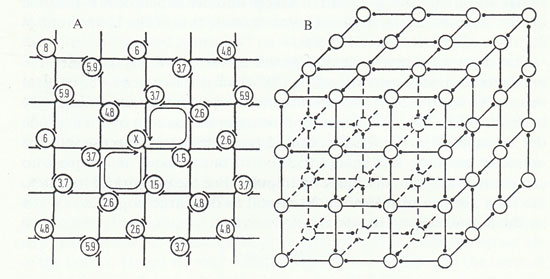
If each neurone receives and gives three synaptic contacts, a similar construction with radial symmetry is possible in three-dimensional network (Fig. 28 B). As shown in Fig. 28 these constructions would give alternating direction of transmission in the successive lines in any plane. Similarly, if each neurone gave and received n synapses, the pattern could be accommodated to an n-dimensional network.
The problem of the mode of action of the will can be simplified and sharpened by considering firstly the behavior of a single neurone in the active neuronal network of the cortex. Suppose some small "influence" were exerted at a node that would make a neurone discharge an impulse at a level of synaptic excitation which would otherwise have been just ineffective, that is, in general to raise the probability of its discharge. Such a discharged impulse would in turn have an excitatory effect on all the other nodes on which it impinges, raising the probability of their discharge, and so on. If we assume, as above, that the transmission time from node to node occupies 1 msec, then, even on the two-dimensional net of Fig. 28 A, a spread to a large number of neurones is possible in, say, 20 msec, a time that is chosen because it is at the lower limit of duration of discrete mental events.
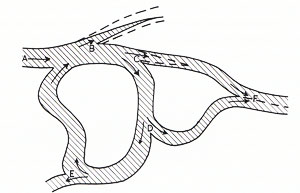
In order to frame a precise problem, we can firstly consider the schematic neuronal networks of Fig. 28 which are assumed to be cortical neurones — both the pyramidal cells and the very numerous stellate cells. We make the postulates that at zero time a neurone (for example X in Fig. 28 A) is caused to discharge an impulse into the quiescent network and that activation of one synapse is adequate to cause any neurone to discharge an impulse. For the network of Fig. 28 A. the total number of neurones, N, caused to discharge impulses is given by the formula (SAWYER, 1951): N = 2m2 — 2m + 2 where m is the number of nodes traversed. In 20 msec m=20, the internodal time being assumed as 1 msec; hence the number of neurones activated is 762. On the same assumptions, but with a multi-dimensional network constructed according to the conventions of Fig. 28, the number of activated neurones, N, is given, where m is large relative to n, by the general formula (SAWYER, 1951): N ≈ (2n/n!) m2 when m = 20 (i. e. within 20 msec) and with n = 3 (Fig. 28 B), N is of the order 104. With n = 4 and 5 respectively, N is of the order 105 and 8 x 10⁵. These calculations are intended merely to give some indication of the large number of cortical neurones that could be affected by a discharge originating in any one. In order to apply them to our problem of how "will" could act on the cerebral cortex, it is necessary to take into account the evidence that "will" can act on the cortical neuronal network only when a considerable part of it is at a relatively high level of excitation, i.e. we have to assume that, for "will" to be operative, large population, of cortical neurones are subjected to strong synaptic bombardment, and are stimulated thereby to discharge impulses which bombard other neurones. Under such dynamic conditions it may be conservatively estimated that, out of the hundred or more synaptic contacts made by any one neurone, at least four or five would be critically effective (when summed with synaptic bombardments by other neurones) in evoking the discharge of neurones next in series. The remainder would be ineffective because the recipient neurones would not be poised at this critical level of excitability, being either at a too low level of excitation, or at a too high level, so that the neuronal discharge occurs regardless of this additional synaptic bombardment. Thus at any instant the postulated action of the "will" on any one neurone would be effectively detected by the "critically poised neurones" on which it acts synaptically. So long as the assumed number of critically effective synaptic excitatory actions by each neurone is kept at the low levels used in the above calculations, it is probable that the conventions of the network structures of Fig. 28 give an approximate method of allowing for all the mass of feed-back connections that occur in the closed-chain linkages of the cerebral cortex (LORENTE DE NO, 1933, 1934, 1943). Further, since the cortex is approximately 3 mm thick and the mean density of neurones 40,000 per sq. mm of surface (THOMPSON, 1899), the spread to some hundreds of thousands of neurones can be treated as spreading indefinitely in all directions without serious restriction by the sheet-like structure of the cortex. Hence we may conclude that, when a region of the cortical neuronal network is at a high level of activity, the discharge of an impulse by any one neurone will have contributed directly and indirectly to the excitation of hundreds of thousands of other neurones within the very brief time of 20 msec. A Neurophysiological Hypothesis of Will As a restatement of the conclusion of the preceding section we may say that in the active cerebral cortex within 20 msec the pattern of discharge of even hundreds of thousands of neurones would be modified as a result of an "influence " that initially caused the discharge of merely one neurone. But further, if we assume that this "influence" is exerted not only at one node of the active network, but also over the whole field of nodes in some sort of spatio-temporal patterning, then it will be evident that potentially the network is capable of integrating the whole aggregate of "influences" to bring about some modification of its patterned activity, that otherwise would be determined by the pattern of afferent input and its own inherent structural and functional properties. Such integration would occur over hundreds of thousands of nodes in a few milliseconds, the effects exerted on any and every node being correlated in the resultant patterned activity of the surrounding hundreds of thousands of neurones. Thus in general. the spatio-temporal pattern of activity would be determined not only by (i) the micro-structure of the neural net and its functional properties as built up by genetic and conditioning factors and (ii) the afferent input over the period of short-term memory, but also (iii) by the postulated "field of mind influence." For example, in Fig. 29 the spatio-temporal pattern determined by factors (i) and (ii) is shown diagrammatically by the shaded structure bounded by the continuous line, while a possible modification by factor (iii) is indicated by the paths outlined by broken lines at B and C. Fig. 29 can be considered as showing boundaries of multilane neuronal traffic as indicated in Figs. 10 and 12.
It can be claimed that no physical instrument would bear comparison with the postulated performance of the active cerebral cortex as a detector of minute "fields of influence" spread over a microscopic pattern am with temporal sequences of milliseconds. The integration, within a few milliseconds, of "influences" picked up at hundreds of thousands of nodes would be unique, particularly when it is remembered that the integration is no mere addition, but is exerted to modify in some specific way "a shifting harmony of sub-patterns" of neuronal activity, achieving expression through the modifications so produced.
Thus, the neurophysiological hypothesis is that the "will" modifies the spatiotemporal activity of the neuronal network by exerting spatiotemporal "fields of influence" that become effective through this unique detector function of the active cerebral cortex. It will be noted that this hypothesis assumes that the "will" or "mind influence" has itself some spatio-temporal patterned character in order to allow it this operative effectiveness.
A. O. Gomes' Quantum Composer
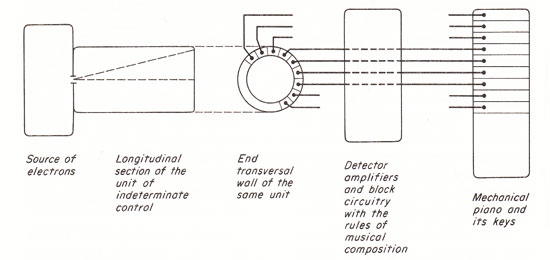
While the Gomes model is little more than an elaboration of Arthur Holly Compton's amplifier, it is at least more peaceful. Where Compton's photocell amplifiers blow up dynamite, Gomes' multiple electron detectors and computer algorithms play music on a piano. A MERELY PHYSICAL ILLUSTRATION
Daniel Dennett's Pseudo-random Number Generator
In his 1978 book Brainstorms, Daniel Dennett proposed an influential "model of decision making" with a two-stage account of free will. In his chapter "On Giving Libertarians What They Say They Want" (p.286), Dennett clearly separates random possibilities from determined choices.
But does Dennett, following James, Poincaré, and Popper, see that this solves the problem of indeterminism in free will that has plagued philosophy since Epicurus' "swerve" of the atoms? He says, a bit sarcastically, that his model "puts indeterminism in the right place for the libertarian, if there is a right place at all [my emphasis]." And after giving six excellent reasons why his suggestion is what libertarians are looking for, Dennett then mistakenly suggests that the randomness generator might as well have been a computer-generated pseudo-random number generator. He says "Isn't it the case that the new improved proposed model for human deliberation can do as well with a random-but-deterministic generation process as with a causally undetermined process?" This completely misses the libertarian's point! But then Dennett's argument for libertarianism may just be a compatibilist's straw man. He does not pursue it in his later works, such as Elbow Room, The Varieties of Free Will Worth Wanting (Dennett, 1984). Here is Dennett's suggestion (Brainstorms, p.295):The model of decision making I am proposing, has the following feature: when we are faced with an important decision, a consideration-generator whose output is to some degree undetermined produces a series of considerations, some of which may of course be immediately rejected as irrelevant by the agent (consciously or unconsciously). Those considerations that are selected by the agent as having a more than negligible bearing on the decision then figure in a reasoning process, and if the agent is in the main reasonable, those considerations ultimately serve as predictors and explicators of the agent's final decision. What can be said in favor of such a model, bearing in mind that there are many possible substantive variations on the basic theme? I have recounted six recommendations for the suggestion that human decision-making involves a non-deterministic generate-and-test procedure. First, it captures whatever is compelling in Russell's hunch. Second, it installs determinism in the only plausible locus for libertarianism (something we have established by a process of elimination). Third, it makes sense from the point of view of strategies of biological engineering. Fourth, it provides a flexible justification of moral education. Fifth, it accounts at least in part for our sense of authorship of our decisions. Sixth, it acknowledges and explains the importance of decisions internal to the deliberation process. It is embarrassing to note, however, that the very feature of the model that inspired its promulgation is apparently either gratuitous or misdescribed or both, and that is the causal indeterminacy of the generator. We have been supposing, for the sake of the libertarian, that the process that generates considerations for our assessment generates them at least in part by a physically or causally undetermined or random process.
Robert Kane's Probability Bubbles
In his 1985 book Free Will and Values, aware of earlier proposals by Eccles, Popper, and Dennett, but working independently, Kane proposed an ambitious amplifier model for a quantum randomizer in the brain - a spinning wheel of fortune with probability bubbles corresponding to alternative possibilities. in the massive switch amplifier tradition of Compton and Gomes.
Kane's work is squarely in the massive switch amplifier (MSA) tradition of Compton and Gomes.
Kane says (p.169):
What I would like to do then, is to show how an MSA model, using Eccles' notion of critically poised neurons as a working hypothesis, might be adapted to the theory of practical, moral and prudential decision making. Keeping these points in mind, let us now suppose that there are neurons in the brain "critically poised" in Eccles' sense, whose probability of firing within a small interval of time is .5. (We shall tamper with this simplifying assumption in a moment.) For every n such neurons, there are 2n possible ordered combinations of firings and non-firings, which may be represented by sequences, such as (101... ), (01101... ), where the "1" 's indicate firings, the "0" 's non-firings, and the dots indicate that the sequences are continued with "0" 's up to n figures. A reasonably small number of such neurons, say a dozen, would yield ordered combinations, in the thousands, enough for the purposes of the theory. As indicated in 8.4, the exact number of possible alternatives or partitionings does not matter so long as it is large; it would likely depend on the exigencies of neurological programming rather than the demands of the theory. For practical choice, these ordered combinations of firings and non-firings of critically poised neurons would correspond to places on a spinning wheel, most of which would give rise to chance selected considerations, opening doors to consciousness of possibly relevant memories, triggering associations of ideas and/or images, focussing attention in various ways, etc. Some combinations of firings and non-firings might draw a blank. But the wheel would keep spinning until it hit something worth considering, so long as the practical reasoner or creative thinker were in a receptive, yet reflective, state of mind. Then the relevance of the consideration to deliberation would have to be assessed and the consideration either accepted or rejected.Kane introduces a probability bubble.
"neurological processes must exist corresponding to the randomizing activity of the spinning wheel and the partitioning of the wheel into equiprobable segments (red, blue, etc.) corresponding to the relevant R-alternatives."Kane's model combines free will and values. Kane claimed his free choice is moral and made in accord with Kant's concept of duty. Claiming that the only free actions are moral decisions is an ethical fallacy. "the succession of random selections among equiprobable alternatives is meant to be a continuing reminder (a mental or neurological representation) of the fact that the reason sets of other persons are to be treated equally."Kane is not satisfied with his free will solution. He explains that the main reason for failure is "locating the master switch and the mechanism of amplification...We do not know if something similar goes on in the brains of cortically developed creatures like ourselves, but I suspect it must if libertarian theories are to succeed." (p.168)Kane's basic failure is his location of indeterminism in the decision process itself, making chance the direct cause of action.
Alfred Mele's Roulette Wheel
Mele describes how indeterminism shows up as a problem of moral luck for libertarians.
Mele, like Kane, clearly makes chance at least partly the direct cause of action.
In his book Free Will and Luck, p.7, he says...
As soon as any agent...judges it best to A, objective probabilities for the various decisions open to the agent are set, and the probability of a decision to A is very high. Larger probabilities get a correspondingly larger segment of a tiny indeterministic neural roulette wheel in the agent's head than do smaller probabilities. A tiny neural ball bounces along the wheel; its landing in a particular segment is the agent's making the corresponding decision. When the ball lands in the segment for a decision to A, its doing so is not just a matter of luck. After all, the design is such that the probability of that happening is very high. But the ball's landing there is partly a matter of luck. For Teachers
For Scholars
|
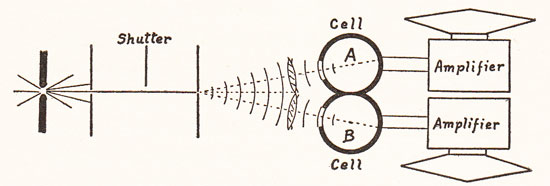 Figure 1
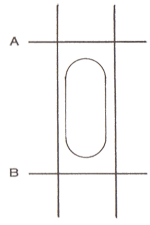 One might think of this as a picture of an air bubble in a glass tube filled with a liquid, with the lines A and B marked on the outside of the glass as on an ordinary carpenter's level. But this description is merely an aid to the imagination. We are going to give the bubble some extraordinary properties. The bubble may represent either the desire to choose to act from duty (out of equal respect) or the effort made to realize this desire in choice. The respective desire and effort are conceptually related because the desire is defined as the disposition to make the effort; and the intensity of the desire is measured by the intensity of the effort. The lines A and B in the figure represent choice thresholds. If the bubble passes above the line A, the choice is made to act from duty; if it passes below B, the choice is made to act on self interested motives. When the bubble is between the lines, as in the figure, no choice has yet been made. A downward pull of gravity in the figure may be thought to represent the natural pull of one's self interested motives, which must be counteracted by an effort to resist temptation.
There is an ambiguity, essential to our problem, about what it means to say that the bubble "passes above" the line A, or "below" the line B. If the bubble passes above A, or below B, then the choice is made to act from duty, or from self interest, respectively. But does this mean that the bubble must be wholly, or only partly, above A, or below B? It is here that we give the bubble some extraordinary properties. We imagine that the bubble represents a probability space, so that, when it is partly above A, there is a corresponding probability, but not certain that the choice is mate to act from duty, and when it is partly below B there is a corresponding probability, but not certainty, that the choice is made to act from self interest. When the bubble is wholly above A (or below B), it is certain that the choice is made to act from duty (or self interest). We then imagine a point particle in the
probability space (the bubble) that moves around randomly, while always remaining within the space. That is, it has an equal probability of appearing in any one of a number of equal sized regions in the space. (There will be further comment on this partitioning and its significance in a moment.) If part of the bubble is above the line A for a certain time and the point particle is in regions all of which are wholly above the line for the same length of time, then the choice is made to act from duty (and similarly for line B).
To complicate matters further, we want to assume that the bubble or probability space does not have an exact position vis a vis the thresholds at any given time and that this inexactness of position is also due to the undetermined movement of the point particle in the regions. There are a number of ways to represent this in the diagram, but the simplest way is the following.
Imagine, as in the following figure, that the choice thresholds A and B have indeterminate position so that they can be anywhere between (or on) the extremes A'-A" and B'-B" respectively:
One might think of this as a picture of an air bubble in a glass tube filled with a liquid, with the lines A and B marked on the outside of the glass as on an ordinary carpenter's level. But this description is merely an aid to the imagination. We are going to give the bubble some extraordinary properties. The bubble may represent either the desire to choose to act from duty (out of equal respect) or the effort made to realize this desire in choice. The respective desire and effort are conceptually related because the desire is defined as the disposition to make the effort; and the intensity of the desire is measured by the intensity of the effort. The lines A and B in the figure represent choice thresholds. If the bubble passes above the line A, the choice is made to act from duty; if it passes below B, the choice is made to act on self interested motives. When the bubble is between the lines, as in the figure, no choice has yet been made. A downward pull of gravity in the figure may be thought to represent the natural pull of one's self interested motives, which must be counteracted by an effort to resist temptation.
There is an ambiguity, essential to our problem, about what it means to say that the bubble "passes above" the line A, or "below" the line B. If the bubble passes above A, or below B, then the choice is made to act from duty, or from self interest, respectively. But does this mean that the bubble must be wholly, or only partly, above A, or below B? It is here that we give the bubble some extraordinary properties. We imagine that the bubble represents a probability space, so that, when it is partly above A, there is a corresponding probability, but not certain that the choice is mate to act from duty, and when it is partly below B there is a corresponding probability, but not certainty, that the choice is made to act from self interest. When the bubble is wholly above A (or below B), it is certain that the choice is made to act from duty (or self interest). We then imagine a point particle in the
probability space (the bubble) that moves around randomly, while always remaining within the space. That is, it has an equal probability of appearing in any one of a number of equal sized regions in the space. (There will be further comment on this partitioning and its significance in a moment.) If part of the bubble is above the line A for a certain time and the point particle is in regions all of which are wholly above the line for the same length of time, then the choice is made to act from duty (and similarly for line B).
To complicate matters further, we want to assume that the bubble or probability space does not have an exact position vis a vis the thresholds at any given time and that this inexactness of position is also due to the undetermined movement of the point particle in the regions. There are a number of ways to represent this in the diagram, but the simplest way is the following.
Imagine, as in the following figure, that the choice thresholds A and B have indeterminate position so that they can be anywhere between (or on) the extremes A'-A" and B'-B" respectively:
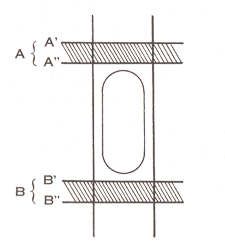 The distances between any two possible threshold positions for A (or any two for B) are equal and each possible threshold position corresponds to a region in the bubble such that, if the point particle is in that region, the threshold is at the corresponding position. But adjacent regions in the bubble need not correspond to adjacent positions of the thresholds and higher or lower regions of the bubble need not correspond to higher and lower threshold positions respectively.
What all this means is that the intensity of the effort to overcome temptation at any given time, which is measure of the intensity of the desire to act from duty (represented by the position of the bubble vis a vis the thresholds and the position of the point particle within the bubble) is indeterminate. And, as a consequence, the outcome of the choice situation at a given time is undetermined and unpredictable as long as the bubble is not wholly above A' or wholly below B".
The distances between any two possible threshold positions for A (or any two for B) are equal and each possible threshold position corresponds to a region in the bubble such that, if the point particle is in that region, the threshold is at the corresponding position. But adjacent regions in the bubble need not correspond to adjacent positions of the thresholds and higher or lower regions of the bubble need not correspond to higher and lower threshold positions respectively.
What all this means is that the intensity of the effort to overcome temptation at any given time, which is measure of the intensity of the desire to act from duty (represented by the position of the bubble vis a vis the thresholds and the position of the point particle within the bubble) is indeterminate. And, as a consequence, the outcome of the choice situation at a given time is undetermined and unpredictable as long as the bubble is not wholly above A' or wholly below B".


