
Follow infophilosopher:
 |
|

|
|
|
Topics
Introduction
Problems Freedom Knowledge Mind Life Chance Quantum Entanglement Scandals Philosophers Mortimer Adler Rogers Albritton Alexander of Aphrodisias Samuel Alexander William Alston Anaximander G.E.M.Anscombe Anselm Louise Antony Thomas Aquinas Aristotle David Armstrong Harald Atmanspacher Robert Audi Augustine J.L.Austin A.J.Ayer Alexander Bain Mark Balaguer Jeffrey Barrett William Barrett William Belsham Henri Bergson George Berkeley Isaiah Berlin Richard J. Bernstein Bernard Berofsky Robert Bishop Max Black Susan Blackmore Susanne Bobzien Emil du Bois-Reymond Hilary Bok Laurence BonJour George Boole Émile Boutroux Daniel Boyd F.H.Bradley C.D.Broad Michael Burke Jeremy Butterfield Lawrence Cahoone C.A.Campbell Joseph Keim Campbell Rudolf Carnap Carneades Nancy Cartwright Gregg Caruso Ernst Cassirer David Chalmers Roderick Chisholm Chrysippus Cicero Tom Clark Randolph Clarke Samuel Clarke Anthony Collins August Compte Antonella Corradini Diodorus Cronus Jonathan Dancy Donald Davidson Mario De Caro Democritus William Dembski Brendan Dempsey Daniel Dennett Jacques Derrida René Descartes Richard Double Fred Dretske Curt Ducasse John Earman Laura Waddell Ekstrom Epictetus Epicurus Austin Farrer Herbert Feigl Arthur Fine John Martin Fischer Frederic Fitch Owen Flanagan Luciano Floridi Philippa Foot Alfred Fouilleé Harry Frankfurt Richard L. Franklin Bas van Fraassen Michael Frede Gottlob Frege Peter Geach Edmund Gettier Carl Ginet Alvin Goldman Gorgias Nicholas St. John Green Niels Henrik Gregersen H.Paul Grice Ian Hacking Ishtiyaque Haji Stuart Hampshire W.F.R.Hardie Sam Harris William Hasker R.M.Hare Georg W.F. Hegel Martin Heidegger Heraclitus R.E.Hobart Thomas Hobbes David Hodgson Shadsworth Hodgson Baron d'Holbach Ted Honderich Pamela Huby David Hume Ferenc Huoranszki Frank Jackson William James Lord Kames Robert Kane Immanuel Kant Tomis Kapitan Walter Kaufmann Jaegwon Kim William King Hilary Kornblith Christine Korsgaard Saul Kripke Thomas Kuhn Andrea Lavazza James Ladyman Christoph Lehner Keith Lehrer Gottfried Leibniz Jules Lequyer Leucippus Michael Levin Joseph Levine George Henry Lewes C.I.Lewis David Lewis Peter Lipton C. Lloyd Morgan John Locke Michael Lockwood Arthur O. Lovejoy E. Jonathan Lowe John R. Lucas Lucretius Alasdair MacIntyre Ruth Barcan Marcus Tim Maudlin James Martineau Nicholas Maxwell Storrs McCall Hugh McCann Colin McGinn Michael McKenna Brian McLaughlin John McTaggart Paul E. Meehl Uwe Meixner Alfred Mele Trenton Merricks John Stuart Mill Dickinson Miller G.E.Moore Ernest Nagel Thomas Nagel Otto Neurath Friedrich Nietzsche John Norton P.H.Nowell-Smith Robert Nozick William of Ockham Timothy O'Connor Parmenides David F. Pears Charles Sanders Peirce Derk Pereboom Steven Pinker U.T.Place Plato Karl Popper Porphyry Huw Price H.A.Prichard Protagoras Hilary Putnam Willard van Orman Quine Frank Ramsey Ayn Rand Michael Rea Thomas Reid Charles Renouvier Nicholas Rescher C.W.Rietdijk Richard Rorty Josiah Royce Bertrand Russell Paul Russell Gilbert Ryle Jean-Paul Sartre Kenneth Sayre T.M.Scanlon Moritz Schlick John Duns Scotus Albert Schweitzer Arthur Schopenhauer John Searle Wilfrid Sellars David Shiang Alan Sidelle Ted Sider Henry Sidgwick Walter Sinnott-Armstrong Peter Slezak J.J.C.Smart Saul Smilansky Michael Smith Baruch Spinoza L. Susan Stebbing Isabelle Stengers George F. Stout Galen Strawson Peter Strawson Eleonore Stump Francisco Suárez Richard Taylor Kevin Timpe Mark Twain Peter Unger Peter van Inwagen Manuel Vargas John Venn Kadri Vihvelin Voltaire G.H. von Wright David Foster Wallace R. Jay Wallace W.G.Ward Ted Warfield Roy Weatherford C.F. von Weizsäcker William Whewell Alfred North Whitehead David Widerker David Wiggins Bernard Williams Timothy Williamson Ludwig Wittgenstein Susan Wolf Xenophon Scientists David Albert Philip W. Anderson Michael Arbib Bobby Azarian Walter Baade Bernard Baars Jeffrey Bada Leslie Ballentine Marcello Barbieri Jacob Barandes Julian Barbour Horace Barlow Gregory Bateson Jakob Bekenstein John S. Bell Mara Beller Charles Bennett Ludwig von Bertalanffy Susan Blackmore Margaret Boden David Bohm Niels Bohr Ludwig Boltzmann John Tyler Bonner Emile Borel Max Born Satyendra Nath Bose Walther Bothe Jean Bricmont Hans Briegel Leon Brillouin Daniel Brooks Stephen Brush Henry Thomas Buckle S. H. Burbury Melvin Calvin William Calvin Donald Campbell John O. Campbell Sadi Carnot Sean B. Carroll Anthony Cashmore Eric Chaisson Gregory Chaitin Jean-Pierre Changeux Rudolf Clausius Arthur Holly Compton John Conway Simon Conway-Morris Peter Corning George Cowan Jerry Coyne John Cramer Francis Crick E. P. Culverwell Antonio Damasio Olivier Darrigol Charles Darwin Paul Davies Richard Dawkins Terrence Deacon Lüder Deecke Richard Dedekind Louis de Broglie Stanislas Dehaene Max Delbrück Abraham de Moivre David Depew Bernard d'Espagnat Paul Dirac Theodosius Dobzhansky Hans Driesch John Dupré John Eccles Arthur Stanley Eddington Gerald Edelman Paul Ehrenfest Manfred Eigen Albert Einstein George F. R. Ellis Walter Elsasser Hugh Everett, III Franz Exner Richard Feynman R. A. Fisher David Foster Joseph Fourier George Fox Philipp Frank Steven Frautschi Edward Fredkin Augustin-Jean Fresnel Karl Friston Benjamin Gal-Or Howard Gardner Lila Gatlin Michael Gazzaniga Nicholas Georgescu-Roegen GianCarlo Ghirardi J. Willard Gibbs James J. Gibson Nicolas Gisin Paul Glimcher Thomas Gold A. O. Gomes Brian Goodwin Julian Gough Joshua Greene Dirk ter Haar Jacques Hadamard Mark Hadley Ernst Haeckel Patrick Haggard J. B. S. Haldane Stuart Hameroff Augustin Hamon Sam Harris Ralph Hartley Hyman Hartman Jeff Hawkins John-Dylan Haynes Donald Hebb Martin Heisenberg Werner Heisenberg Hermann von Helmholtz Grete Hermann John Herschel Francis Heylighen Basil Hiley Art Hobson Jesper Hoffmeyer John Holland Don Howard John H. Jackson Ray Jackendoff Roman Jakobson E. T. Jaynes William Stanley Jevons Pascual Jordan Eric Kandel Ruth E. Kastner Stuart Kauffman Martin J. Klein William R. Klemm Christof Koch Simon Kochen Hans Kornhuber Stephen Kosslyn Daniel Koshland Ladislav Kovàč Leopold Kronecker Bernd-Olaf Küppers Rolf Landauer Alfred Landé Pierre-Simon Laplace Karl Lashley David Layzer Joseph LeDoux Gerald Lettvin Michael Levin Gilbert Lewis Benjamin Libet David Lindley Seth Lloyd Werner Loewenstein Hendrik Lorentz Josef Loschmidt Alfred Lotka Ernst Mach Donald MacKay Henry Margenau Lynn Margulis Owen Maroney David Marr Humberto Maturana James Clerk Maxwell John Maynard Smith Ernst Mayr John McCarthy Barbara McClintock Warren McCulloch N. David Mermin George Miller Stanley Miller Ulrich Mohrhoff Jacques Monod Vernon Mountcastle Gerd B. Müller Emmy Noether Denis Noble Donald Norman Travis Norsen Howard T. Odum Alexander Oparin Abraham Pais Howard Pattee Wolfgang Pauli Massimo Pauri Wilder Penfield Roger Penrose Massimo Pigliucci Steven Pinker Colin Pittendrigh Walter Pitts Max Planck Susan Pockett Henri Poincaré Michael Polanyi Daniel Pollen Ilya Prigogine Hans Primas Giulio Prisco Zenon Pylyshyn Henry Quastler Adolphe Quételet Pasco Rakic Nicolas Rashevsky Lord Rayleigh Frederick Reif Jürgen Renn Giacomo Rizzolati A.A. Roback Emil Roduner Juan Roederer Robert Rosen Frank Rosenblatt Jerome Rothstein David Ruelle David Rumelhart Michael Ruse Stanley Salthe Robert Sapolsky Tilman Sauer Ferdinand de Saussure Jürgen Schmidhuber Erwin Schrödinger Aaron Schurger Sebastian Seung Thomas Sebeok Franco Selleri Claude Shannon James A. Shapiro Charles Sherrington Abner Shimony Herbert Simon Dean Keith Simonton Edmund Sinnott B. F. Skinner Lee Smolin Ray Solomonoff Herbert Spencer Roger Sperry John Stachel Kenneth Stanley Henry Stapp Ian Stewart Tom Stonier Antoine Suarez Leonard Susskind Leo Szilard Max Tegmark Teilhard de Chardin Libb Thims William Thomson (Kelvin) Richard Tolman Giulio Tononi Peter Tse Alan Turing Robert Ulanowicz C. S. Unnikrishnan Nico van Kampen Francisco Varela Vlatko Vedral Vladimir Vernadsky Clément Vidal Mikhail Volkenstein Heinz von Foerster Richard von Mises John von Neumann Jakob von Uexküll C. H. Waddington Sara Imari Walker James D. Watson John B. Watson Daniel Wegner Steven Weinberg August Weismann Paul A. Weiss Herman Weyl John Wheeler Jeffrey Wicken Wilhelm Wien Norbert Wiener Eugene Wigner E. O. Wiley E. O. Wilson Günther Witzany Carl Woese Stephen Wolfram H. Dieter Zeh Semir Zeki Ernst Zermelo Wojciech Zurek Konrad Zuse Fritz Zwicky Presentations ABCD Harvard (ppt) Biosemiotics Free Will Mental Causation James Symposium CCS25 Talk Evo Devo September 12 Evo Devo October 2 Evo Devo Goodness Evo Devo Davies Nov12 |
William James
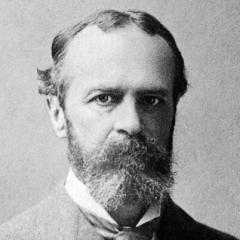
William James simply asserted that his will was free. As his first act of freedom, he said, he chose to believe his will was free. He was encouraged to do this by reading Charles Renouvier. In his diary entry of April 30, 1870, he wrote,
"I think that yesterday was a crisis in my life. I finished the first part of Renouvier's second Essais and see no reason why his definition of free will — 'the sustaining of a thought because I choose to when I might have other thoughts' — need be the definition of an illusion. At any rate, I will assume for the present — until next year — that it is no illusion. My first act of free will shall be to believe in free will."James later coined the terms "hard determinism" and "soft determinism" in his essay on "The Dilemma of Determinism," delivered as an address to Harvard Divinity School students in Divinity Hall, on March 13, 1884 at 7:30pm, and published in the Unitarian Review for September 1884. Old-fashioned determinism was what we may call hard determinism. It did not shrink from such words as fatality, bondage of the will, necessitation, and the like. Nowadays, we have a soft determinism which abhors harsh words, and, repudiating fatality, necessity, and even predetermination, says that its real name is freedom; for freedom is only necessity understood, and bondage to the highest is identical with true freedom.James described chance as neither of these, but "indeterminism." He said, "The stronghold of the determinist argument is the antipathy to the idea of chance. As soon as we begin to talk indeterminism to our friends, we find a number of them shaking their heads. This notion of alternative possibility, they say, this admission that any one of several things may come to pass is, after all, only a roundabout name for chance; and chance is something the notion of which no sane mind can for an instant tolerate in the world. What is it, they ask, but barefaced crazy unreason, the negation of intelligibility and law? And if the slightest particle of it exists anywhere, what is to prevent the whole fabric from falling together, the stars from going out, and chaos from recommencing her topsy-turvy reign?" James was the first thinker to enunciate clearly a two-stage decision process, with chance in a present time of random alternatives, leading to a choice which grants consent to one possibility and transforms an equivocal ambiguous future into an unalterable and simple past. (ibid., p.158) There is a temporal sequence of undetermined alternative possibilities followed by adequately determined choices. "What is meant by saying that my choice of which way to walk home after the lecture is ambiguous and matter of chance?...It means that both Divinity Avenue and Oxford Street are called but only one, and that one either one, shall be chosen."James was considering a case where his two choices were essentially equivalent, the so-called "liberty of indifference" (the scholastic liberum arbitrium indifferentiae). He also imagined his actions repeated in exactly the same circumstances, which is regarded today as one of the great challenges to libertarian free will. Imagine that I first walk through Divinity Avenue, and then imagine that the powers governing the universe annihilate ten minutes of time with all that it contained, and set me back at the door of this hall just as I was before the choice was made. Imagine then that, everything else being the same, I now make a different choice and traverse Oxford Street. You, as passive spectators, look on and see the two alternative universes,--one of them with me walking through Divinity Avenue in it, the other with the same me walking through Oxford Street. Now, if you are determinists you believe one of these universes to have been from eternity impossible: you believe it to have been impossible because of the intrinsic irrationality or accidentality somewhere involved in it. But looking outwardly at these universes, can you say which is the impossible and accidental one, and which the rational and necessary one? I doubt if the most ironclad determinist among you could have the slightest glimmer of light on this point. In other words, either universe after the fact and once there would, to our means of observation and understanding, appear just as rational as the other. (ibid., p.155)
James very likely had the new (1859) model of Darwinian evolution in mind. Unlike his colleague Charles Sanders Peirce, from whom he learned much about chance, James accepted Darwin's explanation of human evolution. Although Peirce is well-known for his enthusiastic acceptance of chance (he called it "Tychism"), he did not care for Darwin's idea that chance drove the variations.
Compare James, who in 1880 suggested a strong similarity between genetic evolution and the evolution of ideas.
A remarkable parallel, which I think has never been noticed, obtains between the facts of social evolution on the one hand, and of zoölogical evolution as expounded by Mr. Darwin on the other. Darwin's achievement was to define the true problem with which we have to deal when we study the effects of the visible environment on the animal. That problem is simply this: Is the environment more likely to preserve or to destroy him, on account of this or that peculiarity with which he may be born?James says that Darwin probably thought that his "accidental variations" were produced in accordance with some grand natural law, so that everything, in some remote and round-about way, hangs together. But James was more willing to see accidents and chance in mental evolution. If we look at an animal or a human being, distinguished from the rest of his kind by the possession of some extraordinary peculiarity, good or bad, we shall be able to discriminate between the causes which originally produced the peculiarity in him and the causes that maintained it after it is produced; and we shall see, if the peculiarity be one that he was born with, that these two sets of causes belong to two such irrelevant cycles. It was the triumphant originality of Darwin to see this, and to act accordingly. Separating the causes of production under the title of 'tendencies to spontaneous variation,' and relegating them to physiological cycles which he forthwith agreed to ignore altogether, he confined his attention to the causes of preservation, and under the names of natural selection and sexual selection studied them exclusively as functions of the cycle of the environment. [In mental evolution], if anywhere, it would seem at first sight as if that school must be right which makes the mind passively plastic, and the environment actively productive of the form and order of its conceptions; which, in a word, thinks that all mental progress must result from a series of adaptive changes, in the sense already defined of that word...It might, accordingly, seem as if there were no room for any agency other than this; as if the distinction we have found so useful between "spontaneous variation," as the producer of changed forms, and the environment, as their preserver and destroyer, did not hold in the case of mental progress; as if, in a word, the parallel with Darwinism might no longer obtain... But, in spite of all these facts, I have no hesitation whatever in holding firm to the Darwinian distinction even here. I maintain that the facts in question are all drawn from the lower strata of the mind, so to speak, - from the sphere of its least evolved functions, from the region of intelligence which man possesses in common with the brutes.Note that James does not literally mean that the environment selects, but only in the Kantian sense that we put our questions to Nature and nature responds. It is one of the tritest truisms that human intelligences of a simple order are very literal. They are slaves of habit, doing what they have been taught without variation; dry, prosaic, and matter-of-fact in their remarks; devoid of humor, except of the coarse physical kind which rejoices in a practical joke; taking the world for granted; and possessing in their faithfulness and honesty the single gift by which they are sometimes able to warm us into admiration.We find that William James was the first of two dozen philosophers and scientists who have proposed a two-stage model for free will and creativity. The first stage involves chance that generates alternative possibilities for action. The second stage is an adequately determined choice by the will. First chance, then choice. First "free," then "will." Compare the Cogito Model. Our thoughts come to us freely. Our actions go from us willfully.
Radical Empiricism, Pure Experience, and Neutral Monism
In a dozen essays published between 1905 and 1907, James put forward his thesis of a radical empiricism that would greatly simplify the idea of consciousness, pulling it back from the dualist metaphysical position that the neo-Kantiams and transcendentalists consigned it to. "Thoughts" and "things" have something important in common, and that is our experience of them. The separation of mind and body, spirit and matter, had produced the "transcendental ego," a bare "consciousness" of which nothing can be said.
I believe that ‘consciousness,’ when once it has evaporated to this estate of pure diaphaneity, is on the point of disappearing altogether. It is the name of a nonentity, and has no right to a place among first principles. Those who still cling to it are clinging to a mere echo, the faint rumor left behind by the disappearing ‘soul’ upon the air of philosophy. During the past year, I have read a number of articles whose authors seemed just on the point of abandoning the notion of consciousness, and substituting for it that of an absolute experience not due to two factors. But they were not quite radical enough, not quite daring enough in their negations. For twenty years past I have mistrusted ‘consciousness’ as an entity; for seven or eight years past I have suggested its non-existence to my students, and tried to give them its pragmatic equivalent in realities of experience. It seems to me that the hour is ripe for it to be openly and universally discarded. To deny plumply that ‘consciousness’ exists seems so absurd on the face of it — for undeniably ‘thoughts’ do exist — that I fear some readers will follow me no farther. Let me then immediately explain that I mean only to deny that the word stands for an entity, but to insist most emphatically that it does stand for a function. There is, I mean, no aboriginal stuff or quality of being, contrasted with that of which material objects are made, out of which our thoughts of them are made; but there is a function in experience which thoughts perform, and for the performance of which this quality of being is invoked. That function is knowing. ‘Consciousness’ is supposed necessary to explain the fact that things not only are, but get reported, are known. Whoever blots out the notion of consciousness from his list of first principles must still provide in some way for that function’s being carried on. My thesis is that if we start with the supposition that there is only one primal stuff or material in the world, a stuff of which everything is composed, and if we call that stuff ‘pure experience,’ the knowing can easily be explained as a particular sort of relation towards one another into which portions of pure experience may enter. The relation itself is a part of pure experience; one if its ‘terms’ becomes the subject or bearer of the knowledge, the knower, the other becomes the object known... It means that not subject, not object, but object-plus-subject is the minimum that can actually be. The subject-object distinction meanwhile is entirely different from that between mind and matter, from that between body and soul. Souls were detachable, had separate destinies; things could happen to them. To consciousness as such nothing can happen, for, timeless itself, it is only a witness of happenings in time, in which it plays no part. It is, in a word, but the logical correlative of ‘content’ in an Experience of which the peculiarity is that fact comes to light in it, that awareness of content takes place... Experience, I believe, ...and the separation of it into consciousness and content comes, not by way of subtraction, but by way of addition — the addition, to a given concrete piece of it, other sets of experiences, in connection with which severally its use or function may be of two different kinds...The dualism connoted by such double-barrelled terms as ‘experience,’ ‘phenomenon,’ ‘datum,’ ‘Vorfindung’ — terms which, in philosophy at any rate, tend more and more to replace the single-barrelled terms of ‘thought’ and ‘thing’ — that dualism, I say, is still preserved in this account, but reinterpreted, so that, instead of being mysterious and elusive, it becomes verifiable and concrete. It is an affair of relations, it falls outside, not inside, the single experience considered, and can always be particularized and defined. The entering wedge for this more concrete way of understanding the dualism was fashioned by Locke when he made the word ‘idea’ stand indifferently for thing and thought, and by Berkeley when he said that what common sense means by realities is exactly what the philosopher means by ideas. Neither Locke nor Berkeley thought his truth out into perfect clearness, but it seems to me that the conception I am defending does little more than consistently carry out the ‘pragmatic’ method which they were the first to use. If the reader will take his own experiences, he will see what I mean. Let him begin with a perceptual experience, the ‘presentation,’ so called, of a physical object, his actual field of vision, the room he sits in, with the book he is reading as its centre; and let him for the present treat this complex object in the common-sense way as being ‘really’ what it seems to be, namely, a collection of physical things cut out from an environing world of other physical things with which these physical things have actual or potential relations. Now at the same time it is just those self-same things which his mind, as we say, perceives; and the whole philosophy of perception from Democritus’s time downwards has just been one long wrangle over the paradox that what is evidently one reality should be in two places at once, both in outer space and in a person’s mind. ‘Representative’ theories of perception avoid the logical paradox, but on the other hand the violate the reader’s sense of life, which knows no intervening mental image but seems to see the room and the book immediately just as they physically exist. The puzzle of how the one identical room can be in two places is at bottom just the puzzle of how one identical point can be on two lines. It can, if it be situated at their intersection; and similarly, if the ‘pure experience’ of the room were a place of intersection of two processes, which connected it with different groups of associates respectively, it could be counted twice over, as belonging to either group, and spoken of loosely as existing in two places, although it would remain all the time a numerically single thing. Well, the experience is a member of diverse processes that can be followed away from it along entirely different lines. The one self-identical thing has so many relations to the rest of experience that you can take it in disparate systems of association, and treat it as belonging with opposite contexts. In one of these contexts it is your ‘field of consciousness’; in another it is ‘the room in which you sit,’ and it enters both contexts in its wholeness, giving no pretext for being said to attach itself to consciousness by one of its parts or aspects, and to out reality by another. What are the two processes, now, into which the room-experience simultaneously enters in this way? One of them is the reader’s personal biography, the other is the history of the house of which the room is part. The presentation, the experience, the that in short (for until we have decided what it is it must be a mere that) is the last term in a train of sensations, emotions, decisions, movements, classifications, expectations, etc., ending in the present, and the first term in a series of ‘inner’ operations extending into the future, on the reader’s part. On the other hand, the very same that is the terminus ad quem of a lot of previous physical operations, carpentering, papering, furnishing, warming, etc., and the terminus a quo of a lot of future ones, in which it will be concerned when undergoing the destiny of a physical room. The physical and the mental operations form curiously incompatible groups. As a room, the experience has occupied that spot and had that environment for thirty years. As your field of consciousness it may never have existed until now. As a room, attention will go on to discover endless new details in it. As your mental state merely, few new ones will emerge under attention’s eye. AS a room, it will taken an earthquake, or a gang of men, and in any case a certain amount of time, to destroy it. As your subjective state, the closing of your eyes, or any instantaneous play of your fancy will suffice. IN the real world, fire will consume it. IN your mind, you can let fire play over it without effect. As an outer object, you must pay so much a month to inhabit it. As an inner content, you may occupy it for any length of time rent-free. If, in short, you follow it in the mental direction, taking it along with events of personal biography solely, all sorts of things are true of it which are false, and false of it which are true if you treat it as a real thing experienced, follow it in the physical direction, and relate it to associates in the outer world.James' notion of "pure experience" provides a philosophical basis for the experience recorder and reproducer (ERR) that is the core of the informational theory of mind and a solution to the "hard" problem of consciousness. The Consciousness of Self
The consciousness of Self involves a stream of thought, each part of which as ' I ' can 1) remember those which went before, and know the things they knew ; and 2) emphasize and care paramountly for certain ones among them as 'me,' and appropriate to these the rest. The nucleus of the 'me' is always the bodily existence felt to be present at the time. Whatever remembered- past-feelings resemble this present feeling are deemed to belong to the same me with it. Whatever other things are perceived to be associated with this feeling are deemed to form part of that me's experience; and of them certain ones (which fluctuate more or less) are reckoned to be themselves constituents of the me in a larger sense, —such are the clothes, the material possessions, the friends, the honors and esteem which the person receives or may receive. This me is an empirical aggregate of things objectively known. The I which knows them cannot itself be an aggregate, neither for psychological purposes need it be considered to be an unchanging metaphysical entity like the Soul, or a principle like the pure Ego, viewed as 'out of time.' It is a Thought, at each moment different from that of the last moment, but appropriative of the latter, together with all that the latter called its own. All the experiential facts find their place in this description,unencumbered with any hypothesis save that of the existence of passing thoughts or states of mind. The same brain may subserve many conscious selves, either alternate or coexisting; but by what modifications in its action, or whether ultra-cerebral conditions may intervene, are questions which cannot now be answered If anyone urge that I assign no reason why the successive passing thoughts should inherit each other's possessions, or why they and the brain-states should be functions (in the mathematical sense) of each other, I reply that the reason, if there be any, must lie where all real reasons lie, in the total sense or meaning of the world. If there be such a meaning, or any approach to it (as we are bound to trust there is), it alone can make clear to us why such finite human streams of thought are called into existence in such functional dependence upon brains. This is as much as to say that the special natural science of psychology must stop with the mere functional formula. If the passing thought be the directly verifiable existent which no school has hitherto doubted it to be, then that thought is itself the thinker, and psychology need not look beyond. The only pathway that I can discover for bringing in a more transcendental thinker would be to deny that we have any direct knowledge of the thought as such. The latter's existence would then be reduced to a postulate, an assertion that there must be a knower correlative to all this known; and the problem who that knower is would have become a metaphysical problem. "With the question once stated in these terms, the spiritualist and transcendentalist solutions must be considered as prima facie on a par with our own psychological one, and discussed impartially. But that carries us beyond the psychological or naturalistic point of view.
James' "Pontifical Cell" - site of "The Soul?"
The cell is no more a unit, materially considered, than the total brain is a unit. It is a compound of molecules, just as the brain is a compound of cells and fibres. And the molecules, according to the prevalent physical theories, are in turn compounds of atoms. The theory in question, therefore, if radically carried out, must set up for its elementary and irreducible psycho-physic couple, not the cell and its consciousness, but the primordial and eternal atom and its consciousness. We are back at Leibnitzian monadism, and therewith leave physiology behind us and dive into regions inaccessible to experience and verification; and our doctrine, although not self-contradictory, becomes so remote and unreal as to be almost as bad as if it were. Speculative minds alone will take an interest in it; and metaphysics, not psychology, will be responsible for its career. That the career may be a successful one must be admitted as a possibility - a theory which Leibnitz, Herbart, and Lotze have taken under their protection must have some sort of a destiny. The Soul - Theory. But is this my last word? By no means. Many readers have certainly been saying to themselves for the last few pages: "Why on earth doesn't the poor man say the Soul and have done with it?" Other readers, of antispiritualistic training and prepossessions, advanced thinkers, or popular evolutionists, will perhaps be a little surprised to find this much-despised word now sprung upon them at the end of so physiological a train of thought. But the plain fact is that all the arguments for a 'pontifical cell' or an 'arch-monad' are also arguments for that well-known spiritual agent in which scholastic psychology and common-sense have always believed. And my only reason for beating the bushes so, and not bringing it in earlier as a possible solution of our difficulties, has been that by this procedure I might perhaps force some of these materialistic minds to feel the more strongly the logical respectability of the spiritualistic position. Are We Automata? (Mind, vol.4, 1 3(January, 1879) pp.1-22 ) Bain and Renouvier (The Nation, vol.22 (June 8, 1876) pp.367-69) The Dilemma of Determinism Does "Consciousness" Exist? Essays In Radical Empiricism Great Men, Great Thoughts, and the Environment Relations of Belief and Will (Principles of Psychology, vol.2, XXI, p.320) The Mind and its 'Ideas' (Principles of Psychology, vol.2, XXVI, pp.559-69) The Question of 'Free Will' (Principles of Psychology, vol.2, XXVI, pp.569-79) What Is An Emotion? (Mind, 9, 188-205. 1884) What Is An Instinct? (Scribner's Magazine, vol.1, 3(March, 1887) pp.355-66) For Teachers
For Scholars
|


