Agent-Causality
Agent-Causality is the idea that agents can start new causal chains that are not
pre-determined by the events of the immediate or distant past and the physical laws of nature.
The first agent-causal libertarian was
Aristotle, followed by
Epicurus, and then
Carneades.
In more recent times, prominent agent-causalists have been
Thomas Reid in the 18th century, followed by
Roderick Chisholm,
Richard Taylor,
Keith Lehrer,
Timothy O'Connor, and
Randolph Clarke in the 20th century.
Aristotle was in many ways the architect of "event"
causality as well as agent-causality.
First he described a causal chain back to a prime mover or first cause, and he elaborated the four possible causes (material, efficient, formal, and final). Aristotle's word for these causes was ἀιτία, which translates as causes in the sense of the multiple factors responsible for an event. Aristotle did not subscribe to the simplistic "every event has a (single) cause" idea that was to come later.
Then, in his Physics and Metaphysics, Aristotle also said there were "accidents"
caused by "
chance (τύχη)." In his Physics, he clearly reckoned chance among the causes. Aristotle might have added chance as a fifth cause - an uncaused or self-caused cause - one he thought happens when two causal chains come together by accident (συμβεβεκός). He noted that the early physicists had found no place for chance among their causes.
Aristotle opposed his accidental chance to necessity:
Nor is there any definite cause for an accident, but only chance (τυχόν), namely an indefinite (ἀόριστον) cause.
(Metaphysics, Book V, 1025a25)
It is obvious that there are principles and causes which are generable and destructible apart from the actual processes of generation and destruction; for if this is not true, everything will be of necessity: that is, if there must necessarily be some cause, other than accidental, of that which is generated and destroyed. Will this be, or not? Yes, if this happens; otherwise not.
(Metaphysics, Book VI, 1027a29)
Tracing any particular sequence of events back in time will usually come to an accidental event - a "starting point" or "fresh start" (Aristotle calls it an origin or
arche (ἀρχῆ) - whose major contributing cause (or causes) was itself uncaused. In modern terms, it involves quantum indeterminacy.
Whether a particular thing happens, says Aristotle, may depend on a series of causes that
goes back to some starting-point, which does not go back to something else. This, therefore, will be the starting-point of the fortuitous, and nothing else is the cause of its generation.
(Metaphysics Book VI 1027b12-14)
In general,
many such causal sequences contribute to any event, including human decisions. Each sequence has a different time of origin, some going back before we were born, some originating during our deliberations.
Beyond causal sequences that are the result of chance or necessity, Aristotle felt that some breaks in the causal chain allow us to feel our actions "
depend on us" (ἐφ' ἡμῖν). These are the causal chains that originate
within us (ἐv ἡμῖν).
Greek philosophy had no precise term for "
free will" as did Latin (
liberum arbitrium or
libera voluntas). The discussion was in terms of
responsibility for actions that are caused by an agent, what Aristotle says "
depends on us."
Aristotle's ἐφ' ἡμῖν is thus a third thing (a
tertium quid), beyond
necessity and
chance, that causes things to happen. This is agent causation.
One generation after Aristotle,
Epicurus argued that as atoms moved through the void, there were occasions when they would "swerve" from their otherwise determined paths, thus initiating new causal chains. Epicurus argued that these swerves would allow us to be more
responsible for our actions, something impossible if every action was deterministically caused. For Epicurus, the occasional interventions of arbitrary gods would be preferable to strict determinism.
Epicurus did not say the swerve was directly involved in decisions. His critics, ancient and modern, have claimed mistakenly that Epicurus did assume "one swerve - one decision" and that "free " actions are uncaused.
But following Aristotle, Epicurus thought human agents have the autonomous ability to transcend necessity and chance (both of which destroy responsibility), so that praise and blame are appropriate. This is a form of agent-causality. It answers the flawed
standard argument against free will..
Three causes -
Necessity
Chance
Autonomous Agents
...some things happen of necessity, others by chance, others through our own agency. ...necessity destroys responsibility and chance is uncertain; whereas our own actions are autonomous, and it is to them that praise and blame naturally attach.
(Letter to Menoeceus, §133)
The Stoics and later the Christian church censored much of Epicurean thought and destroyed Epicurus' reputation as a "hedonist" and an atheistic believer in "chance." They led to the modern impression that Epicurus thought his chance "swerve" was his basis for free will. Philosophers today are astonishingly ignorant of Epicurus' actual position on agent autonomy. Can we correct this?
Alexander of Aphrodisias (c.150-210), the most famous commentator on Aristotle, writing 500 years after Aristotle's death, defended a view of moral responsibility we would call
libertarianism today, with a strong sense of agent-causality.
Alexander believed that Aristotle was not a strict determinist like the Stoics, and Alexander himself argued that some events do not have pre-determined causes. In particular, man is responsible for self-caused decisions, and can choose to do or not to do something.
For Alexander, as for Aristotle, a random event "for no reason" provides a fresh start or new beginning (ἀρχή) of a causal chain (ἄλυσις) that can not be traced back indefinitely. This effectively puts an end to the Stoic ideas of foreknowledge and
pre-determination.
In particular, he held that man is responsible for self-caused decisions, and can choose to do or not to do something. This appears to be not very different from the Stoic
Chrysippus' idea that one can assent or dissent to an action. Chrysippus said actions are
pre-determined (fated) but not
necessitated.
Alexander denied three things - necessity (ἀνάγκη), the
foreknowledge of fated events that was part of the Stoic identification of God and Nature, and
determinism in the sense of a sequence of causes that was laid down beforehand (προκαταβεβλημένος) or
predetermined by antecedents (προηγουμένος).
Alexander, following Aristotle and Epicurus, saw three main things causing events. They are necessity, chance, and agent-causality - what is "
up to us"
Most of the ancient thinkers recognized the obvious difficulty with
chance (or an
uncaused cause) as a source of human freedom. Even Aristotle described chance as a "cause obscure to human reason" (ἀιτιάν ἄδελον ἀνθρωπίνᾠ λογισμῶ).
Actions caused by chance are simply random and we cannot feel
responsible for them. But
we do feel responsible for our actions.
Despite more than twenty-three centuries of philosophizing, most modern thinkers have not moved significantly beyond this core problem of randomness and free will for libertarians - the confused idea that
free actions are caused directly by a random event.
Caught between the horns of a dilemma, with determinism on one side and randomness on the other, the standard argument against free will continues to render agent-causality and human freedom unintelligible (ἄδελον).
The
two-stage model of free will clarifies the argument between libertarians who call themselves "event causalists" (e.g.,
Robert Kane) and those who are "agent causalists" (e.g.,
E. Jonathan Lowe and
Timothy O'Connor).
Lowe says the ultimate cause of an action must not be some "event" that merely happened. We can agree that physical events do not normally have a purpose. The chance events in the first stage that lead to the
alternative possibilities for action are
not themselves the "cause" of the agent's decision in the second stage. It is the
immaterial mind of the agent that is the
responsible cause.
Kane famously said that libertarian free will appeared to require "uncaused causes, immaterial minds, noumenal selves, non-event agent causes, prime movers unmoved, or other examples of what
P. F. Strawson called the 'panicky metaphysics' of libertarianism in his influential 1962 essay 'Freedom and Resentment'".
Now that information philosophy has established that some events are indeed "
uncaused," that the
mind is in fact
immaterial, and that Kant's noumenal world is the world of pure information, we can also welcome non-event agent causes. Human beings are prime movers in the sense of authors of their lives and co-creators of the new information in the universe!
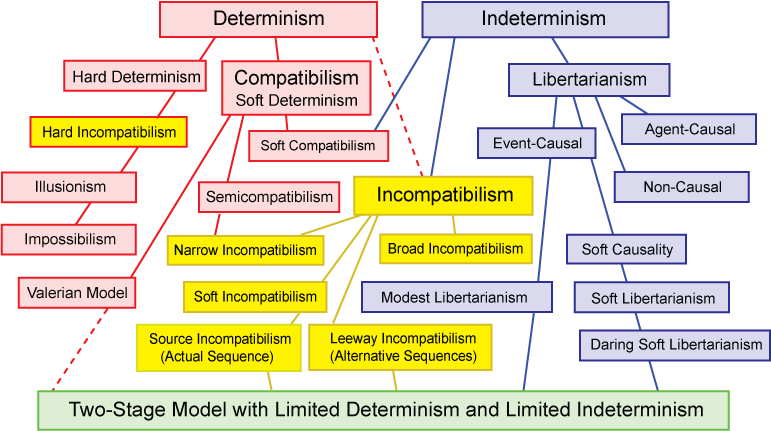
We can situate agent-causality in a
taxonomy of free-will positions and especially in the context of libertarian positions, all of which admit some indeterminism. The author of "non-causality" is
Carl Ginet, who was O'Connors' thesis adviser. Ginet maintains that no cause is needed for human decisions. As Bob Kane says, the
agent's decision is the cause of the action.
Non-causality is a form of agent-causality. It denies any
pre-determining causes.


 |
|