Pierre-Simon, Marquis de Laplace
(1749-1827)
Pierre Simon Laplace is a giant in mathematics, physics, and astronomy. Although much of his work had been done earlier by others (he rarely gives them any credit), his original contributions are a large part of his books on mathematics, probability, and celestial mechanics.
His
Mécanique Céleste reworks Newton's
Principia using the differential calculus. It contains the famous nebular hypothesis of the origin of the solar system, first suggested by Emanuel Swedenborg and
Immanuel Kant.
Laplace's several works on probability (
Théorie des probabilités ,
Théorie analytique des probabilités , and
Essai philosophique sur les probabilités) establish many of the techniques and results of statistics, including the
method of least squares for assessing observational data, but more importantly they defend the idea of
a priori probability that can be used to reason about future events.
In the introduction to the
Essai, he extended an idea of
Gottfried Leibniz which became famous as
Laplace's Demon, a key vision of strict physical
determinism. He said
"We may regard the present state of the universe as the effect of its past and the cause of its future. An intellect which at a certain moment would know all forces that set nature in motion, and all positions of all items of which nature is composed, if this intellect were also vast enough to submit these data to analysis, it would embrace in a single formula the movements of the greatest bodies of the universe and those of the tiniest atom; for such an intellect nothing would be uncertain and the future just like the past would be present before its eyes."
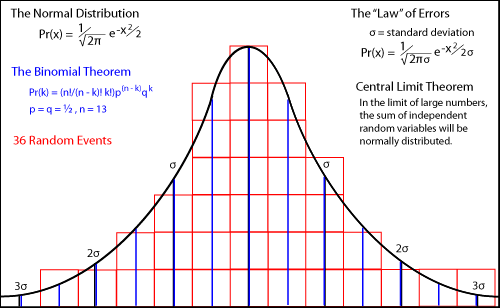
Laplace worked out the mathematics for the binomial distribution. If
p is the probability of a success and
q = 1 -
p the probability of failure, then the probability of
k successes is
Pr(k) = (n!/(n - k)! k!)p(n - k)qk
Abraham de Moivre had derived this result in his
The Doctrine of Chances (1738). It is sometimes called the
de Moivre-Laplace Theorem.
Laplace emphasized his view that real
chance did not exist by calling his work the "calculus of probabilities." With its connotation of approbation, probability was a more respectable term than chance, with its associations of gambling and lawlessness. For Laplace, the random outcomes were not predictable only because we lack the detailed information to predict. As did the ancient Stoics, Laplace explained the appearance of chance as the result of human ignorance. He said as early as 1783 and later popularized in the
Essais of 1814,
"The word 'chance,' then expresses only our ignorance of the causes of the phenomena that we observe to occur and to succeed one another in no apparent order."
The implication is that all
chance events are driven by underlying
laws that insure the observed statistics of the "normal distribution."
Pr(x) = (1/√(2π)) e-x2/2
This mathematical form seemed to explain the many new studies of social statistics in the nineteenth century. Most philosophers and scientists held the view that chance was simply the result of human ignorance as to the causes. That chance events must be determined by unknown causes was (mistakenly) justified by the lawful nature of their distribution.
This mistaken idea appears again in the late 18th century (
Kant himself thought it proved phenomenal determinism) and the early 19th century (in the work of
Joseph Fourier,
Adolph Quételet, and
Thomas Henry Buckle).
References
A Philosophical Essay on Probabilities
Lijia Yu's Bean Machine and the Central Limit Theorem
For Teachers
To hide this material, click on the Normal link.
For Scholars
To hide this material, click on the Teacher or Normal link.

 |
|