Citation for this page in APA citation style.           Close


Core Concepts

Adequate Determinism
Agent-Causality
Alternative Possibilities
Causa Sui
Causality
Certainty
Chance
Chance Not Direct Cause
The Cogito Model
Compatibilism
Comprehensive   Compatibilism
Conceptual Analysis
Control
Could Do Otherwise
Creativity
Default Responsibility
De-liberation
Determination
Determination Fallacy
Determinism
Disambiguation
Either Way
Ethical Fallacy
Experimental Philosophy
Extreme Libertarianism
Event Has Many Causes
Frankfurt Cases
Free Choice
Freedom of Action
"Free Will"
Free Will Axiom
Free Will in Antiquity
Free Will Mechanisms
Free Will Requirements
Free Will Theorem
Future Contingency
Hard Incompatibilism
Illusion of Determinism
Illusionism
Impossibilism
Incompatibilism
Indeterminacy
Indeterminism
Infinities
Laplace's Demon
Libertarianism
Liberty of Indifference
Libet Experiments
Luck
Master Argument
Modest Libertarianism
Moral Necessity
Moral Responsibility
Moral Sentiments
Mysteries
Naturalism
Necessity
Noise
Non-Causality
Nonlocality
Origination
Paradigm Case
Pre-determinism
Predictability
Probability
Pseudo-Problem
Random When?/Where?
Rational Fallacy
Responsibility
Same Circumstances
Scandal
Science Advance Fallacy
Second Thoughts
Semicompatibilism
Separability
Soft Causality
Special Relativity
Standard Argument
Taxonomy
Temporal Sequence
Tertium Quid
Torn Decision
Two-Stage Models
Ultimate Responsibility
Uncertainty
Up To Us
Voluntarism

Philosophers

Mortimer Adler
Rogers Albritton
Alexander of Aphrodisias
G.E.M.Anscombe
Anselm
Thomas Aquinas
Aristotle
David Armstrong
Augustine
J.L.Austin
A.J.Ayer
Alexander Bain
Mark Balaguer
William Belsham
Henri Bergson
Isaiah Berlin
Bernard Berofsky
Susanne Bobzien
George Boole
Émile Boutroux
F.H.Bradley
C.D.Broad
C.A.Campbell
Joseph Keim Campbell
Carneades
Ernst Cassirer
Roderick Chisholm
Chrysippus
Cicero
Randolph Clarke
Samuel Clarke
Anthony Collins
Diodorus Cronus
Donald Davidson
Democritus
Daniel Dennett
René Descartes
Richard Double
Emil du Bois-Reymond
Fred Dretske
John Earman
Laura Waddell Ekstrom
Epictetus
Epicurus
Herbert Feigl
John Martin Fischer
Owen Flanagan
Luciano Floridi
Philippa Foot
Alfred Fouillée
Harry Frankfurt
Richard L. Franklin
Michael Frede
Carl Ginet
H.Paul Grice
Nicholas St. John Green
Ian Hacking
Ishtiyaque Haji
Stuart Hampshire
W.F.R.Hardie
R.M.Hare
Georg W.F. Hegel
Martin Heidegger
R.E.Hobart
Thomas Hobbes
David Hodgson
Shadsworth Hodgson
Ted Honderich
Pamela Huby
David Hume
Ferenc Huoranszki
William James
Lord Kames
Robert Kane
Immanuel Kant
Tomis Kapitan
William King
Christine Korsgaard
Keith Lehrer
Gottfried Leibniz
Leucippus
Michael Levin
C.I.Lewis
David Lewis
Peter Lipton
John Locke
Michael Lockwood
John R. Lucas
Lucretius
James Martineau
Hugh McCann
Colin McGinn
Michael McKenna
Paul E. Meehl
Alfred Mele
John Stuart Mill
Dickinson Miller
G.E.Moore
Thomas Nagel
Friedrich Nietzsche
P.H.Nowell-Smith
Robert Nozick
William of Ockham
Timothy O'Connor
David F. Pears
Charles Sanders Peirce
Derk Pereboom
Steven Pinker
Karl Popper
H.A.Prichard
Hilary Putnam
Willard van Orman Quine
Frank Ramsey
Ayn Rand
Thomas Reid
Charles Renouvier
Nicholas Rescher
C.W.Rietdijk
Josiah Royce
Bertrand Russell
Paul Russell
Gilbert Ryle
T.M.Scanlon
Moritz Schlick
Arthur Schopenhauer
John Searle
Wilfrid Sellars
Henry Sidgwick
Walter Sinnott-Armstrong
J.J.C.Smart
Saul Smilansky
Michael Smith
L. Susan Stebbing
George F. Stout
Galen Strawson
Peter Strawson
Eleonore Stump
Richard Taylor
Kevin Timpe
Peter van Inwagen
Manuel Vargas
John Venn
Kadri Vihvelin
Voltaire
G.H. von Wright
David Foster Wallace
R. Jay Wallace
W.G.Ward
Ted Warfield
Roy Weatherford
Alfred North Whitehead
David Widerker
David Wiggins
Bernard Williams
Ludwig Wittgenstein
Susan Wolf

Scientists

Michael Arbib
Bernard Baars
John S. Bell
Charles Bennett
Margaret Boden
David Bohm
Neils Bohr
Ludwig Boltzmann
Emile Borel
Max Born
Stephen Brush
Leon Brillouin
Thomas Buckle
Donald Campbell
Anthony Cashmore
Eric Chaisson
Jean-Pierre Changeux
Arthur Holly Compton
John Conway
E. H. Culverwell
Charles Darwin
Abraham de Moivre
Paul Dirac
John Eccles
Arthur Stanley Eddington
Albert Einstein
Paul Ehrenfest
Richard Feynman
Michael Gazzaniga
GianCarlo Ghirardi
Nicolas Gisin
Thomas Gold
A.O.Gomes
Joshua Greene
Jacques Hadamard
Patrick Haggard
Augustin Hamon
Sam Harris
Martin Heisenberg
Werner Heisenberg
William Stanley Jevons
Pascual Jordan
Simon Kochen
Stephen Kosslyn
Rolf Landauer
Alfred Landé
Pierre-Simon Laplace
David Layzer
Benjamin Libet
Josef Loschmidt
Ernst Mach
Henry Margenau
James Clerk Maxwell
Ernst Mayr
Jacques Monod
Roger Penrose
Steven Pinker
Max Planck
Henri Poincaré
Adolphe Quételet
Jerome Rothstein
Erwin Schrödinger
Claude Shannon
Dean Keith Simonton
Herbert Simon
B. F. Skinner
Henry Stapp
Antoine Suarez
Leo Szilard
William Thomson (Kelvin)
John von Neumann
Daniel Wegner
Steven Weinberg
Norbert Wiener
Eugene Wigner
E. O. Wilson
Ernst Zermelo

 
The Free Will Scandal
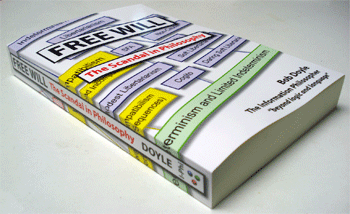
The Freedom section is now a book.
Free Will:
The Scandal in Philosophy

Click here for info

Click for information about <i>Free Will: The Scandal in Philosophy</i>

John Searle says it is a scandal that philosophers have not made more progress on the problem of free will.
The persistence of the free will problem in philosophy seems to me something of a scandal. After all these centuries of writing about free will, it does not seem to me that we have made very much progress.
(Freedom and Neurobiology, p.37)

Two centuries ago, Immanuel Kant called it a scandal that academic philosophers were so out of touch with the common sense of the masses when they doubted the existence of the external world. David Hume had criticized the Theory of Ideas of his fellow British empiricists John Locke and George Berkeley. If they are right that knowledge is limited to perceptions of sense data, we cannot "know" anything about external objects, even our own bodies. Kant's main change in the second edition of the Critique of Pure Reason was an attempted refutation of this idealism (B 273). He thought he had a proof of the existence of the external world. Kant thought it a scandal in philosophy that we must accept the existence of things outside ourselves merely as a belief, with no proof. He said that "speculative metaphysics must be investigated

to prevent the scandal which metaphysical controversies are sure, sooner or later, to cause even to the masses.

However innocent idealism may be considered with respect to the essential purposes of metaphysics (without being so in reality), it remains a scandal to philosophy, and to human reason in general, that we should have to accept the existence of things outside us (from which after all we derive the whole material for our knowledge, even for that of our inner sense) merely on trust, and have no satisfactory proof with which to counter any opponent who chooses to doubt it. (Preface to Second Edition, Critique of Pure Reason)

Martin Heidegger commented on Kant's scandal:

The "scandal of philosophy" is not that this proof has yet to be given, but that such proofs are expected and attempted again and again.
(Being and Time, Macquarrie and Robinson, translators, pp. 249)

The free will scandal is related to the knowledge scandal because so many philosophers and scientists have thought that they could prove that free will does not exist, that it is an illusion.

Ths most common proof is based on the two-part standard argument against free will.

If our actions are determined, they are not free.

If our actions are directly caused by chance, they are simply random and we cannot be responsible for them.

Despite more than twenty-three centuries of philosophizing, most modern thinkers have not moved significantly beyond this core problem of randomness and free will - the mistaken idea that free actions are caused directly by a random event.

To be responsible for our actions, they must have been caused by something within us, they must "depend on us" (the Greeks called this ἐφ ἡμῖν). Modern "agent-causal" theorists demand that something in the agent's mind - perhaps a uniquely mental substance - gives us the power to cause our actions.
In two-stage models of free will, responsibility comes from an adequately determined will choosing from among randomly generated alternative possibilities.
We have identified the critical requirements for a practical and plausible model of free will.
For Teachers
For Scholars

Chapter 3.7 - The Ergod Chapter 4.2 - The History of Free Will
Part Three - Value Part Five - Problems
Normal | Teacher | Scholar