
Follow infophilosopher:
 |
|

|
|
|
Philosophers
Mortimer Adler Rogers Albritton Alexander of Aphrodisias Samuel Alexander William Alston Anaximander G.E.M.Anscombe Anselm Louise Antony Thomas Aquinas Aristotle David Armstrong Harald Atmanspacher Robert Audi Augustine J.L.Austin A.J.Ayer Alexander Bain Mark Balaguer Jeffrey Barrett William Barrett William Belsham Henri Bergson George Berkeley Isaiah Berlin Richard J. Bernstein Bernard Berofsky Robert Bishop Max Black Susanne Bobzien Emil du Bois-Reymond Hilary Bok Laurence BonJour George Boole Émile Boutroux Daniel Boyd F.H.Bradley C.D.Broad Michael Burke Jeremy Butterfield Lawrence Cahoone C.A.Campbell Joseph Keim Campbell Rudolf Carnap Carneades Nancy Cartwright Gregg Caruso Ernst Cassirer David Chalmers Roderick Chisholm Chrysippus Cicero Tom Clark Randolph Clarke Samuel Clarke Anthony Collins Antonella Corradini Diodorus Cronus Jonathan Dancy Donald Davidson Mario De Caro Democritus Daniel Dennett Jacques Derrida René Descartes Richard Double Fred Dretske John Earman Laura Waddell Ekstrom Epictetus Epicurus Austin Farrer Herbert Feigl Arthur Fine John Martin Fischer Frederic Fitch Owen Flanagan Luciano Floridi Philippa Foot Alfred Fouilleé Harry Frankfurt Richard L. Franklin Bas van Fraassen Michael Frede Gottlob Frege Peter Geach Edmund Gettier Carl Ginet Alvin Goldman Gorgias Nicholas St. John Green H.Paul Grice Ian Hacking Ishtiyaque Haji Stuart Hampshire W.F.R.Hardie Sam Harris William Hasker R.M.Hare Georg W.F. Hegel Martin Heidegger Heraclitus R.E.Hobart Thomas Hobbes David Hodgson Shadsworth Hodgson Baron d'Holbach Ted Honderich Pamela Huby David Hume Ferenc Huoranszki Frank Jackson William James Lord Kames Robert Kane Immanuel Kant Tomis Kapitan Walter Kaufmann Jaegwon Kim William King Hilary Kornblith Christine Korsgaard Saul Kripke Thomas Kuhn Andrea Lavazza James Ladyman Christoph Lehner Keith Lehrer Gottfried Leibniz Jules Lequyer Leucippus Michael Levin Joseph Levine George Henry Lewes C.I.Lewis David Lewis Peter Lipton C. Lloyd Morgan John Locke Michael Lockwood Arthur O. Lovejoy E. Jonathan Lowe John R. Lucas Lucretius Alasdair MacIntyre Ruth Barcan Marcus Tim Maudlin James Martineau Nicholas Maxwell Storrs McCall Hugh McCann Colin McGinn Michael McKenna Brian McLaughlin John McTaggart Paul E. Meehl Uwe Meixner Alfred Mele Trenton Merricks John Stuart Mill Dickinson Miller G.E.Moore Ernest Nagel Thomas Nagel Otto Neurath Friedrich Nietzsche John Norton P.H.Nowell-Smith Robert Nozick William of Ockham Timothy O'Connor Parmenides David F. Pears Charles Sanders Peirce Derk Pereboom Steven Pinker U.T.Place Plato Karl Popper Porphyry Huw Price H.A.Prichard Protagoras Hilary Putnam Willard van Orman Quine Frank Ramsey Ayn Rand Michael Rea Thomas Reid Charles Renouvier Nicholas Rescher C.W.Rietdijk Richard Rorty Josiah Royce Bertrand Russell Paul Russell Gilbert Ryle Jean-Paul Sartre Kenneth Sayre T.M.Scanlon Moritz Schlick John Duns Scotus Arthur Schopenhauer John Searle Wilfrid Sellars David Shiang Alan Sidelle Ted Sider Henry Sidgwick Walter Sinnott-Armstrong Peter Slezak J.J.C.Smart Saul Smilansky Michael Smith Baruch Spinoza L. Susan Stebbing Isabelle Stengers George F. Stout Galen Strawson Peter Strawson Eleonore Stump Francisco Suárez Richard Taylor Kevin Timpe Mark Twain Peter Unger Peter van Inwagen Manuel Vargas John Venn Kadri Vihvelin Voltaire G.H. von Wright David Foster Wallace R. Jay Wallace W.G.Ward Ted Warfield Roy Weatherford C.F. von Weizsäcker William Whewell Alfred North Whitehead David Widerker David Wiggins Bernard Williams Timothy Williamson Ludwig Wittgenstein Susan Wolf Xenophon Scientists David Albert Michael Arbib Walter Baade Bernard Baars Jeffrey Bada Leslie Ballentine Marcello Barbieri Gregory Bateson Horace Barlow John S. Bell Mara Beller Charles Bennett Ludwig von Bertalanffy Susan Blackmore Margaret Boden David Bohm Niels Bohr Ludwig Boltzmann Emile Borel Max Born Satyendra Nath Bose Walther Bothe Jean Bricmont Hans Briegel Leon Brillouin Stephen Brush Henry Thomas Buckle S. H. Burbury Melvin Calvin Donald Campbell Sadi Carnot Anthony Cashmore Eric Chaisson Gregory Chaitin Jean-Pierre Changeux Rudolf Clausius Arthur Holly Compton John Conway Simon Conway-Morris Jerry Coyne John Cramer Francis Crick E. P. Culverwell Antonio Damasio Olivier Darrigol Charles Darwin Richard Dawkins Terrence Deacon Lüder Deecke Richard Dedekind Louis de Broglie Stanislas Dehaene Max Delbrück Abraham de Moivre Bernard d'Espagnat Paul Dirac Hans Driesch John Dupré John Eccles Arthur Stanley Eddington Gerald Edelman Paul Ehrenfest Manfred Eigen Albert Einstein George F. R. Ellis Hugh Everett, III Franz Exner Richard Feynman R. A. Fisher David Foster Joseph Fourier Philipp Frank Steven Frautschi Edward Fredkin Augustin-Jean Fresnel Benjamin Gal-Or Howard Gardner Lila Gatlin Michael Gazzaniga Nicholas Georgescu-Roegen GianCarlo Ghirardi J. Willard Gibbs James J. Gibson Nicolas Gisin Paul Glimcher Thomas Gold A. O. Gomes Brian Goodwin Joshua Greene Dirk ter Haar Jacques Hadamard Mark Hadley Patrick Haggard J. B. S. Haldane Stuart Hameroff Augustin Hamon Sam Harris Ralph Hartley Hyman Hartman Jeff Hawkins John-Dylan Haynes Donald Hebb Martin Heisenberg Werner Heisenberg Grete Hermann John Herschel Basil Hiley Art Hobson Jesper Hoffmeyer Don Howard John H. Jackson William Stanley Jevons Roman Jakobson E. T. Jaynes Pascual Jordan Eric Kandel Ruth E. Kastner Stuart Kauffman Martin J. Klein William R. Klemm Christof Koch Simon Kochen Hans Kornhuber Stephen Kosslyn Daniel Koshland Ladislav Kovàč Leopold Kronecker Rolf Landauer Alfred Landé Pierre-Simon Laplace Karl Lashley David Layzer Joseph LeDoux Gerald Lettvin Gilbert Lewis Benjamin Libet David Lindley Seth Lloyd Werner Loewenstein Hendrik Lorentz Josef Loschmidt Alfred Lotka Ernst Mach Donald MacKay Henry Margenau Owen Maroney David Marr Humberto Maturana James Clerk Maxwell Ernst Mayr John McCarthy Warren McCulloch N. David Mermin George Miller Stanley Miller Ulrich Mohrhoff Jacques Monod Vernon Mountcastle Emmy Noether Donald Norman Travis Norsen Alexander Oparin Abraham Pais Howard Pattee Wolfgang Pauli Massimo Pauri Wilder Penfield Roger Penrose Steven Pinker Colin Pittendrigh Walter Pitts Max Planck Susan Pockett Henri Poincaré Daniel Pollen Ilya Prigogine Hans Primas Zenon Pylyshyn Henry Quastler Adolphe Quételet Pasco Rakic Nicolas Rashevsky Lord Rayleigh Frederick Reif Jürgen Renn Giacomo Rizzolati A.A. Roback Emil Roduner Juan Roederer Jerome Rothstein David Ruelle David Rumelhart Robert Sapolsky Tilman Sauer Ferdinand de Saussure Jürgen Schmidhuber Erwin Schrödinger Aaron Schurger Sebastian Seung Thomas Sebeok Franco Selleri Claude Shannon Charles Sherrington Abner Shimony Herbert Simon Dean Keith Simonton Edmund Sinnott B. F. Skinner Lee Smolin Ray Solomonoff Roger Sperry John Stachel Henry Stapp Tom Stonier Antoine Suarez Leo Szilard Max Tegmark Teilhard de Chardin Libb Thims William Thomson (Kelvin) Richard Tolman Giulio Tononi Peter Tse Alan Turing C. S. Unnikrishnan Nico van Kampen Francisco Varela Vlatko Vedral Vladimir Vernadsky Mikhail Volkenstein Heinz von Foerster Richard von Mises John von Neumann Jakob von Uexküll C. H. Waddington James D. Watson John B. Watson Daniel Wegner Steven Weinberg Paul A. Weiss Herman Weyl John Wheeler Jeffrey Wicken Wilhelm Wien Norbert Wiener Eugene Wigner E. O. Wilson Günther Witzany Stephen Wolfram H. Dieter Zeh Semir Zeki Ernst Zermelo Wojciech Zurek Konrad Zuse Fritz Zwicky Presentations Biosemiotics Free Will Mental Causation James Symposium |
Cosmic Creation Process
What is Being Created?
Information philosophy answers the most fundamental question in ontology - what exists and how did it come into existence? We don't answer Gottfried Leibniz's deep question of how matter came into existence from nothing at all, but we have a suggestion about that.
From the beginning of time the most general possible description of what is created is new information. in particular it is abstract and immaterial information that is embodied in material "information structures." The information is the arrangement of the smaller material components that make up the structure.
Neither new matter nor new energy is being created - actually the total of matter and energy is a constant. Matter is simply being rearranged, producing order out of chaos. From the formation of atoms to the planets, stars, and galaxies, the forces creating all information structures do not themselves involve information. Formation is passive, under the control of the four fundamental forces, electromagnetism, the weak and strong nuclear interactions, and gravitation. Quantum cooperative phenomena indirectly influence these forces, setting limits on the allowed positions of the elementary particles. And the indeterminism of quantum physics introduces the ontological chance behind the emergence of novelty in the universe. Our story of the evolution of information starts with quarks and gluons, plus electrons and photons, forming new elementary particles like protons and neutrons, in the first few minutes of cosmic evolution. Around 380,000 years later, the temperature fell enough for protons and electrons to form stable hydrogen atoms and the universe became transparent to the ionizing radiation that had been keeping them mostly separated. After this time high temperature radiation from the original plasma gas "fireball" (now cooled to 5000K) could traverse the universe to show up on Earth as the cosmic microwave background radiation, now redshifted and cooled to a mere 2.7K. This is called the era of "recombination," though strictly it was the first stable and lasting "combination" of those new elementary particles and the beginnings of their later combinations into atoms and later molecules. Between then and a few hundred million years after the "big bang," the sky darkened from intensely bright 5000K in all directions to a deep black, even darker than today's night sky. With the radiation pressure greatly reduced (radiation energy was converted into the binding energy of the atoms) density fluctuations in the hydrogen gas began condensing into clouds. The relatively weak, but very long-range, force of gravity overcame the reduced radiation pressure, and gas clouds collapsed, leading to proto-galaxies, some of which formed "little bangs" that collapsed all the way to black holes. This was the beginning of galactic evolution. Some of the hydrogen clouds paused when their centers heated up to temperatures high enough for thermonuclear fusion to start, with internal radiation pressure now increasing again and balancing the force of gravity to form stars, some with very long lifetimes - billions of years. This is the beginning of stellar evolution, in which the stars convert primordial hydrogen to helium in their interiors. Some stars also create some of the lighter elements - lithium, beryllium, boron, carbon, nitrogen and oxygen, for example. This was the beginning of nucleosynthesis, which ultimately creates all the chemical elements in our periodic table, mostly in the center of giant stars that collapse gravitationally as supernovae, scattering these new heavy elements into space to form a second stellar population. The centers of these supernovae reach temperatures and pressures that create the heaviest elements. The new elements spread into interstellar space wind up in dust clouds that condensed again to form "second-generation" stars like our Sun as well as the cooler planets like our Earth. The deep black sky of this hundred-million-year "dark age" of cosmic evolution was then punctuated with the bright spots of new-born stars, many so bright and hot that they created spheres of ionized gas (and some dust) around them, the so-called nebulae. The Earth is composed of all these atomic elements, complex molecules, and some macromolecules. Chemical evolution leads to the emergence of life. Today, dust clouds in between the stars in our Milky Way contain a surprising number of these complex molecules found in all living things. There came a time when some information structures on Earth (macromolecules) duplicated themselves. Random errors in replication create "species" of molecules with different reproduction rates, the initial form of evolution. The information in the original structure is the template for the information in the duplicate, but the information itself in no way manages that duplication, as it will in biological evolution. There comes a still later time when information structures communicate with one another, allowing the information to actively control the process of its replication. This is the case for all today's living things.
Creation of Information Always Involves Quantum Mechanics and Thermodynamics.
From the moment two or more particles aggregate to form a larger structure (quarks and gluons to form protons and neutrons in the first few minutes, baryons and electrons to form atoms a few hundred thousand years later, or atoms to form molecules), their combination is a quantum-cooperative phenomenon. It is statistical, a matter of ontological chance whether they succeed in forming a lasting "information structure."
We can say that the components have (at least two) "alternative possibilities," to form or not to form an information structure. They do not choose between these possibilities. The choice is randomly determined by what Paul Dirac called "Nature's choice."
As each new emergent information structure adds information to the universe. the new information will not be stable and the structure will not be permanent, unless the reduction in the local entropy (information is negative entropy) is compensated by an increase in the positive global entropy, to satisfy the second law of thermodynamics. Part of this global entropy is the heat (of binding energy) radiated away in an exothermic reaction.
Three great scientists contributed to our understanding of this pre-biological phase of cosmic evolution, first, Albert Einstein's discovery of quantum chance in 1916 showed that evolution of the universe was not pre-determined by the laws of physics or an intelligent creative agent, second, his theory of general relativity the same year found the universe might be contracting or expanding, though he mistakenly added his famous cosmological constant to make the universe static, because astronomers told him the distant universe contained only "fixed stars."
The second contributor was the scientist and philosopher Arthur Stanley Eddington, whose 1918 observations of starlight bending around the Sun during an eclipse confirmed Einstein's prediction of spatial curvature and made Einstein world famous. Eddington's 1928 book The Nature of the Physical World said that Werner Heisenberg's "uncertainty principle" (a consequence of Einstein's chance) had broken detrains and opened the possibility of free will.
In 1929 astronomer Edwin Hubble confirmed that the universe is expanding and a few years later Eddington suggested that the expansion could escape the supposed "heat death" of the universe implied by the second law of thermodynamics, that entropy and disorder is always increasing.
In 1944, quantum physicist Erwin Schrödinger's short article "What Is Life?" explained 1) how genetic information could be stored in a special macromolecule (now DNA) and 2) how life needs a source energy with negative entropy, so called "free energy" or energy available to do useful work. He speculated that the worse of negative entropy is the Sun, and said "life feeds on negative entropy."
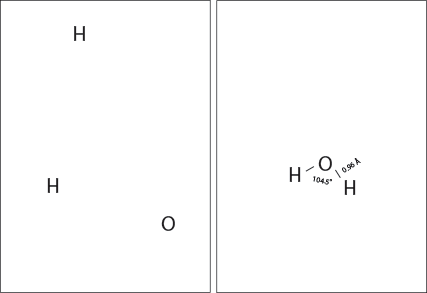
An information structure is distinguished from its components distributed at random. Atoms in molecules have fixed spatial relationships. In the hydrogen molecule the H atoms' distance to O is 0.95 angstrom and the angle between them is 104.5°.
This is the only possibility for the molecule in its ground state - every hydrogen molecule contains exactly the same internal information as every other hydrogen molecule. By contrast, living biological molecules have large numbers of alternative possibilities.
When molecules are disassociated into their component atoms, the number of possible distributions W is enormous for disconnected components (high entropy S) compared to those in fixed molecular relationships (low entropy).
It is an error to assume that any particular distribution of N atoms has the same intrinsic information and probability as any other distribution.
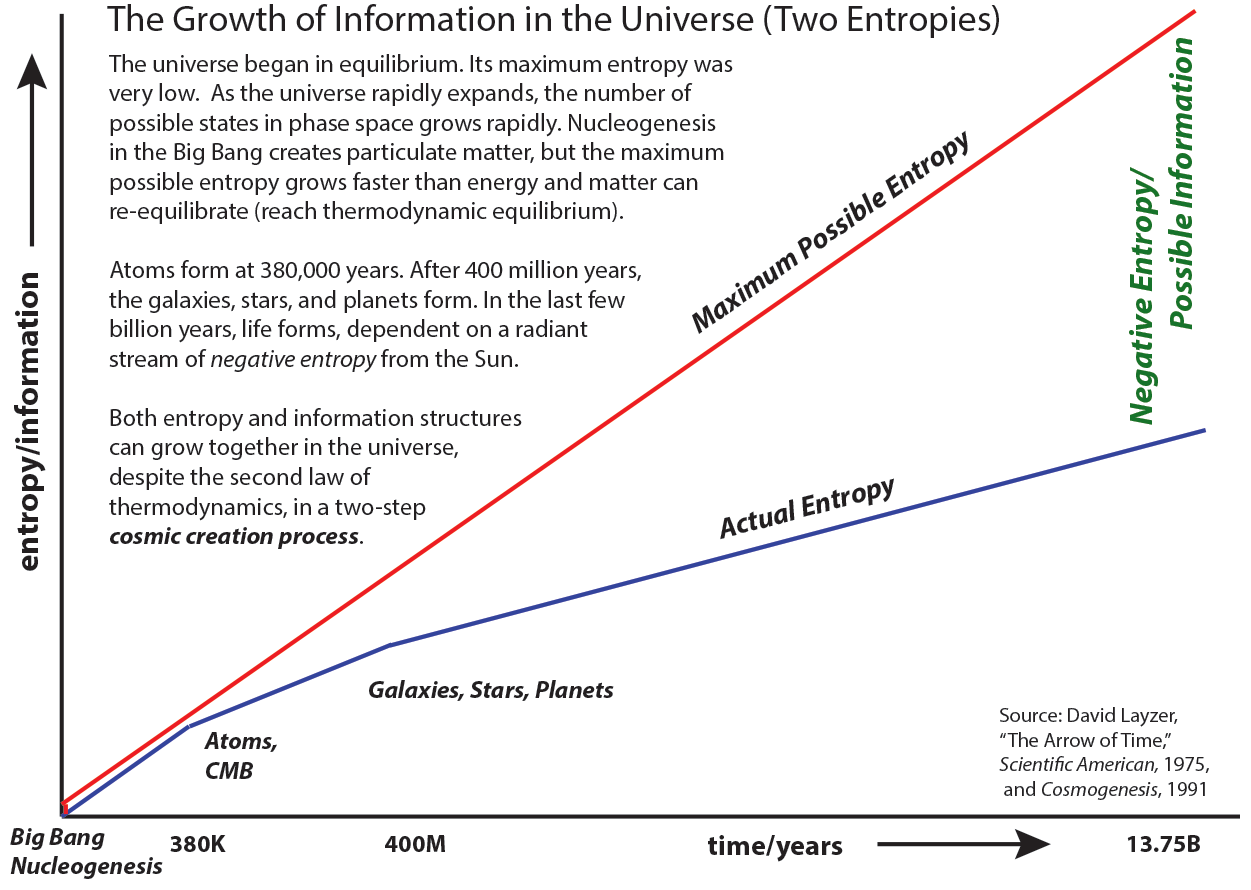
 Creation of information structures means that in parts of the universe the local entropy is actually going down. Creation of a low entropy system is always accompanied by radiation of positive entropy away from the local structures to distant parts of the universe, into the night sky for example. The total global entropy always increases, satisfying the second law, even if it never reaches the maximum possible entropy.
A few hundred million years after the formation of atoms, gravitational forces pulled together clouds of those atoms and molecules to form the planets, stars, and galaxies. Gravitational attraction involves little chance. Any quantum randomness is averaged out by the immensely large number of particles. This is why the classical mechanics of large objects is "adequately determined."
The creation of astrophysical objects like the planets, stars, and galaxies creates new information, but information itself is not involved in their creation, as it will be for living things. Particles in these objects are passive, acted upon, not themselves "acting."
Around nine billion years later, on planet Earth, some very complex macromolecules began to replicate themselves. They had encoded the information needed to clone themselves. All earlier information structures were formed passively, under the influence of purely physical forces. The information in these macromolecules was actively involved in their own creation.
The creation of living things is a transition from passive participants to active agents.
A steady flow of energy with low entropy is needed to support life, as Erwin Schrödinger made famous in his 1944 essay, "What Is Life? He wrote that life feeds on low entropy and the Sun is the source of that negative entropy and order.
At some time, active information structures began to notice their neighbors, probably by chemical secretions into the environment. This was the first communication between information structures.
Eventually, the information communicated between some living entities consisted of pure abstract ideas, from one thinking being to another. This information is neither matter nor energy, though it needs matter to be embodied and energy to be communicated. It is the basis for all human knowledge. Information goes "beyond logic and language" in its ability to represent nature.
All along in the history of the cosmic creation process, information can be altered by accidental errors in the stored data or noise in the communicated signals. Sometimes the noise causes a variation or mutation in the genetic structure. Very rarely, the mutation is an improvement that gives the organism greater reproductive success. This of course explains Darwinian evolution of the species.
To summarize, we can divide the creation and evolution of information structures into four cosmic epochs:
Creation of information structures means that in parts of the universe the local entropy is actually going down. Creation of a low entropy system is always accompanied by radiation of positive entropy away from the local structures to distant parts of the universe, into the night sky for example. The total global entropy always increases, satisfying the second law, even if it never reaches the maximum possible entropy.
A few hundred million years after the formation of atoms, gravitational forces pulled together clouds of those atoms and molecules to form the planets, stars, and galaxies. Gravitational attraction involves little chance. Any quantum randomness is averaged out by the immensely large number of particles. This is why the classical mechanics of large objects is "adequately determined."
The creation of astrophysical objects like the planets, stars, and galaxies creates new information, but information itself is not involved in their creation, as it will be for living things. Particles in these objects are passive, acted upon, not themselves "acting."
Around nine billion years later, on planet Earth, some very complex macromolecules began to replicate themselves. They had encoded the information needed to clone themselves. All earlier information structures were formed passively, under the influence of purely physical forces. The information in these macromolecules was actively involved in their own creation.
The creation of living things is a transition from passive participants to active agents.
A steady flow of energy with low entropy is needed to support life, as Erwin Schrödinger made famous in his 1944 essay, "What Is Life? He wrote that life feeds on low entropy and the Sun is the source of that negative entropy and order.
At some time, active information structures began to notice their neighbors, probably by chemical secretions into the environment. This was the first communication between information structures.
Eventually, the information communicated between some living entities consisted of pure abstract ideas, from one thinking being to another. This information is neither matter nor energy, though it needs matter to be embodied and energy to be communicated. It is the basis for all human knowledge. Information goes "beyond logic and language" in its ability to represent nature.
All along in the history of the cosmic creation process, information can be altered by accidental errors in the stored data or noise in the communicated signals. Sometimes the noise causes a variation or mutation in the genetic structure. Very rarely, the mutation is an improvement that gives the organism greater reproductive success. This of course explains Darwinian evolution of the species.
To summarize, we can divide the creation and evolution of information structures into four cosmic epochs:
1. From the origin to the formation of atoms (~380,000 years).
2. The formation of planets, stars, and galaxies, even supernovae and black holes (~400 million years).
3. The creation and evolution of life on Earth (~9 billion years).
4. The evolution of the human mind and the creation of abstract information stored outside living beings..
Information philosophy (actually information physics and biology) has identified the two steps in the process needed to create any new information structure.
1. The Quantum Step. Whenever matter is rearranged to create a new information structure, the quantum binding forces involve a collapse of the wave function that introduces an element of chance. Without alternative possibilities, no new information is possible. With those possibilities, things could have been otherwise.
2) The Thermodynamic Step. The new information structure reduces the local entropy. It cannot be stable unless it transfers away enough positive entropy to satisfy the second law of thermodynamics, which says that the total entropy (disorder) must always increase. The increase in global entropy is the result of the increase in phase-space cells because the universe is expanding. According to Boltzmann's Principle, the entropy S = k lnW. The increasing volume of space means there are many more possible arrangements W of the finite number of particles in the observable universe. All possibilities are the result of the cosmic expansion.
Epoch 1 begins with extraordinarily high temperature and density. The temperature is falling and density is decreasing because the universe is expanding. Quarks are packed tightly as independent particles in pre-hadronic matter until the temperature is low enough for them to be frozen out, bound into hadrons (protons, neutrons). These are the first assembled structures. During much of this epoch the global entropy is near its maximum (disorder, chaos), but is very low compared to what it will become. And the combination of quarks into baryons is the first formation of relatively negative entropy objects.
The next such phase is when the high-entropy free electron gas starts to bind with protons into the earliest atoms. The free-electron gas was optically thick to the photon gas at temperatures above several thousand degrees, with an extremely short mean free path between scatterings.
There was no observer to see it, but the "sky" at that time was hotter than the surface of today's sun in all directions. Material structures would be instantly melted, vaporized, or ionized. The universe was filled with a "plasma" of ionized hydrogen and a small amount of helium.
The first neutral atoms did not become stable entities until at least 380,000 years after the origin of the universe when the temperature was about 5000K.
In the first few hundred thousand years of the early universe, when matter was a very hot ionized plasma gas, occasional electrons combined with protons to form a hydrogen atom. In a quantum transition from an unbound quantum state to a bound electronic state, the new atom radiated away the binding energy as a photon, - the electron's wave function collapsed into one of the possible bound states.
But immediately, a photon in the hot radiation field re-ionized the new atom. The information in that new atomic structure could not last until the universe cooled down enough to become transparent to radiation. Once the universe became transparent, the radiation could carry away the positive entropy needed to satisfy the second law of thermodynamics globally and new atomic structures left behind were pockets of local negative entropy.
We see those escaping photons, coming today in all directions through the now transparent universe from the cosmic microwave background radiation, the remains of the "Big Bang" nearly 14 billion light years away. Those primordial photons have cooled from 5000K to less than a few degrees Kelvin today. .
Epoch 2. A similar two-step process is needed to form the galaxies, stars, and planets, which were starting to form about 400 million years after the origin. When gravitational forces attract huge volumes of matter, the matter heats up as it collapses. If a gravitating object could not radiate away that heat, it could not become a new information structure like a star or galaxy.
The space between the forming galaxies, into which positive entropy can be radiated, is provided by the expansion of the universe. Without the expansion, no new information would be possible in the universe.
To be sure, quantum chance plays little or no role in gravitational structures. The force of gravity is overwhelmingly adequately deterministic. The same is true of fundamental particles like protons, neutrons, atoms, and purely chemical molecules. Biological (living) molecules are a completely different story, as we shall see. Some use their internal information, along with environmental information, to decide what to become.
All these purely physical, cosmic information structures are informationally passive. Their interactions follow simple laws of "bottom-up reductionist physics.
But the biological structures of life on Earth are far from passive. They have the extraordinary active and emergent, "top-down" capability of replicating and processing information, then communicating vital information among their parts. Immaterial information is a causal force managing the matter and energy in a living information structure.
Living organisms exhibit purposeful behavior called teleonomy or entelechy, not the teleology many philosophers and theologians think must pre-exist their existence. Living things, you and I, are dynamic growing information structures,
forms through which matter and energy continuously flow.
And it is information processing that controls those flows!
Information is the modern spirit, the ghost in the machine, the mind in the body. It is the soul, and when we die, it is our information that perishes. The matter remains.
No doubt some of our human purposes are simply inherited, "built-in," as Immanuel Kant thought. They are "teleological" in the sense that their "telos" pre-existed the individual's existence. But not all of our ancestors had those purposes. At some time, some ancestors acquired new purposes.
"What is a priori in an individual was a posteriori in his/her ancestral lineage."
Finally, the same two steps, first random alternative possibilities, then adequately determined outcomes, are involved in our minds when we create a new idea! Most of our ideas are simply inherited as the traditional knowledge of our culture, but some new thoughts are the work of our creative individuals. Albert Einstein called them "free creations of the human mind." In that sense, we are all co-creators of the universe.
Information philosophy tells a story of cosmic and biological evolution that is one creation process all the way from the original cosmic material to the immaterial minds that have now discovered the creation process itself!
Sadly, cosmic creation is horrendously wasteful. In the existential
balance between the forces of destruction and the forces of creation,
there is no contest. The dark side is overwhelming.
By quantitative physical measures of matter and energy content,
there is far more chaos than cosmos in our universe. But it is the
cosmos that we prize, the information that we value.
Information philosophy focuses on the
qualitatively valuable information structures in the universe. The
destructive forces are entropic, they increase entropy and disorder.
Creative forces are anti-entropic. They increase the
order and information. We call them ergodic.
By information we mean a quantity that can be understood mathematically and physically. It corresponds to the common-sense meaning of information, in the sense of communicating or informing. It also corresponds to the information stored in books and computers. But it also measures the information in any physical object, like a stone or a snowflake, in a production process like a recipe or formula, and the information in biological systems, including cell and organ structures and the genetic code.
Information is mathematically related to the measure of disorder known as the thermodynamic quantity called "entropy." Ludwig Boltzmann derived a famous formula S = k log W, where S is the entropy and W is the probability - the number of ways that the internal components (the matter and energy particles of the system) can be rearranged and still be the same system. Thus information is related to probability and possibilities for different arrangements of matter.
The information we mean is closely related to "negative entropy," the departure of a physical system from pure chaos, from "thermodynamic equilibrium."
"Negative entropy" is simply the difference between the maximum possible entropy (where all the particles in a physical system are in a maximum state of disorder, there is no visible structure) and the actual entropy.
In a state of thermodynamic equilibrium, there is only motion of the microscopic constituent particles ("the motion we call heat"). The existence of macroscopic structures, such as the stars and planets, and their motions, is a departure from thermodynamic equilibrium. And that departure we call the "negative entropy."
The second law of thermodynamics says that the entropy (or disorder) of a closed physical system increases until it reaches a maximum, the state of thermodynamic equilibrium. It requires that the entropy of the universe is now and has always been increasing.
This established fact of increasing entropy led many scientists and philosophers to assume that the universe we have is "running down" to a "heat death." They thought that meant the universe must have begun in a very high state of information, since the second law requires that any organization or order is susceptible to decay. The information that remains today, in their view, has always been here. There is nothing new under the sun.
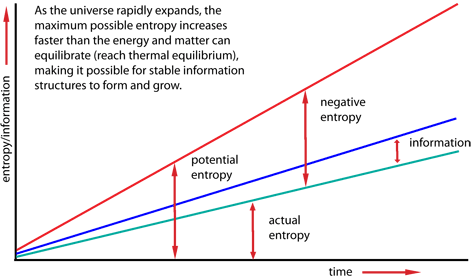
But the universe is not a closed system. It is in a dynamic state of expansion that is moving away from thermodynamic equilibrium faster than entropic processes can keep up. The maximum possible entropy is increasing much faster than the actual increase in entropy. The difference between the maximum possible entropy and the actual entropy is potential information, as shown by David Layzer.
 Creation of information structures means that in parts of the universe the local entropy is actually going down. Creation of a low entropy system is always accompanied by radiation of entropy away from the local structures to distant parts of the universe, into the night sky for example.
As the universe expands (see the figure), both positive and negative entropy
are generated. The normal thermodynamic
entropy, known as the Boltzmann Entropy, is the large black arrow. The negative entropy, often called the Shannon Entropy, is a measure of the information content in the evolving universe.
Creation of information structures means that in parts of the universe the local entropy is actually going down. Creation of a low entropy system is always accompanied by radiation of entropy away from the local structures to distant parts of the universe, into the night sky for example.
As the universe expands (see the figure), both positive and negative entropy
are generated. The normal thermodynamic
entropy, known as the Boltzmann Entropy, is the large black arrow. The negative entropy, often called the Shannon Entropy, is a measure of the information content in the evolving universe.
 Entropy and information can thus
increase at the same time in the expanding universe. There are
generally two entropy/information flows. In any process, the positive entropy
increase is always at least equal to, and generally orders of
magnitude larger than, the negative entropy in any created information
structures. Positive entropy must exceed negative, to satisfy the second law of thermodynamics, which says that overall entropy always increases.
Material particles are the first information structures to form
in the universe.. They are quarks, baryons, and atomic nuclei,
which will combine with electrons to form atoms and eventually molecules,
when the temperature is low enough. These material particles are
attracted together by the force of universal gravitation to form the gigantic
information structures of the galaxies, stars, and planets.
Entropy and information can thus
increase at the same time in the expanding universe. There are
generally two entropy/information flows. In any process, the positive entropy
increase is always at least equal to, and generally orders of
magnitude larger than, the negative entropy in any created information
structures. Positive entropy must exceed negative, to satisfy the second law of thermodynamics, which says that overall entropy always increases.
Material particles are the first information structures to form
in the universe.. They are quarks, baryons, and atomic nuclei,
which will combine with electrons to form atoms and eventually molecules,
when the temperature is low enough. These material particles are
attracted together by the force of universal gravitation to form the gigantic
information structures of the galaxies, stars, and planets.
 Microscopic quantum mechanical particles and huge self-gravitating
systems are both stable and have extremely long lifetimes.
When stars form, they become another source of radiation after the original Big Bang
cosmic source, which has cooled down to 3 degrees Kelvin (3K)
and shines as the cosmic microwave background radiation.
Microscopic quantum mechanical particles and huge self-gravitating
systems are both stable and have extremely long lifetimes.
When stars form, they become another source of radiation after the original Big Bang
cosmic source, which has cooled down to 3 degrees Kelvin (3K)
and shines as the cosmic microwave background radiation.
 Our solar radiation has a high color temperature (5780K) but a low energy-content temperature (273K). It is out of equilibrium
and it is the source of all the information-generating negative
entropy that drives biological evolution on the Earth.
Our solar radiation has a high color temperature (5780K) but a low energy-content temperature (273K). It is out of equilibrium
and it is the source of all the information-generating negative
entropy that drives biological evolution on the Earth.
 Note that
the fraction of the Sun's light falling on Earth is less than a billionth of
that which passes by and is lost in space.
A tiny fraction of the solar energy falling on the earth gets converted
into the information structures of plants and animals. Most
of it gets converted to heat and is radiated away as waste energy to
the night sky.
Note that
the fraction of the Sun's light falling on Earth is less than a billionth of
that which passes by and is lost in space.
A tiny fraction of the solar energy falling on the earth gets converted
into the information structures of plants and animals. Most
of it gets converted to heat and is radiated away as waste energy to
the night sky.
The Evolution of Life
 Every biological structure is a quantum-mechanical information structure.
DNA has maintained its stable information structure (again, thanks to the extraordinary stability of quantum structures) over billions of years in the constant presence of chaos and noise.
With the emergence of teleonomic (purposive) information in self-replicating systems, the same core process underlies all biological creation. But now some random changes in information structures are rejected by natural selection, while others reproduce successfully.
Every biological structure is a quantum-mechanical information structure.
DNA has maintained its stable information structure (again, thanks to the extraordinary stability of quantum structures) over billions of years in the constant presence of chaos and noise.
With the emergence of teleonomic (purposive) information in self-replicating systems, the same core process underlies all biological creation. But now some random changes in information structures are rejected by natural selection, while others reproduce successfully.
 The stable information content of a human being survives many
changes in the material content of the body during a person’s lifetime.
Only with death does the mental information (spirit, soul)
dissipate - unless it is saved somewhere.
The stable information content of a human being survives many
changes in the material content of the body during a person’s lifetime.
Only with death does the mental information (spirit, soul)
dissipate - unless it is saved somewhere.
Information increases and we are co-creators of the universe
Creation of information structures means that today there is more information in the universe than at any earlier time. This fact of increasing information fits well with an undetermined universe that is still creating itself. In this universe, stars are still forming, biological systems are creating new species, and intelligent human beings are co-creators of the world we live in.
Darwin's evolutionary theory requires random variations followed by natural selection. Once DNA was understood to be carrying the information in the genetic code, it was argued that random point-mutations were the source of the variations needed for new species development. But the enormous information content of DNA, even the gene sequences of the DNA that code for specific proteins, were seen to be too large for random point-mutations to have enough time to produce the known differences in species DNA.
Critics of the modern synthesis said "chance" could not possible explain evolution and looked to other more deterministic mechanisms.
But in recent years we have learned that large meaningful sequences of DNA can randomly "jump" from one place in the chromosomal DNA to another, moving a functional element to another place in the developing organism. James A. Shapiro calls these mobile genetic elements "natural genetic engineering." They are based on Barbara McClintock's discovery of "jumping genes" in the 1960's.
We now know that evolutionary change is still driven by "chance," probably still quantum chance, but now instead of two bits of new information (one letter of the genetic code A,G,C,T is about two bits), random variations can now add many thousands of bits of new information, greatly reducing the time needed to produce meaningful genetic changes in the evolution of life.
The Evolution of Mind
The total mental information in a living human is orders of
magnitude less than the information content and information
processing rate of the body. But the information structures created
by humans outside the body, in the form of external knowledge
(we call them the Sum), including the enormous collection of human artifacts,
rival the total biological information content.
Information philosophy views the mind as the immaterial information in the brain, which is seen as a biological information processor. Mind is software in the brain's hardware. The "stuff" of mind is pure information. Information is neither matter nor energy, though it needs matter for its embodiment and energy for its communication. In ancient philosophy, mind and body formed one of the classic dualisms, like idealism versus materialism, the problem of the one (monism) or the many (pluralism), the distinction between essence and existence, between universals and particulars, between the eternal and the ephemeral. When mind and body are viewed today as a dualism, the emphasis is on the mind, that is to say the information, being fundamentally different from the material brain. Since the universe is continuously creating new information, by rearranging existing matter, this is an important and understandable difference. Matter (and energy) is conserved, a constant of the universe. Information is not conserved, it is the source of genuine novelty, including new thoughts in the mind leading to new things in the human world. Mental processes are also the result of the two-step core process that creates all information. It is a combination of two distinct physical processes, one quantum mechanical, the other thermodynamic. Understanding this core creative process is as close as we are likely to come to understanding the idea of an anthropomorphic creator of the universe, a still-present divine providence, the cosmic source of everything good and evil. As we have seen, everything created since the origin of the universe over thirteen billion years ago has involved just two fundamental physical processes that combine to form the core of all creative processes. These two steps occur whenever even a single bit of new information is created and comes into the universe. In the mind we describe a two-stage model of creativity and free will. Given the "laws of nature" and the "fixed past" just before a decision, philosophers wonder how a free agent can have any possible alternatives. This is partly because they imagine a timeline for the decision that shrinks the decision process to a single moment. 


Something from Nothing
The simplest possible explanation of a universe that was preceded by nothing might be to assume that what came into existence was two things that are exactly opposite to one another, such that should they recombine we would be back to nothing. Zero = +1 and -1.
Matter and anti-matter are not good enough, because when they recombine they become pure energy.
Cosmogenesis
Cosmogenesis was chosen by David Layzer as the title of his most important book, Cosmogenesis: The Growth of Order in the Universe.
It is almost certain that Layzer knew the origin of this fruitful term, though he did not mention it in his book. Cosmogenesis was coined by the great French priest and scientist Pierre Teilhard de Chardin in his most famous book, The Phenomenon of Man.
Teilhard's cosmogenesis
For Teachers
For Scholars
|


