Antoine Suarez is the founding director of the
Center for Quantum Philosophy in Zurich, based on philosophical questions raised in the 1970's and 1980's by
John Bell.
Suarez and Valerio Scarani, inspired by discussions with Bell, proposed in 1997 the "before-before" experiment. They proposed to use moving measurement devices to test quantum
entanglement and
nonlocality (the
EPR experiment) to see whether there is some ordering process behind the nonlocal correlations. Suarez hoped to find something wrong with standard quantum mechanics.
The "before-before" experiment used the idea of hyperplanes of simultaneity from the special theory of relativity. Back in the 1960's,
C. W. Rietdijk and
Hilary Putnam argued that physical
determinism could be proved to be true by considering experiments and observers moving at high speed with respect to one another.
Roger Penrose developed a similar argument in his book
The Emperor's New Mind called the
Andromeda Paradox.
Suarez and Scarani showed that for some relative speeds between two observers A and B, observer A could "see" the measurement of observer B to be in his future, and vice versa.
Because the two experiments have a "spacelike" separation (neither is inside the causal light cone of the other), each observer thinks he does his own measurement before the other.
In 2001, Suarez collaborated with
Nicolas Gisin on these tests. Suarez and Gisin described the situation as some influence coming "from outside space-time" to cause the 100% correlations found in their tests of
Bell's Theorem.
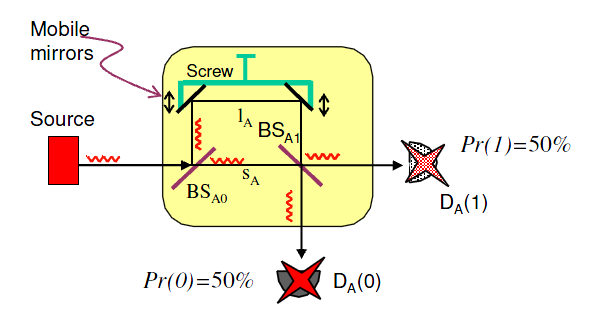
They tested the limits on this effect by moving mirrors in one of the paths in a path-length (Mach-Zehnder) interferometer. They showed that, like the other Bell inequalities, the "before-before" suggestion of Suarez and Scarani could not eliminate nonlocality and
entanglement. Their tests confirmed quantum mechanics and refuted the Suarez temporal explanation.
In his recent essay "Does Free Will Require New Physics," Suarez explores the possibility that the brain contains a generator of the random bits seen in his nonlocality experiments, and that the will might in some way control the order of those bits to make "pieces of information". This resembles the idea of
downward causation.
Like many physicists proposing specific
free will mechanisms, Suarez imagines a physical process in the brain related to the work in physics that he is most familiar with. In his case it is a path-length interferometer.
Suarez knows that making a decision is closely related to the
problem of measurement in quantum mechanics. In our information physics view,
John von Neumann's "cut" or "schnitt" between the atomic level and the macroscopic measuring apparatus occurs when stable information enter the universe. Stability means the balancing entropy has been carried away (the Ludwig-Landauer principle). Suarez knows that the conscious observer has little to do with it. He says
the decision about which detector clicks (in an interference experiment,
like that represented in the Figure) does not happen when "one photon encounters a
detector" but only subsequently, after a virtual cascade involving billions of electrons
has been triggered. Only then an irreversible registration of a result happens and a
human observer can become aware of it.
An event is "measured", i.e. irreversibly registered, only if it is possible
for a human observer to become aware of it.
Irreversibility is the hallmark of stable information creation and increase in thermodynamic entropy. Suarez notes that quantum mechanics may need "new physics" because it cannot explain precisely when a measurement happens. He says
Conscious free will implies irreversibility and therefore requires new physics
capable of well defining this concept. But quantum mechanics itself requires such a new
physics. Quantum theory does not define at all which conditions determine when
measurement happens and a result becomes irreversibly registered. This state of affairs
clearly shows a point where the theory can and must be completed.
We hope that the
information physics view of the problem of measurement can help complete that theory. And our insight into the
origin of irreversibility can be added to
decoherence to explain experiment outcomes.
Suarez cites the
Free Will Theorem of
John Conway and
Simon Kochen as making free will an axiom, without which science itself could not proceed. Suarez does not believe that his current movements can be "explained by a chain of temporal cause going back to the Big Bang."
With the support of Carlos Cavallé and his Social Trends Institute, Suarez organized an
experts meeting on the question "Is Science Compatible With Our Desire For Freedom?" in October 2010. Several philosophers and scientists interested in the the problem of free will attended, including
Robert Kane,
Alfred Mele,
Bob Doyle, and
Martin Heisenberg.
For Scholars
To hide this material, click on the Teacher or Normal link.
The experimental setup for quantum entanglement tests is theoretically simple but experimentally difficult. Two spin 1/2 electrons are prepared in a state, say with opposing spins so the total spin angular momentum of the electrons is zero. They are said to be in a singlet state. Most recent studies, like Gisin's, used entangled polarized photon pairs.)
Two experimenters (call them A and B) measure the electron spins at some later time.
The conservation of angular momentum requires that should one of these electrons be measured with spin up, the other must be spin down. This is what is described as "nonlocal" correlation of the spin measurement results.
A simpler way of looking at the problem is to consider the conservation of angular momentum, a law of nature that can not be violated. What would the lack of "correlation" between electron spins look like? It would include some spin-up measurements by experimenter A at the same time as spin-up measurements by experimenter B.
But this is a clear violation of the conservation law for angular momentum.
This conservation law in no way depends on supra-luminal communications between particles. Consider two electrons at opposite ends of the Andromeda galaxy, say 100,000 light years apart. As they revolve around the center of the galaxy, they conserve their orbital angular momenta perfectly.
We might say that conservation laws are "outside space-time."
Note that the original EPR thought experiment involved electrons going in opposite directions from a central source. In that case the governing conservation law was for ordinary translational momentum. And note that modern experiments like those of Suarez and Gisin use circularly polarized photons. But it is still a matter of conservation of angular momentum.

 |
|