Follow infophilosopher:
 |
|

|
|
|
Philosophers
Mortimer Adler Rogers Albritton Alexander of Aphrodisias Samuel Alexander William Alston Anaximander G.E.M.Anscombe Anselm Louise Antony Thomas Aquinas Aristotle David Armstrong Harald Atmanspacher Robert Audi Augustine J.L.Austin A.J.Ayer Alexander Bain Mark Balaguer Jeffrey Barrett William Barrett William Belsham Henri Bergson George Berkeley Isaiah Berlin Richard J. Bernstein Bernard Berofsky Robert Bishop Max Black Susanne Bobzien Emil du Bois-Reymond Hilary Bok Laurence BonJour George Boole Émile Boutroux Daniel Boyd F.H.Bradley C.D.Broad Michael Burke Jeremy Butterfield Lawrence Cahoone C.A.Campbell Joseph Keim Campbell Rudolf Carnap Carneades Nancy Cartwright Gregg Caruso Ernst Cassirer David Chalmers Roderick Chisholm Chrysippus Cicero Tom Clark Randolph Clarke Samuel Clarke Anthony Collins Antonella Corradini Diodorus Cronus Jonathan Dancy Donald Davidson Mario De Caro Democritus Daniel Dennett Jacques Derrida René Descartes Richard Double Fred Dretske John Earman Laura Waddell Ekstrom Epictetus Epicurus Austin Farrer Herbert Feigl Arthur Fine John Martin Fischer Frederic Fitch Owen Flanagan Luciano Floridi Philippa Foot Alfred Fouilleé Harry Frankfurt Richard L. Franklin Bas van Fraassen Michael Frede Gottlob Frege Peter Geach Edmund Gettier Carl Ginet Alvin Goldman Gorgias Nicholas St. John Green H.Paul Grice Ian Hacking Ishtiyaque Haji Stuart Hampshire W.F.R.Hardie Sam Harris William Hasker R.M.Hare Georg W.F. Hegel Martin Heidegger Heraclitus R.E.Hobart Thomas Hobbes David Hodgson Shadsworth Hodgson Baron d'Holbach Ted Honderich Pamela Huby David Hume Ferenc Huoranszki Frank Jackson William James Lord Kames Robert Kane Immanuel Kant Tomis Kapitan Walter Kaufmann Jaegwon Kim William King Hilary Kornblith Christine Korsgaard Saul Kripke Thomas Kuhn Andrea Lavazza James Ladyman Christoph Lehner Keith Lehrer Gottfried Leibniz Jules Lequyer Leucippus Michael Levin Joseph Levine George Henry Lewes C.I.Lewis David Lewis Peter Lipton C. Lloyd Morgan John Locke Michael Lockwood Arthur O. Lovejoy E. Jonathan Lowe John R. Lucas Lucretius Alasdair MacIntyre Ruth Barcan Marcus Tim Maudlin James Martineau Nicholas Maxwell Storrs McCall Hugh McCann Colin McGinn Michael McKenna Brian McLaughlin John McTaggart Paul E. Meehl Uwe Meixner Alfred Mele Trenton Merricks John Stuart Mill Dickinson Miller G.E.Moore Ernest Nagel Thomas Nagel Otto Neurath Friedrich Nietzsche John Norton P.H.Nowell-Smith Robert Nozick William of Ockham Timothy O'Connor Parmenides David F. Pears Charles Sanders Peirce Derk Pereboom Steven Pinker U.T.Place Plato Karl Popper Porphyry Huw Price H.A.Prichard Protagoras Hilary Putnam Willard van Orman Quine Frank Ramsey Ayn Rand Michael Rea Thomas Reid Charles Renouvier Nicholas Rescher C.W.Rietdijk Richard Rorty Josiah Royce Bertrand Russell Paul Russell Gilbert Ryle Jean-Paul Sartre Kenneth Sayre T.M.Scanlon Moritz Schlick John Duns Scotus Arthur Schopenhauer John Searle Wilfrid Sellars David Shiang Alan Sidelle Ted Sider Henry Sidgwick Walter Sinnott-Armstrong Peter Slezak J.J.C.Smart Saul Smilansky Michael Smith Baruch Spinoza L. Susan Stebbing Isabelle Stengers George F. Stout Galen Strawson Peter Strawson Eleonore Stump Francisco Suárez Richard Taylor Kevin Timpe Mark Twain Peter Unger Peter van Inwagen Manuel Vargas John Venn Kadri Vihvelin Voltaire G.H. von Wright David Foster Wallace R. Jay Wallace W.G.Ward Ted Warfield Roy Weatherford C.F. von Weizsäcker William Whewell Alfred North Whitehead David Widerker David Wiggins Bernard Williams Timothy Williamson Ludwig Wittgenstein Susan Wolf Scientists David Albert Michael Arbib Walter Baade Bernard Baars Jeffrey Bada Leslie Ballentine Marcello Barbieri Gregory Bateson Horace Barlow John S. Bell Mara Beller Charles Bennett Ludwig von Bertalanffy Susan Blackmore Margaret Boden David Bohm Niels Bohr Ludwig Boltzmann Emile Borel Max Born Satyendra Nath Bose Walther Bothe Jean Bricmont Hans Briegel Leon Brillouin Stephen Brush Henry Thomas Buckle S. H. Burbury Melvin Calvin Donald Campbell Sadi Carnot Anthony Cashmore Eric Chaisson Gregory Chaitin Jean-Pierre Changeux Rudolf Clausius Arthur Holly Compton John Conway Simon Conway-Morris Jerry Coyne John Cramer Francis Crick E. P. Culverwell Antonio Damasio Olivier Darrigol Charles Darwin Richard Dawkins Terrence Deacon Lüder Deecke Richard Dedekind Louis de Broglie Stanislas Dehaene Max Delbrück Abraham de Moivre Bernard d'Espagnat Paul Dirac Hans Driesch John Dupré John Eccles Arthur Stanley Eddington Gerald Edelman Paul Ehrenfest Manfred Eigen Albert Einstein George F. R. Ellis Hugh Everett, III Franz Exner Richard Feynman R. A. Fisher David Foster Joseph Fourier Philipp Frank Steven Frautschi Edward Fredkin Augustin-Jean Fresnel Benjamin Gal-Or Howard Gardner Lila Gatlin Michael Gazzaniga Nicholas Georgescu-Roegen GianCarlo Ghirardi J. Willard Gibbs James J. Gibson Nicolas Gisin Paul Glimcher Thomas Gold A. O. Gomes Brian Goodwin Joshua Greene Dirk ter Haar Jacques Hadamard Mark Hadley Patrick Haggard J. B. S. Haldane Stuart Hameroff Augustin Hamon Sam Harris Ralph Hartley Hyman Hartman Jeff Hawkins John-Dylan Haynes Donald Hebb Martin Heisenberg Werner Heisenberg Grete Hermann John Herschel Basil Hiley Art Hobson Jesper Hoffmeyer Don Howard John H. Jackson William Stanley Jevons Roman Jakobson E. T. Jaynes Pascual Jordan Eric Kandel Ruth E. Kastner Stuart Kauffman Martin J. Klein William R. Klemm Christof Koch Simon Kochen Hans Kornhuber Stephen Kosslyn Daniel Koshland Ladislav Kovàč Leopold Kronecker Rolf Landauer Alfred Landé Pierre-Simon Laplace Karl Lashley David Layzer Joseph LeDoux Gerald Lettvin Gilbert Lewis Benjamin Libet David Lindley Seth Lloyd Werner Loewenstein Hendrik Lorentz Josef Loschmidt Alfred Lotka Ernst Mach Donald MacKay Henry Margenau Owen Maroney David Marr Humberto Maturana James Clerk Maxwell Ernst Mayr John McCarthy Warren McCulloch N. David Mermin George Miller Stanley Miller Ulrich Mohrhoff Jacques Monod Vernon Mountcastle Emmy Noether Donald Norman Travis Norsen Alexander Oparin Abraham Pais Howard Pattee Wolfgang Pauli Massimo Pauri Wilder Penfield Roger Penrose Steven Pinker Colin Pittendrigh Walter Pitts Max Planck Susan Pockett Henri Poincaré Daniel Pollen Ilya Prigogine Hans Primas Zenon Pylyshyn Henry Quastler Adolphe Quételet Pasco Rakic Nicolas Rashevsky Lord Rayleigh Frederick Reif Jürgen Renn Giacomo Rizzolati A.A. Roback Emil Roduner Juan Roederer Jerome Rothstein David Ruelle David Rumelhart Robert Sapolsky Tilman Sauer Ferdinand de Saussure Jürgen Schmidhuber Erwin Schrödinger Aaron Schurger Sebastian Seung Thomas Sebeok Franco Selleri Claude Shannon Charles Sherrington Abner Shimony Herbert Simon Dean Keith Simonton Edmund Sinnott B. F. Skinner Lee Smolin Ray Solomonoff Roger Sperry John Stachel Henry Stapp Tom Stonier Antoine Suarez Leo Szilard Max Tegmark Teilhard de Chardin Libb Thims William Thomson (Kelvin) Richard Tolman Giulio Tononi Peter Tse Alan Turing C. S. Unnikrishnan Nico van Kampen Francisco Varela Vlatko Vedral Vladimir Vernadsky Mikhail Volkenstein Heinz von Foerster Richard von Mises John von Neumann Jakob von Uexküll C. H. Waddington James D. Watson John B. Watson Daniel Wegner Steven Weinberg Paul A. Weiss Herman Weyl John Wheeler Jeffrey Wicken Wilhelm Wien Norbert Wiener Eugene Wigner E. O. Wilson Günther Witzany Stephen Wolfram H. Dieter Zeh Semir Zeki Ernst Zermelo Wojciech Zurek Konrad Zuse Fritz Zwicky Presentations Biosemiotics Free Will Mental Causation James Symposium |
Claude Shannon
Claude Shannon is often described as "the father of information theory" although he described his work as "communication theory." it was Shannon who put the communication of signals in the presence of noise on a sound mathematical basis. His co-workers at Bell Laboratories called what was being transmitted "intelligence" (Harry Nyquist) and "information" (Ralph Hartley). Shannon used "intelligence" in his earliest reports and proposals and information later.
Hartley had a deep insight into
In 1871, James Clerk Maxwell showed how an intelligent being could in principle sort out the disorder in a gas of randomly moving molecules, by gathering knowledge-intelligence-information about their speeds and sorting them into hot and cold gases, in apparent violation of the second law of thermodynamics. William Thomson (Lord Kelvin) called this being "Maxwell's intelligent demon."
Ludwig Boltzmann, who established the statistical physics foundation of thermodynamics, chose the logarithm of the number W of equiprobable microstates as the measure for his entropy, because he wanted entropy to be an extensive additive quantity.
S = k log W
where k is Boltzmann's constant. If one system can be in one thousand possible states and another system also in a thousand possible states, the combined system has a million possible states. In a base 10 system, log101000 = 3, and 3 + 3 is 6 = log101000000.
In 1929, Leo Szilard imagined a gas with but a single molecule in a container. He then devised a mechanism that could behave like Maxwell's demon. It would insert a partition into the middle of the container, then gather the information about which of the two sides of the partition the molecule was in. This was a binary decision and it allowed Szilard to develop the mathematical form for the amount of entropy S produced by a one-bit measurement, which Szilard identified as the acquisition of information and storage in the "memory" of a physical device or of a human observer.
S = k log 2
The base-2 logarithm reflects the binary decision.
The amount of entropy generated by the measurement may, of course, always be greater than this fundamental amount of negative entropy (information) created, but not smaller, or the second law - that overall entropy must increase - would be violated.
The earlier work of Maxwell, Boltzmann, and Szilard did not figure directly in Shannon's work. Shannon studied the design of early analog computers (specifically Vannevar Bush's differential analyzer at MIT, which was used by Coolidge and James to calculate the first wave functions of the hydrogen molecule in 1936). Then, with John von Neumann and Alan Turing, Shannon helped design the first digital computers, based on the Boolean logic of 1's and 0's and binary arithmetic.
Shannon analyzed telephone switching circuits that used electromagnetic relay switches, then realized that the switches could solve some problems in Boolean algebra.
During World War II, Shannon worked at Bell Labs on cryptography and sending "intelligence" signals in the presence of noise. Alan Turing visited the labs for a couple of months and showed Shannon his 1936 ideas for a universal computer (the "Turing Machine").
Shannon's work on communications, control systems, and cryptography were initially classified, but they contained almost all of the mathematics that eventually appeared in his landmark 1948 article "A Mathematical Theory of Communication," that is considered the basis for modern information theory.
Norbert Wiener's work on probability theory in Cybernetics had an important influence on Shannon. There can be no new information in a world of certainty. Probability and statistics are at the heart of both information theory and quantum theory.
Following a suggestion by John von Neumann, Shannon developed his expression for an information (Shannon) entropy, which he showed has the same mathematical form as thermodynamic (Boltzmann) entropy. He wrote:
Suppose we have a set of possible events whose probabilities of occurrence are p1, p2, • • • , pn. These probabilities are known but that is all we know concerning which event will occur. Can we find a measure of how much "choice" is involved in the selection of the event or of how uncertain we are of the outcome? If there is such a measure, say H(p1, p2, • • • , pn), it is reasonable to require of it the following properties: 1. H should be continuous in the pn. 2. If all the pn are equal, pi = 1/n, then H should be a monotonic increasing function of n. With equally likely events there is more choice, or uncertainty, when there are more possible events. 3. If a choice be broken down into two successive choices, the original H should be the weighted sum of the individual values of H. The meaning of this is illustrated in Fig. 6.
Shannon Entropy and Boltzmann Entropy
Boltzmann entropy: S = k ∑ pi ln pi. Shannon information: I = - ∑ pi ln pi.
Shannon entropy is the average (expected) value of the information contained in a received message. If there are many possible messages, we get a lot more information than when there are only two possibilities (one bit of information). It is the base 2 logarithm of the number of possibilities. Shannon entropy thus characterizes our uncertainty about the information in an incoming message, and increases for more possibilities with greater randomness. The less likely an event is, the more information it provides when it occurs. Shannon defined his entropy or information as the negative of the logarithm of the probability distribution. He briefly considered calling it "uncertainty (after the Heisenberg uncertainty principle). but decided on "entropy" following the suggestion by von Neumann. One bit of information is also known as one "shannon."
Boltzmann entropy is maximized when the particle distribution is maximally random among positions in phase space, when the number of microstates W corresponding to a given macrostate is as large as possible. An improbable macrostate might be when every particle is in the same microstate. Finding all the particles in a corner of the possible volume is information in the same sense as receiving one of the possible messages. An equilibrium macrostate is when particles are as randomly distributed as possible. Any information is gone.
Counterintuitively, maximum Boltzmann entropy (no information) is maximal uncertainty before a message is received and then maximal Shannon entropy (information), after a message is received, making the two entropies hard to compare.
Historical Background
Information in physical systems was connected to a measure of the structural order in a system as early as the nineteenth century by William Thomson (Lord Kelvin) and Ludwig Boltzmann, who described an increase in the thermodynamic entropy as “lost information.”
In 1877, Boltzmann proved his “H-Theorem” that the entropy or disorder in the universe always increases. He defined entropy S as the logarithm of the number W of possible states of a physical system, an equation now known as Boltzmann’s Principle,
S = k log W.
In 1929, Leo Szilard showed the mean value of the quantity of information produced by a 1-bit, two-possibility (“yes/no”) measurement as S = k log 2, where k is Boltzmann’s constant, connecting information directly to entropy.
Following Szilard, Ludwig von Bertalanffy, Erwin Schrödinger, Norbert Wiener, Claude Shannon, Warren Weaver, John von Neumann, and Leon Brillouin, all expressed similar views on the connection between physical entropy and abstract “bits” of information.
Schrödinger said the information in a living organism is the result of “feeding on negative entropy” from the sun. Wiener said “The quantity we define as amount of information is the negative of the quantity usually defined as entropy in similar situations.”
Brillouin created the term “negentropy” because he said, “One of the most interesting parts in Wiener’s Cybernetics is the discussion on “Time series, information, and communication,” in which he specifies that a certain “amount of information is the negative of the quantity usually defined as entropy in similar situations.”
Shannon, with a nudge from von Neumann, used the term entropy to describe his estimate of the amount of information that can be communicated over a channel, because his mathematical theory of the communication of information produced a mathematical formula identical to Boltzmann’s equation for entropy, except for a minus sign (the negative in negative entropy).
Shannon described a set of i messages, each with probability pi. He then defined a quantity H,
H = k Σ pi log pi,
where k is a positive constant. Since H looked like the H in Boltzmann’s H-Theorem, Shannon called it the entropy of the set of probabilities p1, p2, . . . , pn.
To see the connection between the two entropies, we can note that Boltzmann assumed that all his probabilities were equal. For n equal states, the probability of each state is p = 1/n.
The sum over n states,
Σ pi log pi, is then n x 1/n x log (1/n) = log (1/n) = - log n.
If we set Shannon's number of possible messages n equal to Boltzmann's number of possible microstates W, we get Boltzmann’s entropy with a minus sign,
H = - k log W.
Shannon’s entropy H is the negative of Boltzmann’s S.
Shannon showed that a communication that is certain to tell you something you already know (one of the messages has probability unity) contains no new information.
For Teachers
For Scholars
The Mathematical Theory of Communication (excerpts)
Introduction
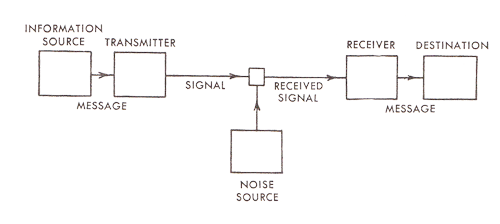
The recent development of various methods of modulation such as PCM and PPM which exchange bandwidth for signal-to-noise ratio has intensified the interest in a general theory of communication. A basis for such a theory is contained in the important papers of Nyquist1 and Hartley2 on this subject. In the present paper we will extend the theory to include a number of new factors, in particular the effect of noise in the channel, and the savings possible due to the statistical structure of the original message and due to the nature of the final destination of the information.
|
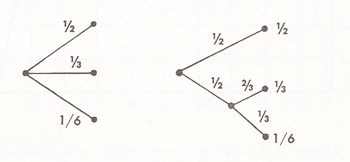 Fig. 6.— Decomposition of a choice from three possibilities.