
Follow infophilosopher:
 |
|

|
|
|
Philosophers
Mortimer Adler Rogers Albritton Alexander of Aphrodisias Samuel Alexander William Alston Anaximander G.E.M.Anscombe Anselm Louise Antony Thomas Aquinas Aristotle David Armstrong Harald Atmanspacher Robert Audi Augustine J.L.Austin A.J.Ayer Alexander Bain Mark Balaguer Jeffrey Barrett William Barrett William Belsham Henri Bergson George Berkeley Isaiah Berlin Richard J. Bernstein Bernard Berofsky Robert Bishop Max Black Susanne Bobzien Emil du Bois-Reymond Hilary Bok Laurence BonJour George Boole Émile Boutroux Daniel Boyd F.H.Bradley C.D.Broad Michael Burke Jeremy Butterfield Lawrence Cahoone C.A.Campbell Joseph Keim Campbell Rudolf Carnap Carneades Nancy Cartwright Gregg Caruso Ernst Cassirer David Chalmers Roderick Chisholm Chrysippus Cicero Tom Clark Randolph Clarke Samuel Clarke Anthony Collins Antonella Corradini Diodorus Cronus Jonathan Dancy Donald Davidson Mario De Caro Democritus Daniel Dennett Jacques Derrida René Descartes Richard Double Fred Dretske John Earman Laura Waddell Ekstrom Epictetus Epicurus Austin Farrer Herbert Feigl Arthur Fine John Martin Fischer Frederic Fitch Owen Flanagan Luciano Floridi Philippa Foot Alfred Fouilleé Harry Frankfurt Richard L. Franklin Bas van Fraassen Michael Frede Gottlob Frege Peter Geach Edmund Gettier Carl Ginet Alvin Goldman Gorgias Nicholas St. John Green H.Paul Grice Ian Hacking Ishtiyaque Haji Stuart Hampshire W.F.R.Hardie Sam Harris William Hasker R.M.Hare Georg W.F. Hegel Martin Heidegger Heraclitus R.E.Hobart Thomas Hobbes David Hodgson Shadsworth Hodgson Baron d'Holbach Ted Honderich Pamela Huby David Hume Ferenc Huoranszki Frank Jackson William James Lord Kames Robert Kane Immanuel Kant Tomis Kapitan Walter Kaufmann Jaegwon Kim William King Hilary Kornblith Christine Korsgaard Saul Kripke Thomas Kuhn Andrea Lavazza James Ladyman Christoph Lehner Keith Lehrer Gottfried Leibniz Jules Lequyer Leucippus Michael Levin Joseph Levine George Henry Lewes C.I.Lewis David Lewis Peter Lipton C. Lloyd Morgan John Locke Michael Lockwood Arthur O. Lovejoy E. Jonathan Lowe John R. Lucas Lucretius Alasdair MacIntyre Ruth Barcan Marcus Tim Maudlin James Martineau Nicholas Maxwell Storrs McCall Hugh McCann Colin McGinn Michael McKenna Brian McLaughlin John McTaggart Paul E. Meehl Uwe Meixner Alfred Mele Trenton Merricks John Stuart Mill Dickinson Miller G.E.Moore Ernest Nagel Thomas Nagel Otto Neurath Friedrich Nietzsche John Norton P.H.Nowell-Smith Robert Nozick William of Ockham Timothy O'Connor Parmenides David F. Pears Charles Sanders Peirce Derk Pereboom Steven Pinker U.T.Place Plato Karl Popper Porphyry Huw Price H.A.Prichard Protagoras Hilary Putnam Willard van Orman Quine Frank Ramsey Ayn Rand Michael Rea Thomas Reid Charles Renouvier Nicholas Rescher C.W.Rietdijk Richard Rorty Josiah Royce Bertrand Russell Paul Russell Gilbert Ryle Jean-Paul Sartre Kenneth Sayre T.M.Scanlon Moritz Schlick John Duns Scotus Arthur Schopenhauer John Searle Wilfrid Sellars David Shiang Alan Sidelle Ted Sider Henry Sidgwick Walter Sinnott-Armstrong Peter Slezak J.J.C.Smart Saul Smilansky Michael Smith Baruch Spinoza L. Susan Stebbing Isabelle Stengers George F. Stout Galen Strawson Peter Strawson Eleonore Stump Francisco Suárez Richard Taylor Kevin Timpe Mark Twain Peter Unger Peter van Inwagen Manuel Vargas John Venn Kadri Vihvelin Voltaire G.H. von Wright David Foster Wallace R. Jay Wallace W.G.Ward Ted Warfield Roy Weatherford C.F. von Weizsäcker William Whewell Alfred North Whitehead David Widerker David Wiggins Bernard Williams Timothy Williamson Ludwig Wittgenstein Susan Wolf Xenophon Scientists David Albert Michael Arbib Walter Baade Bernard Baars Jeffrey Bada Leslie Ballentine Marcello Barbieri Gregory Bateson Horace Barlow John S. Bell Mara Beller Charles Bennett Ludwig von Bertalanffy Susan Blackmore Margaret Boden David Bohm Niels Bohr Ludwig Boltzmann Emile Borel Max Born Satyendra Nath Bose Walther Bothe Jean Bricmont Hans Briegel Leon Brillouin Stephen Brush Henry Thomas Buckle S. H. Burbury Melvin Calvin Donald Campbell Sadi Carnot Anthony Cashmore Eric Chaisson Gregory Chaitin Jean-Pierre Changeux Rudolf Clausius Arthur Holly Compton John Conway Simon Conway-Morris Jerry Coyne John Cramer Francis Crick E. P. Culverwell Antonio Damasio Olivier Darrigol Charles Darwin Richard Dawkins Terrence Deacon Lüder Deecke Richard Dedekind Louis de Broglie Stanislas Dehaene Max Delbrück Abraham de Moivre Bernard d'Espagnat Paul Dirac Hans Driesch John Dupré John Eccles Arthur Stanley Eddington Gerald Edelman Paul Ehrenfest Manfred Eigen Albert Einstein George F. R. Ellis Hugh Everett, III Franz Exner Richard Feynman R. A. Fisher David Foster Joseph Fourier Philipp Frank Steven Frautschi Edward Fredkin Augustin-Jean Fresnel Benjamin Gal-Or Howard Gardner Lila Gatlin Michael Gazzaniga Nicholas Georgescu-Roegen GianCarlo Ghirardi J. Willard Gibbs James J. Gibson Nicolas Gisin Paul Glimcher Thomas Gold A. O. Gomes Brian Goodwin Joshua Greene Dirk ter Haar Jacques Hadamard Mark Hadley Patrick Haggard J. B. S. Haldane Stuart Hameroff Augustin Hamon Sam Harris Ralph Hartley Hyman Hartman Jeff Hawkins John-Dylan Haynes Donald Hebb Martin Heisenberg Werner Heisenberg Grete Hermann John Herschel Basil Hiley Art Hobson Jesper Hoffmeyer Don Howard John H. Jackson William Stanley Jevons Roman Jakobson E. T. Jaynes Pascual Jordan Eric Kandel Ruth E. Kastner Stuart Kauffman Martin J. Klein William R. Klemm Christof Koch Simon Kochen Hans Kornhuber Stephen Kosslyn Daniel Koshland Ladislav Kovàč Leopold Kronecker Rolf Landauer Alfred Landé Pierre-Simon Laplace Karl Lashley David Layzer Joseph LeDoux Gerald Lettvin Gilbert Lewis Benjamin Libet David Lindley Seth Lloyd Werner Loewenstein Hendrik Lorentz Josef Loschmidt Alfred Lotka Ernst Mach Donald MacKay Henry Margenau Owen Maroney David Marr Humberto Maturana James Clerk Maxwell Ernst Mayr John McCarthy Warren McCulloch N. David Mermin George Miller Stanley Miller Ulrich Mohrhoff Jacques Monod Vernon Mountcastle Emmy Noether Donald Norman Travis Norsen Alexander Oparin Abraham Pais Howard Pattee Wolfgang Pauli Massimo Pauri Wilder Penfield Roger Penrose Steven Pinker Colin Pittendrigh Walter Pitts Max Planck Susan Pockett Henri Poincaré Daniel Pollen Ilya Prigogine Hans Primas Zenon Pylyshyn Henry Quastler Adolphe Quételet Pasco Rakic Nicolas Rashevsky Lord Rayleigh Frederick Reif Jürgen Renn Giacomo Rizzolati A.A. Roback Emil Roduner Juan Roederer Jerome Rothstein David Ruelle David Rumelhart Robert Sapolsky Tilman Sauer Ferdinand de Saussure Jürgen Schmidhuber Erwin Schrödinger Aaron Schurger Sebastian Seung Thomas Sebeok Franco Selleri Claude Shannon Charles Sherrington Abner Shimony Herbert Simon Dean Keith Simonton Edmund Sinnott B. F. Skinner Lee Smolin Ray Solomonoff Roger Sperry John Stachel Henry Stapp Tom Stonier Antoine Suarez Leo Szilard Max Tegmark Teilhard de Chardin Libb Thims William Thomson (Kelvin) Richard Tolman Giulio Tononi Peter Tse Alan Turing C. S. Unnikrishnan Nico van Kampen Francisco Varela Vlatko Vedral Vladimir Vernadsky Mikhail Volkenstein Heinz von Foerster Richard von Mises John von Neumann Jakob von Uexküll C. H. Waddington James D. Watson John B. Watson Daniel Wegner Steven Weinberg Paul A. Weiss Herman Weyl John Wheeler Jeffrey Wicken Wilhelm Wien Norbert Wiener Eugene Wigner E. O. Wilson Günther Witzany Stephen Wolfram H. Dieter Zeh Semir Zeki Ernst Zermelo Wojciech Zurek Konrad Zuse Fritz Zwicky Presentations Biosemiotics Free Will Mental Causation James Symposium |
Metaphysics
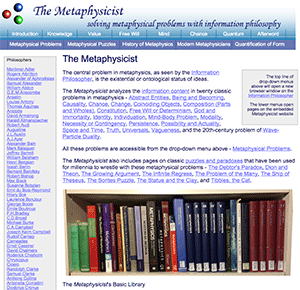
Metaphysicist.com is a new website that solves some classic metaphysical problems using the methods and tools of information philosophy See metaphysicist.com The Metaphysicist analyzes the information content in twenty classic problems in metaphysics - Abstract Entities, Being and Becoming, Causality, Chance, Change, Coinciding Objects, Composition (Parts and Wholes), Constitution, Free Will or Determinism, God and Immortality, Identity, Individuation, Mind-Body Problem, Modality, Necessity or Contingency, Persistence, Possibility and Actuality, Space and Time, Truth, Universals, Vagueness, and the 20th-century problem of Wave-Particle Duality.
Metaphysician or Metaphysicist?
Philosophers who specialize in metaphysics have traditionally been called metaphysicians in English (in French they are called a metaphysicien, in German a metaphysiker). Perhaps most modern anglo-american metaphysicians think problems in metaphysics can be treated as problems in language, potentially solved by conceptual analysis. They are analytical language philosophers. Others are specialists in modal logic, some who claim that modal logic is metaphysics..
But language is too flexible, too ambiguous, too full of metaphor, to be a metaphysical diagnostic tool. We must go beyond language games and logical puzzles to the underlying information contained in a concept, and to the matter that embodies the immaterial concept. This we do at our new website the Metaphysicist.
Today's metaphysicians are overwhelmingly naturalists. They believe everything can be explained by what they call the "laws of nature." They take those laws to be the laws of classical physics, because few understand modern quantum physics. Even many physicists are baffled by the nonintuitive aspects of quantum mechanics, which have led to dozens of interpretations of quantum mechanics.
Even more problematic, today's metaphysicians are materialists, even eliminative materialists who thinkk there is "nothing but" matter. They mistakenly believe that only material objects exist. The exceptions are religious metaphysicians who are still seeking a God and immortal souls.
Materialism is the claim that there is nothing in the world beyond the material (including energy), that everything follows "laws of nature," and that these laws are both causal and deterministic. So "supernatural" appears to imply "immaterial" and the freedom to break the laws of nature. Information philosophy denies the supernatural. But it defends immaterial information as that which constitutes the human spirit, or soul, the "ghost in the machine." And it defends ontological chance as the generator of novel, even metaphysical possibilities that are not determined by the "fixed past," opening the door to metaphysical free will.
Historical Background
Metaphysics has signified many things in the history of philosophy, but it has not strayed far from a literal reading of "beyond the physical," which meant beyond the material. The term was invented by the 1st-century BCE head of Aristotle's Peripatetic school, Andronicus of Rhodes. Andronicus edited and arranged Aristotle's works, giving the name Metaphysics (τα μετα τα φυσικα βιβλια), literally "the books beyond the physics," perhaps the books to be read after reading Aristotle's books on nature, which he called the Physics. The Greek for nature is physis, so metaphysical is also "beyond the natural."
Aristotle never used the term metaphysics. For Plato, Aristotle's master, the realm of abstract ideas was more "real" than that of physical. i.e., material or concrete, objects, because ideas can be more permanent (the Being of Parmenides), whereas material objects are constantly changing (the Becoming of Heraclitus).
In recent centuries then, metaphysical has become "beyond the material." Metaphysics has become the study of immaterial things, like the mind, which is said to "supervene" on the material brain. Metaphysics is a kind of idealism, in stark contrast to materialism. And metaphysics has failed in proportion to the phenomenal success of naturalism, the idea that the laws of nature alone can completely explain the contents of the universe. For the eliminative materialist and determinist philosopher, who thinks there is "nothing but" matter, metaphysics is dismissed as nonsense.
The books of Aristotle that Andronicus considered "beyond nature" included Aristotle's "First Philosophy" — ontology (the science of being), cosmology (the fundamental processes and original causes of physical things), and theology (is a god required as "first cause?").
Aristotle's Physics describes the four "causes" or "explanations" (aitia) of change and movement of objects already existing in the universe (the ideal formal and final causes, vs. the efficient and material causes). Aristotle's metaphysics can then be seen as explanations for existence itself. What exists? What is it to be? What processes can bring things into (or out of) existence? Is there a cause or explanation for the universe as a whole?
In critical philosophical discourse, metaphysics has perhaps been tarnished by its Latinate translation as "supernatural," with its strong theological implications. But from the beginning, Aristotle's books on "First Philosophy" considered God among the possible causes of the fundamental things in the universe. Tracing the regress of causes back in time as an infinite chain, Aristotle postulated a first cause or "uncaused cause." Where every motion needs a prior mover to explain it, he postulated an "unmoved first mover." These postulates became a major element of theology down to modern times.
Metaphysics is the division of philosophy which includes ontology, or the science of being, and cosmology, or the science of the fundamental causes and processes of things. The primary meaning of metaphysics is derived from those discussions by Aristotle which he himself called the First Philosophy or Theology, and which deal with the nature of being as such, with first causes, new beginnings or genesis, and thus with the existence of God.
For medieval philosophers, metaphysics was understood as the science of the supersensible. Albertus Magnus called it science beyond the physical. Thomas Aquinas narrowed it to the cognition of God. John Duns Scotus disagreed, arguing that only study of the world can yield knowledge of God. Scholastic philosophers mostly returned metaphysics to the study of being in itself, that is, ontology, which again today is the core area of metaphysical arguments. In renaissance Germany, Christian Wolff broadened metaphysics to include psychology, along with ontology, cosmology, and natural or rational theology. In renaissance England, Francis Bacon narrowed metaphysics to the Aristotelian study of formal and final causes, separating it from natural philosophy which he saw as the study of efficient and material causes.
Descartes made a turn from what exists to knowledge of what exists. He changed the emphasis from a study of being to a study of the conditions of knowledge or epistemology. For empiricists in England like John Locke and David Hume, metaphysics includes the "primary" things beyond psychology and "secondary" sensory experiences. They denied that any knowledge was possible apart from experimental and mathematical reasoning. Hume thought metaphysics was sophistry and illusion.
If we take in our hand any volume; of divinity or school metaphysics, for instance; let us ask, Does it contain any abstract reasoning concerning quantity or number? No. Does it contain any experimental reasoning concerning matter of fact and existence? No. Commit it then to the flames: for it can contain nothing but sophistry and illusion.
This "linguistic turn" and naturalizing of epistemology can be traced back to Kant and perhaps even to Descartes.
The logical positivism of Bertrand Russell and Ludwig Wittgenstein claims that all valid knowledge is scientific knowledge, though science is often criticized for "reducing" all phenomena to physical or chemical events. The logical positivists may have identified ontology not with the things themselves but what we can say - using concepts and language - about the things themselves.
Logical positivists and the logical empiricists of the Vienna Circle not only asserted that all knowledge is scientific knowledge derived from experience, i.e., from verifiable observations, they also added the logical analysis of language as the principal tool for solving philosophical problems. They divided statements into those that are reducible to simpler statements about experience and those with no empirical basis. These latter they called "metaphysics" and "meaningless." While language is too slippery and ambiguous to serve as a reliable tool for philosophical analysis, quantitative information, which underlies all language use, is such a tool.
Logical positivists and empiricists mistakenly claim that physical theories can be logically deduced (or derived) from the results of experiments. A second flaw in all empiricist thinking since Locke et al. is the mistaken idea that all knowledge is derived from experience, written on the blank slate of our minds, etc. In science, this is the flawed idea that all knowledge is ultimately experimental. To paraphrase Kant and Charles Sanders Peirce, theories without experiments may be empty, but experiments without theories are blind.
By contrast, the modern hypothetical-deductive method of science maintains that theories are not the logical (or inductive) consequences of experiments. As Einstein put it, after shaking off his early enthusiasm for Mach's positivistic ideas, theories are "free inventions of the human mind." Theories begin with hypotheses, mere guesses, "fictions" whose value is shown only when they can be confirmed by the results of experiments. Again and again, theories have predicted behaviors in as yet untested physical conditions that have surprised scientists, often suggesting new experiments that have extended the confirmation of theories, which again surprise us. As pure information, scientific knowledge is far beyond the results of experiments alone.
Metaphysics has been a search for the preconditions of existence, for the meaning of being, for original "first causes" (arche) and final ends (telos), especially for that which is beyond our senses - the "things themselves." In an epistemological age after Descartes, metaphysics came to include the preconditions for knowledge, especially knowledge of physical things, somehow independent of our sensible experience, and especially certain knowledge - knowledge by abstract reason alone. Although in recent years metaphysics has become something of a catch-all category for unsolved problems in philosophy and physics, ontology has remained its central concern and we will focus on the ontological status of material objects as "information structures" and the existential status of "immaterial information" about these structures and about information itself, as our basis for knowledge. Immaterial ideas are as real a part of the physical world and its causal structure as is matter, even though they are ideal and not material. Beyond synchronic ontology, diachronic cosmology has now traced back the origin and evolution of the material universe to a "Big Bang" some 13.75 billion years ago. But deep metaphysical questions remain. Did time start at the Big Bang? Was there space with nothing in it, before matter came into existence? Could there have been pure information before there was space and time? Did that information include the possibility of the universe? Are space and time only universal ideas, continuous immaterial forms, that help us organize and describe the workings of discontinuous and discrete particulate matter and energy?
How Information Philosophy Solves Some Problems in Metaphysics
The first claim of a metaphysics based on information is that the physical universe contains more than just matter (and energy) in motion. The Platonic realm of ideas, Kant's noumenal realm of "things in themselves" unconstrained by the deterministic laws of matter in motion, an immaterial mind that gives those ideas causal powers, and the immortal aspect of those ideas, all these touch on problems traditionally part of metaphysics.
Information philosophy may never answer "ultimate" questions like Leibniz' "Why is there something rather than nothing?," but it can answer why there appears to be a providential process at work that makes the world comfortable for life in general and man in particular.
For information philosophy, ontology is not about what we can think nor what we can say about the things themselves. Rather, it is about the immaterial information content of things, which is intimately connected with the information in the thoughts in our minds and in the concepts and words used to communicate the information that is in the things themselves. The partial isomorphism between the information in the external world of objects and the internal information about those objects in our minds is a quantitative measure of our knowledge about the objects.
Thus there is a second claim. Because the external information is in the things themselves, information philosophy provides an ontological inventory of what exists in a mind-independent reality that in no way depends on how we came to acquire the knowledge of what exists. Furthermore, complete information in a thing (while probably rarely obtainable) may contain what it is like to be some thing.
A third claim rests on the unqualified existence of immaterial, non-substantial, abstract, universals, some of which are necessary by logical definition, all of them existing in the Platonic and noumenal realm of pure information. By contrast, substantial concrete particulars are all material (including the pure energy of radiation) and thus contingent and empirical. The third claim is that, although our knowledge of the information realm has come initially from experience, that is from empirical sources, the information realm itself is non-empirical (though physical) and therefore non-reducible to "causally closed" matter in motion.
Metaphysics asks about the general nature of all things/beings, and Being itself. Information is such an essential property of all things. And it is a quantitative property, much more powerful that linguistic concepts. It gives form to the matter. Matter without form is not distinguishable, comprehensible, blind/invisible. Form without matter is empty - an essence without an existence. Individuation, instantiation of a form in matter, etc.
Problems in Metaphysics
Many of the problems facing today's metaphysicians concern the fundamental structure of reality, the underlying material substance and the creative process that gives individual objects their shape and form, their qualities or properties.
Apart from appearances and the sense data of experiences, what is the underlying reality, what is there "really?" What "constitutes" a material object? What is its "principle of individuation?" Does a concrete object maintain its identity as it moves in space and time?
A surprising number of today's metaphysical questions were first asked over two millennia ago by the ancient Greek philosophers. It is shocking that so little progress has been made toward definitive answers to some of them.
Perhaps it is because metaphysics is a search for certain knowledge that is beyond the material world, not derivable from experience, and eternally true (in any possible world). Such knowledge is limited to immaterial ideas in logic ("A is A"), mathematics (7 + 5 = 12), and some sentences or propositions that are true by (conventional) definition.
Can unchanging eternal ideas and truths provide us any knowledge about the constantly changing material world?
And what is the existential (or ontological) status of these abstract ideas? Do numbers exist? If so, is their kind of existence different from that of material objects? Do the past and present exist? Are there immaterial minds apart from material brains? How could they interact?
Although many metaphysicians claim to be exploring the fundamental structure of reality, the overwhelming fraction of their writings is about problems in analytic linguistic philosophy, that is to say problems with words. Many questions appear to be verbal quibbles. Others lack meaning or have no obvious truth value, dissolving into paradoxes.
Based on current practice, we can sharpen the definition of a metaphysician to be an analytic language philosopher who discusses metaphysical problems.
By contrast, a metaphysicist is an information philosopher who is familiar with modern physics, chemistry, and biology, as well as the interpretation of quantum physics. The fundamental structure of reality today must confront the mysteries and puzzles of quantum reality.
For example, the wave function of a quantum particle is pure information. Some interpretations of quantum mechanics are fundamentally metaphysical, problems for a metaphysicist.
Note that many metaphysical problems are dichotomies, with either/or debates, suggesting that a common underlying theme is some kind of dualism, almost always the dualism between materialism and idealism (pure abstract information).
For Teachers
For Scholars
References
Chisholm, R., 1989. On Metaphysics, U. of Minnesota Press.
Lowe, R. J., 2002. A Survey of Metaphysics, Oxford University Press.
Rea, M. C. [Ed.], 2008. Metaphysics: Critical Concepts in Philosophy, Five Volumes, Oxford University Press.
Sider, T. J. Hawthorne, and D. W. Zimmerman, 2008. Contemporary Debates in Metaphysics, Blackwell Publishing.
Taylor, R., 1963. Metaphysics, Prentice Hall.
Van Inwagen, P., 2015. Metaphysics, 4th Ed., U. of Notre Dame Press.
Van Inwagen, P., and D. W. Zimmerman, 2008. Metaphysics: The Big Questions, 2nd Ed., Blackwell Publishing.
|

