Follow infophilosopher:
 |
|

|
|
|
Philosophers
Mortimer Adler Rogers Albritton Alexander of Aphrodisias Samuel Alexander William Alston Anaximander G.E.M.Anscombe Anselm Louise Antony Thomas Aquinas Aristotle David Armstrong Harald Atmanspacher Robert Audi Augustine J.L.Austin A.J.Ayer Alexander Bain Mark Balaguer Jeffrey Barrett William Barrett William Belsham Henri Bergson George Berkeley Isaiah Berlin Richard J. Bernstein Bernard Berofsky Robert Bishop Max Black Susanne Bobzien Emil du Bois-Reymond Hilary Bok Laurence BonJour George Boole Émile Boutroux Daniel Boyd F.H.Bradley C.D.Broad Michael Burke Jeremy Butterfield Lawrence Cahoone C.A.Campbell Joseph Keim Campbell Rudolf Carnap Carneades Nancy Cartwright Gregg Caruso Ernst Cassirer David Chalmers Roderick Chisholm Chrysippus Cicero Tom Clark Randolph Clarke Samuel Clarke Anthony Collins Antonella Corradini Diodorus Cronus Jonathan Dancy Donald Davidson Mario De Caro Democritus Daniel Dennett Jacques Derrida René Descartes Richard Double Fred Dretske John Earman Laura Waddell Ekstrom Epictetus Epicurus Austin Farrer Herbert Feigl Arthur Fine John Martin Fischer Frederic Fitch Owen Flanagan Luciano Floridi Philippa Foot Alfred Fouilleé Harry Frankfurt Richard L. Franklin Bas van Fraassen Michael Frede Gottlob Frege Peter Geach Edmund Gettier Carl Ginet Alvin Goldman Gorgias Nicholas St. John Green H.Paul Grice Ian Hacking Ishtiyaque Haji Stuart Hampshire W.F.R.Hardie Sam Harris William Hasker R.M.Hare Georg W.F. Hegel Martin Heidegger Heraclitus R.E.Hobart Thomas Hobbes David Hodgson Shadsworth Hodgson Baron d'Holbach Ted Honderich Pamela Huby David Hume Ferenc Huoranszki Frank Jackson William James Lord Kames Robert Kane Immanuel Kant Tomis Kapitan Walter Kaufmann Jaegwon Kim William King Hilary Kornblith Christine Korsgaard Saul Kripke Thomas Kuhn Andrea Lavazza James Ladyman Christoph Lehner Keith Lehrer Gottfried Leibniz Jules Lequyer Leucippus Michael Levin Joseph Levine George Henry Lewes C.I.Lewis David Lewis Peter Lipton C. Lloyd Morgan John Locke Michael Lockwood Arthur O. Lovejoy E. Jonathan Lowe John R. Lucas Lucretius Alasdair MacIntyre Ruth Barcan Marcus Tim Maudlin James Martineau Nicholas Maxwell Storrs McCall Hugh McCann Colin McGinn Michael McKenna Brian McLaughlin John McTaggart Paul E. Meehl Uwe Meixner Alfred Mele Trenton Merricks John Stuart Mill Dickinson Miller G.E.Moore Ernest Nagel Thomas Nagel Otto Neurath Friedrich Nietzsche John Norton P.H.Nowell-Smith Robert Nozick William of Ockham Timothy O'Connor Parmenides David F. Pears Charles Sanders Peirce Derk Pereboom Steven Pinker U.T.Place Plato Karl Popper Porphyry Huw Price H.A.Prichard Protagoras Hilary Putnam Willard van Orman Quine Frank Ramsey Ayn Rand Michael Rea Thomas Reid Charles Renouvier Nicholas Rescher C.W.Rietdijk Richard Rorty Josiah Royce Bertrand Russell Paul Russell Gilbert Ryle Jean-Paul Sartre Kenneth Sayre T.M.Scanlon Moritz Schlick John Duns Scotus Arthur Schopenhauer John Searle Wilfrid Sellars David Shiang Alan Sidelle Ted Sider Henry Sidgwick Walter Sinnott-Armstrong Peter Slezak J.J.C.Smart Saul Smilansky Michael Smith Baruch Spinoza L. Susan Stebbing Isabelle Stengers George F. Stout Galen Strawson Peter Strawson Eleonore Stump Francisco Suárez Richard Taylor Kevin Timpe Mark Twain Peter Unger Peter van Inwagen Manuel Vargas John Venn Kadri Vihvelin Voltaire G.H. von Wright David Foster Wallace R. Jay Wallace W.G.Ward Ted Warfield Roy Weatherford C.F. von Weizsäcker William Whewell Alfred North Whitehead David Widerker David Wiggins Bernard Williams Timothy Williamson Ludwig Wittgenstein Susan Wolf Scientists David Albert Michael Arbib Walter Baade Bernard Baars Jeffrey Bada Leslie Ballentine Marcello Barbieri Gregory Bateson Horace Barlow John S. Bell Mara Beller Charles Bennett Ludwig von Bertalanffy Susan Blackmore Margaret Boden David Bohm Niels Bohr Ludwig Boltzmann Emile Borel Max Born Satyendra Nath Bose Walther Bothe Jean Bricmont Hans Briegel Leon Brillouin Stephen Brush Henry Thomas Buckle S. H. Burbury Melvin Calvin Donald Campbell Sadi Carnot Anthony Cashmore Eric Chaisson Gregory Chaitin Jean-Pierre Changeux Rudolf Clausius Arthur Holly Compton John Conway Simon Conway-Morris Jerry Coyne John Cramer Francis Crick E. P. Culverwell Antonio Damasio Olivier Darrigol Charles Darwin Richard Dawkins Terrence Deacon Lüder Deecke Richard Dedekind Louis de Broglie Stanislas Dehaene Max Delbrück Abraham de Moivre Bernard d'Espagnat Paul Dirac Hans Driesch John Dupré John Eccles Arthur Stanley Eddington Gerald Edelman Paul Ehrenfest Manfred Eigen Albert Einstein George F. R. Ellis Hugh Everett, III Franz Exner Richard Feynman R. A. Fisher David Foster Joseph Fourier Philipp Frank Steven Frautschi Edward Fredkin Augustin-Jean Fresnel Benjamin Gal-Or Howard Gardner Lila Gatlin Michael Gazzaniga Nicholas Georgescu-Roegen GianCarlo Ghirardi J. Willard Gibbs James J. Gibson Nicolas Gisin Paul Glimcher Thomas Gold A. O. Gomes Brian Goodwin Joshua Greene Dirk ter Haar Jacques Hadamard Mark Hadley Patrick Haggard J. B. S. Haldane Stuart Hameroff Augustin Hamon Sam Harris Ralph Hartley Hyman Hartman Jeff Hawkins John-Dylan Haynes Donald Hebb Martin Heisenberg Werner Heisenberg Grete Hermann John Herschel Basil Hiley Art Hobson Jesper Hoffmeyer Don Howard John H. Jackson William Stanley Jevons Roman Jakobson E. T. Jaynes Pascual Jordan Eric Kandel Ruth E. Kastner Stuart Kauffman Martin J. Klein William R. Klemm Christof Koch Simon Kochen Hans Kornhuber Stephen Kosslyn Daniel Koshland Ladislav Kovàč Leopold Kronecker Rolf Landauer Alfred Landé Pierre-Simon Laplace Karl Lashley David Layzer Joseph LeDoux Gerald Lettvin Gilbert Lewis Benjamin Libet David Lindley Seth Lloyd Werner Loewenstein Hendrik Lorentz Josef Loschmidt Alfred Lotka Ernst Mach Donald MacKay Henry Margenau Owen Maroney David Marr Humberto Maturana James Clerk Maxwell Ernst Mayr John McCarthy Warren McCulloch N. David Mermin George Miller Stanley Miller Ulrich Mohrhoff Jacques Monod Vernon Mountcastle Emmy Noether Donald Norman Travis Norsen Alexander Oparin Abraham Pais Howard Pattee Wolfgang Pauli Massimo Pauri Wilder Penfield Roger Penrose Steven Pinker Colin Pittendrigh Walter Pitts Max Planck Susan Pockett Henri Poincaré Daniel Pollen Ilya Prigogine Hans Primas Zenon Pylyshyn Henry Quastler Adolphe Quételet Pasco Rakic Nicolas Rashevsky Lord Rayleigh Frederick Reif Jürgen Renn Giacomo Rizzolati A.A. Roback Emil Roduner Juan Roederer Jerome Rothstein David Ruelle David Rumelhart Robert Sapolsky Tilman Sauer Ferdinand de Saussure Jürgen Schmidhuber Erwin Schrödinger Aaron Schurger Sebastian Seung Thomas Sebeok Franco Selleri Claude Shannon Charles Sherrington Abner Shimony Herbert Simon Dean Keith Simonton Edmund Sinnott B. F. Skinner Lee Smolin Ray Solomonoff Roger Sperry John Stachel Henry Stapp Tom Stonier Antoine Suarez Leo Szilard Max Tegmark Teilhard de Chardin Libb Thims William Thomson (Kelvin) Richard Tolman Giulio Tononi Peter Tse Alan Turing C. S. Unnikrishnan Nico van Kampen Francisco Varela Vlatko Vedral Vladimir Vernadsky Mikhail Volkenstein Heinz von Foerster Richard von Mises John von Neumann Jakob von Uexküll C. H. Waddington James D. Watson John B. Watson Daniel Wegner Steven Weinberg Paul A. Weiss Herman Weyl John Wheeler Jeffrey Wicken Wilhelm Wien Norbert Wiener Eugene Wigner E. O. Wilson Günther Witzany Stephen Wolfram H. Dieter Zeh Semir Zeki Ernst Zermelo Wojciech Zurek Konrad Zuse Fritz Zwicky Presentations Biosemiotics Free Will Mental Causation James Symposium |
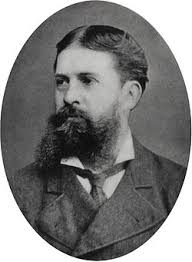
Charles Sanders Peirce
102. In an article published in The Monist for January, 1891, I endeavored to show what ideas ought to form the warp of a system of philosophy, and particularly emphasized that of absolute chance. In the number of April, 1892, I argued further in favor of that way of thinking, which it will be convenient to christen tychism (from τύχη, chance). A serious student of philosophy will be in no haste to accept or reject this doctrine; but he will see in it one of the chief attitudes which speculative thought may take, feeling that it is not for an individual, nor for an age, to pronounce upon a fundamental question of philosophy. That is a task for a whole era to work out. I have begun by showing that tychism must give birth to an evolutionary cosmology, in which all the regularities of nature and of mind are regarded as products of growth. The next step in the study of cosmology must be to examine the general law of mental action. In doing this, I shall for the time drop my tychism out of view, in order to allow a free and independent expansion to another conception signalised in my first Monist paper as one of the most indispensable to philosophy, though it was not there dwelt upon ; I mean the idea of continuity. The tendency to regard continuity, in the sense in which I shall define it, as an idea of prime importance in philosophy may conveniently be termed synechism.Peirce's idea of Tychism was inspired by the writings of Charles Renouvier and Alfred Fouillée, who were proponents of irreducible chance and indeterminism decades before quantum mechanics. But Renouvier and Fouillée were neo-Kantians who saw indeterminism and determinism as antinomies needing to be reconciled. Both speculated about free will somehow based on indeterminism. Peirce also would follow a sort of neo-Hegelian Aufhebung, reconciling the two moments, tychastic (chance) and anancastic (determined), with his agapastic evolutionary love which he also called continuity or synechism. What he did say in was somewhat obscure and equivocal. He talks vaguely about two sides to the free-will question that he does not resolve. [T]he question of free-will and fate in its simplest form, stripped of verbiage, is something like this: I have done something of which I am ashamed; could I, by an effort of the will, have resisted the temptation, and done otherwise?... it is perfectly true to say that, if I had willed to do otherwise than I did, I should have done otherwise. On the other hand, arranging the facts so as to exhibit another important consideration, it is equally true that, when a temptation has once been allowed to work, it will, if it has a certain force, produce its effect, let me struggle how I may.In his "Doctrine of Necessity Examined," Peirce attacks the determinism of Democritus, and says that "Epicurus, in revising the atomic doctrine and repairing its defenses, found himself obliged to suppose that atoms swerve from their courses by spontaneous chance; and thereby he conferred upon the theory life and entelechy."Peirce notes that Aristotle and later Epicurus both admitted free will and moral responsibility for a voluntary agent who deliberates when making a choice or decision. The freedom of the will, too, was admitted both by Aristotle and by Epicurus. But the Stoa, which in every department seized upon the most tangible, hard, and lifeless element, and blindly denied the existence of every other, which, for example, impugned the validity of the inductive method and wished to fill its place with the reductio ad absurdum, very naturally became the one school of ancient philosophy to stand by a strict necessitarianism, thus returning to a single principle of Democritus that Epicurus had been unable to swallow.Peirce (correctly) reads Aristotle as espousing absolute chance as a possible fifth cause beyond the classical four (material, formal, efficient, and final-teleological). In Physics, Book II, where Aristotle defined those four causes, he said Chance and spontaneity are also reckoned among causes.Aristotle notes that The early physicists [notably Democritus and Leucippus] found no place for chance among the causes they recognized - love, strife, fire, mind, or the like.A bit later, Aristotle finds that Some attribute our Heaven and all the worlds to chance happenings, [that the] cosmic order came about by chance.Now the Stoics were great logicians and Peirce one of the greatest modern logicians. They were both aware of the law of the excluded middle. For any proposition, either that proposition is true or its negation is true. There is no third possibility. Peirce finds that Aristotle offers a tertium quid beyond the "two moments" of chance and necessity. Citing Aristote's Physics, Book II. Peirce finds that Aristotle repeatedly and emphatically condemned the dictum of Democritus (especially in the Physics, Book II, chapters iv, v, vi), holding that events come to pass in three ways, namely (1) by external compulsion, or the action of efficient causes, (2) by virtue of an inward nature, or the influence of final causes, and (3) irregularly without definite cause, but just by absolute chance; and this doctrine is of the inmost essence of Aristotelianism. It affords, at any rate, a valuable enumeration of the possible ways in which anything can be supposed to have come about.Note that Aristotle spread over several chapters these three ways that events come to pass, whereas Epicurus, in the next century, combined the three ways in two short lines of his letter to Menoeceus, just as Peirce combines them above in one sentence. Peirce does not quote Epicurus, but must have read him? ...some things happen of necessity (ἀνάγκη), others by chance (τύχη), others through our own agency (παρ’ ἡμᾶς).The Stoics strongly criticized Epicurus for suggesting that chance contributes to freedom. But Epicurus never did say the swerve was directly involved in decisions and choices, which would make actions random. His ancient critics, as well as modern determinists and compatibilists), have claimed mistakenly that Epicurus did assume "one swerve - one decision." Some recent philosophers call this the "traditional interpretation" of Epicurean free will. We see that Epicurus, perhaps following Aristotle, finds a tertium quid, beyond necessity (Democritus' physics) and chance (Epicurus' swerve). The tertium quid for Epicurus is agent autonomy. Aristotle said it was deliberation. With his fondness for triads, Peirce should have admired Epicurus' argument that human agents have an autonomous ability to transcend the chance and necessity of some events. This special ability makes us morally responsible for our actions. Can we see Peirce finding his own deep interest in tuche and ananke in Epicurus' concise wording of the problem of human agency? ...some things happen of necessity (ἀνάγκη), others by chance (τύχη), others through our own agency (παρ’ ἡμᾶς).Peirce is boastful about his knowledge of early philosophers, and we know he was familiar with the ancient Stoic objection to chance (since at least Chrysippus and Cicero) as the cause of human actions. The Stoics objected that we cannot be responsibile for chance actions. Peirce agrees, saying "To undertake to account for anything by saying baldly that it is due to chance would, indeed, be futile. But this I do not do. I make use of chance chiefly to make room for a principle of generalization, or tendency to form habits, which I hold has produced all regularities."The Stoics may have made Peirce guarded about chance and free will. And, without his ever formulating it clearly, he worried about the standard argument against free will, that neither necessity nor chance can provide free will. I attribute it altogether to chance, it is true, but to chance in the form of a spontaneity which is to some degree regular. It seems to me clear at any rate that one of these two positions must be taken, or else specification must be supposed due to a spontaneity which develops itself in a certain and not in a chance way, by an objective logic like that of Hegel. This last way I leave as an open possibility, for the present; for it is as much opposed to the necessitarian scheme of existence as my own theory is.Since, well before the 1890's, Peirce's close colleague William James had embraced absolute chance as contributing the alternative possibilities that made the will free and the future open, it is odd that Peirce, the champion of chance, did not support James's two-stage model for free will. In the first stage chance, in the second stage deliberative choice. But then, sadly, the support between James and Peirce was mostly one way. Even more puzzling is Peirce's failure to see (as James saw) the parallel between two stages of free will and the two steps of Darwinian evolution, the first step generating chance variations and natural selection determining the outcome in the second step. Peirce's life work was primarily in science, and he was well aware that observational error made the doctrine of necessity strictly unprovable by any experiment. Peirce was quite familiar with the work of astronomers like that of the Belgian Adolphe Quételet. Quételet developed a theory of observational errors that had the same mathematical form as Abraham de Moivre's approximation to the binomial distribution in his book The Doctrine of Chances. De Moivre also derived the "bell-shaped" distribution known as "Gaussian" and the "central limit theorem" of Laplace's calculus of probabilities. It was Peirce who gave the modern name "Normal" to this distribution. De Moivre's work was a famous book called "The Doctrine of Chances." In the 1738 edition he found that in the limit of large numbers of tosses of a coin, the discrete binomial expansion of (p - q)n could be approximated by a continuous mathematical curve (the modern bell curve). 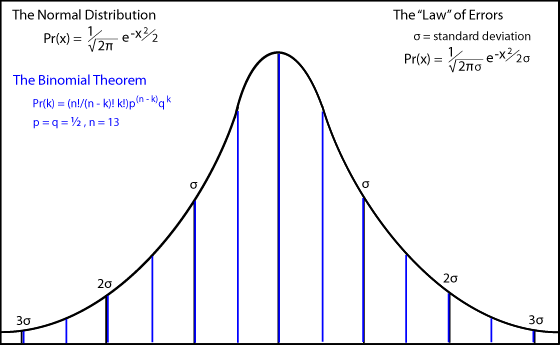 But Peirce thought about this "normal" distribution differently from all the earlier scientists and mathematicians back to De Moivre. For all of them, chance was merely epistemic, the result of human ignorance into the exact deterministic workings of the laws of nature. Chance is "atheistical," said De Moivre, and this set an attitude toward chance that Peirce opposed. For Peirce, chance drove the growth of complexity he saw everywhere in the universe, "Everywhere the main fact is growth and increasing complexity...there is probably in nature some agency by which the complexity and diversity of things can be increased."
Peirce's (and Darwin's) evolutionary view opposed the idea that the variety of everything in the world was implicit (if not explicitly present) from the beginning of time. Peirce said, "variety is a fact which must be admitted; and the theory of chance merely consists in supposing this diversification does not antedate all time."
Social scientists like Quételet and the English historian Henry Thomas Buckle even reached the absurd conclusion that the regularities seen in normal distributions of random events "proved" that the events themselves were not really random!
Better than any other philosopher, Peirce articulated the difference between a priori probabilities and a posteriori statistics.
He knew that probabilities are a priori theories and that statistics are a posteriori empirical measurements, the results of observations and experiments.
Peirce used the theory of errors in his thirty years of scientific work for the U.S. Coast Survey, and his father had developed an important criterion for rejecting observational data when it was too far from the standard deviation of errors. For Peirce, necessity and determinism were merely assumptions. That there is nothing necessary and logically true of the universe, Peirce learned from discussions of the work of Alexander Bain in the famous "Metaphysical Club" of the 1860's, although the ultimate source for the limits on logic was no doubt David Hume's skepticism.
Peirce modeled his ideas about "evolutionary love"" on the 1859 work of Charles Darwin, but he was not satisfied with Darwin's fortuitous variation and natural selection. He falsely associated it with the Social Darwinist thinking of his time and called it a "greed philosophy."
But Peirce thought about this "normal" distribution differently from all the earlier scientists and mathematicians back to De Moivre. For all of them, chance was merely epistemic, the result of human ignorance into the exact deterministic workings of the laws of nature. Chance is "atheistical," said De Moivre, and this set an attitude toward chance that Peirce opposed. For Peirce, chance drove the growth of complexity he saw everywhere in the universe, "Everywhere the main fact is growth and increasing complexity...there is probably in nature some agency by which the complexity and diversity of things can be increased."
Peirce's (and Darwin's) evolutionary view opposed the idea that the variety of everything in the world was implicit (if not explicitly present) from the beginning of time. Peirce said, "variety is a fact which must be admitted; and the theory of chance merely consists in supposing this diversification does not antedate all time."
Social scientists like Quételet and the English historian Henry Thomas Buckle even reached the absurd conclusion that the regularities seen in normal distributions of random events "proved" that the events themselves were not really random!
Better than any other philosopher, Peirce articulated the difference between a priori probabilities and a posteriori statistics.
He knew that probabilities are a priori theories and that statistics are a posteriori empirical measurements, the results of observations and experiments.
Peirce used the theory of errors in his thirty years of scientific work for the U.S. Coast Survey, and his father had developed an important criterion for rejecting observational data when it was too far from the standard deviation of errors. For Peirce, necessity and determinism were merely assumptions. That there is nothing necessary and logically true of the universe, Peirce learned from discussions of the work of Alexander Bain in the famous "Metaphysical Club" of the 1860's, although the ultimate source for the limits on logic was no doubt David Hume's skepticism.
Peirce modeled his ideas about "evolutionary love"" on the 1859 work of Charles Darwin, but he was not satisfied with Darwin's fortuitous variation and natural selection. He falsely associated it with the Social Darwinist thinking of his time and called it a "greed philosophy."
293. The Origin of Species of Darwin merely extends politico-economical views of progress to the entire realm of animal and vegetable life. The vast majority of our contemporary naturalists hold the opinion that the true cause of those exquisite and marvelous adaptations of nature for which, when I was a boy, men used to extol the divine wisdom, is that creatures are so crowded together that those of them that happen to have the slightest advantage force those less pushing into situations unfavorable to multiplication or even kill them before they reach the age of reproduction. Among animals, the mere mechanical individualism is vastly reënforced as a power making for good by the animal's ruthless greed. As Darwin puts it on his title-page, it is the struggle for existence; and he should have added for his motto: Every individual for himself, and the Devil take the hindmost! Jesus, in his sermon on the Mount, expressed a different opinion. 294. Here, then, is the issue. The gospel of Christ says that progress comes from every individual merging his individuality in sympathy with his neighbors. On the other side, the conviction of the nineteenth century is that progress takes place by virtue of every individual's striving for himself with all his might and trampling his neighbor under foot whenever he gets a chance to do so. This may accurately be called the Gospel of Greed.Peirce also rejected the deterministic evolution scheme of Herbert Spencer, and proposed his own grand scheme for the evolution of everything including the laws of Nature! He called this synechism, his coined term for continuity, community, and the "evolutionary love" of God, in clear contrast to the merely random events of his tychism. Pierce's evolutionist thinking resembles that of Hegel. It was the basis for the evolutionary growth of variety, of irregular departures from an otherwise mechanical universe, including life and Peirce's own original thoughts. For Peirce and Hegel, ideas are living things with meanings that grow over time. Peirce was a "realist" in that he believed these ideas have a metaphysically real existence. There is no doubt that language evolves, and Peirce made foundational contributions to the theory of semiotics, the study of signs and symbols. "Every symbol is a living thing, in a very strict sense that is no mere figure of speech. The body of the symbol changes slowly, but its meaning inevitably grows, incorporates new elements and throws off old ones." Every symbol is, in its origin, either an image of the idea signified, or a reminiscence of some original occurrence, person or thing, connected with its meaning, or it is a metaphor. "A regular progression of one, two, three may be remarked in the three orders of signs, Icon, Index, Symbol. The Icon has no dynamical connection with the object it represents; it simply happens that its qualities resemble those of that object, and excite analogous sensations in the mind for which it is a likeness. But it really stands unconnected with them. The Index is physically connected with its object; they make an organic pair, but the interpreting mind has nothing to do with this connection, except remarking it, after it is established. The Symbol [ground] is connected with its object by virtue of the idea of the symbol-using mind [interpretant], without which no such connection would exist.
The author's response to the anticipated suspicion that he attaches a superstitious or fanciful importance to the number three, and forces divisions to a Procrustean bed of trichotomy. 568. I fully admit that there is a not uncommon craze for trichotomies. I do not know but the psychiatrists have provided a name for it. If not, they should. " Trichimania," [?] unfortunately, happens to be preempted for a totally different passion; but it might be called triadomany. I am not so afflicted; but I find myself obliged, for truth's sake, to make such a large number of trichotomies that I could not [but] wonder if my readers, especially those of them who are in the way of knowing how common the malady is, should suspect, or even opine, that I am a victim of it. But I am now and here going to convince those who are open to conviction, that it is not so, but that there is a good reason why a thorough student of the subject of this book should be led to make trichotomies, that the nature of the science is such that not only is it to be expected that it should involve real trichotomies, but furthermore, that there is a cause that tends to give this form even to faulty divisions, such as a student, thirsting for thoroughness and full of anxiety lest he omit any branch of his subject, will be liable to fall into. Were it not for this cause, the trichotomic form would, as I shall show, be a strong argument in confirmation of the reasoning whose fruit should take this form.In his fifth Monist essay, "Evolutionary Love," Peirce defined his basic triad as tychasm, anancasm, and agapasm. I propose to devote a few pages to a very slight examination of these questions in their relation to the historical development of human thought. I first formulate for the reader's convenience the briefest possible definitions of the three conceivable modes of development of thought, distinguishing also two varieties of anancasm and three of agapasm. The tychastic development of thought, then, will consist in slight departures from habitual ideas in different directions indifferently, quite purposeless and quite unconstrained whether by outward circumstances or by force of logic, these new departures being followed by unforeseen results which tend to fix some of them as habits more than others. The anancastic development of thought will consist of new ideas adopted without foreseeing whither they tend, but having a character determined by causes either external to the mind, such as changed circumstances of life, or internal to the mind as logical developments of ideas already accepted, such as generalizations. The agapastic development of thought is the adoption of certain mental tendencies, not altogether heedlessly, as in tychasm, nor quite blindly by the mere force of circumstances or of logic, as in anancasm, but by an immediate attraction for the idea itself, whose nature is divined before the mind possesses it, by the power of sympathy, that is, by virtue of the continuity of mind; and this mental tendency may be of three varieties, as follows. First, it may affect a whole people or community in its collective personality, and be thence communicated to such individuals as are in powerfully sympathetic connection with the collective people, although they may be intellectually incapable of attaining the idea by their private understandings or even perhaps of consciously apprehending it. Second, it may affect a private person directly, yet so that he is only enabled to apprehend the idea, or to appreciate its attractiveness, by virtue of his sympathy with his neighbors, under the influence of a striking experience or development of thought. The conversion of St. Paul may be taken as an example of what is meant. Third, it may affect an individual, independently of his human affections, by virtue of an attraction it exercises upon his mind, even before he has comprehended it. This is the phenomenon which has been well called the divination of genius; for it is due to the continuity between the man's mind and the Most High.Then, in the unpublished "A Guess at the Riddle," Peirce made a successful triadomanic move. He extended Darwin's two-step evolutionary process of random spontaneous variation followed by natural selection into a three-step process - "first, the principle of individual variation or sporting; second, the principle of hereditary transmission, which wars against the first principle; and third, the principle of the elimination of unfavorable characters." The result is not exactly tychastic-anancastic-agapastic, but it does break out the need for inheritance, which Darwin knew, but the mechanism for which which was not understood until the synthesis of Mendelian genetics in the early twentieth century and the mid-century discovery of DNA. Peirce seems to make the question of free will into a reductio ad absurdum. [T]he question of free-will and fate in its simplest form, stripped of verbiage, is something like this: I have done something of which I am ashamed; could I, by an effort of the will, have resisted the temptation, and done otherwise? The philosophical reply is, that this is not a question of fact, but only of the arrangement of facts. Arranging them so as to exhibit what is particularly pertinent to my question -- namely, that I ought to blame myself for having done wrong -- it is perfectly true to say that, if I had willed to do otherwise than I did, I should have done otherwise. On the other hand, arranging the facts so as to exhibit another important consideration, it is equally true that, when a temptation has once been allowed to work, it will, if it has a certain force, produce its effect, let me struggle how I may. There is no objection to a contradiction in what would result from a false supposition. The reductio ad absurdum consists in showing that contradictory results would follow from a hypothesis which is consequently judged to be false. Many questions are involved in the free-will discussion, and I am far from desiring to say that both sides are equally right. On the contrary, I am of opinion that one side denies important facts, and that the other does not. But what I do say is, that the above single question was the origin of the whole doubt; that, had it not been for this question, the controversy would never have arisen; and that this question is perfectly solved in the manner which I have indicated.In his Fixation of Belief, Peirce set out his ideas about knowledge acquisition. The object of reasoning is to find out, from the consideration of what we already know, something else which we do not know. Consequently, reasoning is good if it be such as to give a true conclusion from true premisses, and not otherwise. Thus, the question of validity is purely one of fact and not of thinking. A being the facts stated in the premisses and B being that concluded, the question is, whether these facts are really so related that if A were B would generally be. If so, the inference is valid; if not, not. It is not in the least the question whether, when the premisses are accepted by the mind, we feel an impulse to accept the conclusion also. It is true that we do generally reason correctly by nature. But that is an accident; the true conclusion would remain true if we had no impulse to accept it; and the false one would remain false, though we could not resist the tendency to believe in it.For Peirce, belief indicates the existence of a habit that will guide action. We think of it as actionable information. Doubt is quite the contrary; it inhibits action. The feeling of believing is a more or less sure indication of there being established in our nature some habit which will determine our actions. Doubt never has such an effect. Doubt is an uneasy and dissatisfied state from which we struggle to free ourselves and pass into the state of belief; while the latter is a calm and satisfactory state which we do not wish to avoid, or to change to a belief in anything else. On the contrary, we cling tenaciously, not merely to believing, but to believing just what we do believe. Thus, both doubt and belief have positive effects upon us, though very different ones. Belief does not make us act at once, but puts us into such a condition that we shall behave in some certain way, when the occasion arises. Doubt has not the least such active effect, but stimulates us to inquiry until it is destroyed. This reminds us of the irritation of a nerve and the reflex action produced thereby; while for the analogue of belief, in the nervous system, we must look to what are called nervous associations -- for example, to that habit of the nerves in consequence of which the smell of a peach will make the mouth water. The irritation of doubt causes a struggle to attain a state of belief. I shall term this struggle inquiry, though it must be admitted that this is sometimes not a very apt designation. The irritation of doubt is the only immediate motive for the struggle to attain belief. It is certainly best for us that our beliefs should be such as may truly guide our actions so as to satisfy our desires; and this reflection will make us reject every belief which does not seem to have been so formed as to insure this result. But it will only do so by creating a doubt in the place of that belief. With the doubt, therefore, the struggle begins, and with the cessation of doubt it ends. Hence, the sole object of inquiry is the settlement of opinion. 1. Some philosophers have imagined that to start an inquiry it was only necessary to utter a question whether orally or by setting it down upon paper, and have even recommended us to begin our studies with questioning everything! But the mere putting of a proposition into the interrogative form does not stimulate the mind to any struggle after belief. There must be a real and living doubt, and without this all discussion is idle. 2. It is a very common idea that a demonstration must rest on some ultimate and absolutely indubitable propositions. These, according to one school, are first principles of a general nature; according to another, are first sensations. But, in point of fact, an inquiry, to have that completely satisfactory result called demonstration, has only to start with propositions perfectly free from all actual doubt. If the premisses are not in fact doubted at all, they cannot be more satisfactory than they are. 3. Some people seem to love to argue a point after all the world is fully convinced of it. But no further advance can be made. When doubt ceases, mental action on the subject comes to an end; and, if it did go on, it would be without a purpose.
"Everything is both similar and dissimilar to everything else" Collected Papers I, Principles of Philosophy, 1.566)
Idealism without Materialism is void. Materialism without Idealism is blind. (Variation on the Kantian chiasmos.)
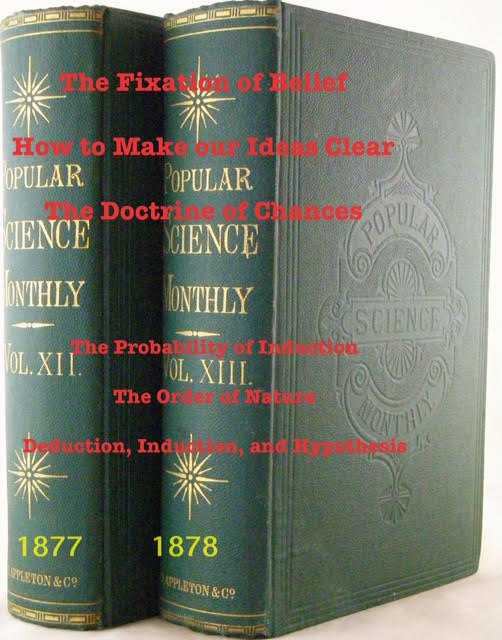
Popular Science Monthly Papers
The Fixation of Belief, Popular Science Monthly, vol.12, 1-15. (November 1877)
How To Make Our Ideas Clear, Popular Science Monthly, vol.12, 286-302. (January 1878)
The Doctrine of Chances, Popular Science Monthly, vol.12, 604-615. (March 1878)
The Probability of Induction, Popular Science Monthly, vol.12, 705-718. (April 1878)
The Order of Nature, Popular Science Monthly, vol.13, 203-217. (June 1878)
Algebra of Logic Papers
On the Algebra of Logic, American Journal of Mathematics 3.1 1880, 15-57
On the Algebra of Logic: A Contribution to the Philosophy of Notation, American Journal of Mathematics 7.2 1885, 180-196
On the Algebra of Logic, American Journal of Mathematics 7.3 1885, 197-202
Monist Papers
The Architecture of Theories from Monist, vol.1, p.161-176, (1891)
The Doctrine of Necessity Examined from Monist, vol.2 (1892)
The Law of Mind from Monist, vol.2, pp.533-559 (1892)
Man's Glassy Essence from Monist, vol.2, pp.1-22 (1892)
Evolutionary Love from Monist, vol. 3, p.176 (1892/1893)
Reply to the Necessitarians from Monist, vol. 3, pp.526-570 (1892/1893)
For Teachers
For Scholars
On analytic/synthetic distinctions The truth is our ideas about the distinction between analytical and synthetical judgments is much modified by the logic of relatives, and by the logic of probable inference. An analytical proposition is a definition or a proposition deducible from definitions; a synthetical proposition is a proposition not analytical.* Deduction, or analytical reasoning, is, as I have shown in my "Theory of Probable Reasoning,"t a reasoning in which the conclusion follows (necessarily, or probably) from the state of things expressed in the premisses, in contradistinction to scientific or synthetical, reasoning, which is a reasoning in which the conclusion follows probably and approximately from the premisses, owing to the conditions under which the latter have been observed, or otherwise ascertained. The two classes of reasoning present, besides, some other contrasts that need not be insisted upon in this place. They also present some significant resemblances. Deduction is really a matter of perception and of experimentation, just as induction and hypothetic inference are; only, the perception and experimentation are concerned with imaginary objects instead of with real ones. The operations of perception and of experimentation are subject to error, and therefore it is only in a Pickwickian sense that mathematical reasoning can be said to be perfectly certain. It is so only under the condition that no error creeps into it; yet, after all, it is susceptible of attaining a practical certainty. So, for that matter, is scientific reasoning; but not so readily. Again, mathematics brings to light results as truly occult' and unexpected as those of chemistry; only they are results dependent upon the action of reason in the depths of our own consciousness, instead of being dependent, like those of chemistry, upon the action of Cosmical Reason, or Law. Or, stating the matter under another aspect, analytical reasoning depends upon associations of similarity, synthetical reasoning upon associations of contiguity. The logic of relatives, which justifies these assertions, shows accordingly that deductive reasoning is really quite different from what it was supposed by Kant to be; and this explains how it is that he and others have taken various mathematical propositions to be synthetical which in their ideal sense, as propositions of pure mathematics, are in truth only analytical.Quotes
|