Follow infophilosopher:
 |
|

|
|
|
Core Concepts
Actualism Adequate Determinism Agent-Causality Alternative Possibilities Causa Sui Causal Closure Causalism Causality Certainty Chance Chance Not Direct Cause Chaos Theory The Cogito Model Compatibilism Complexity Comprehensive Compatibilism Conceptual Analysis Contingency Control Could Do Otherwise Creativity Default Responsibility De-liberation Determination Determination Fallacy Determinism Disambiguation Double Effect Either Way Enlightenment Emergent Determinism Epistemic Freedom Ethical Fallacy Experimental Philosophy Extreme Libertarianism Event Has Many Causes Frankfurt Cases Free Choice Freedom of Action "Free Will" Free Will Axiom Free Will in Antiquity Free Will Mechanisms Free Will Requirements Free Will Theorem Future Contingency Hard Incompatibilism Idea of Freedom Illusion of Determinism Illusionism Impossibilism Incompatibilism Indeterminacy Indeterminism Infinities Laplace's Demon Libertarianism Liberty of Indifference Libet Experiments Luck Master Argument Modest Libertarianism Moral Necessity Moral Responsibility Moral Sentiments Mysteries Naturalism Necessity Noise Non-Causality Nonlocality Origination Paradigm Case Possibilism Possibilities Pre-determinism Predictability Probability Pseudo-Problem Random When?/Where? Rational Fallacy Reason Refutations Replay Responsibility Same Circumstances Scandal Science Advance Fallacy Second Thoughts Self-Determination Semicompatibilism Separability Soft Causality Special Relativity Standard Argument Supercompatibilism Superdeterminism Taxonomy Temporal Sequence Tertium Quid Torn Decision Two-Stage Models Ultimate Responsibility Uncertainty Up To Us Voluntarism What If Dennett and Kane Did Otherwise? Topics Introduction Problems Freedom Knowledge Mind Life Chance Quantum Entanglement Scandals Philosophers Mortimer Adler Rogers Albritton Alexander of Aphrodisias Samuel Alexander William Alston Anaximander G.E.M.Anscombe Anselm Louise Antony Thomas Aquinas Aristotle David Armstrong Harald Atmanspacher Robert Audi Augustine J.L.Austin A.J.Ayer Alexander Bain Mark Balaguer Jeffrey Barrett William Barrett William Belsham Henri Bergson George Berkeley Isaiah Berlin Richard J. Bernstein Bernard Berofsky Robert Bishop Max Black Susan Blackmore Susanne Bobzien Emil du Bois-Reymond Hilary Bok Laurence BonJour George Boole Émile Boutroux Daniel Boyd F.H.Bradley C.D.Broad Michael Burke Jeremy Butterfield Lawrence Cahoone C.A.Campbell Joseph Keim Campbell Rudolf Carnap Carneades Nancy Cartwright Gregg Caruso Ernst Cassirer David Chalmers Roderick Chisholm Chrysippus Cicero Tom Clark Randolph Clarke Samuel Clarke Anthony Collins August Compte Antonella Corradini Diodorus Cronus Jonathan Dancy Donald Davidson Mario De Caro Democritus William Dembski Brendan Dempsey Daniel Dennett Jacques Derrida René Descartes John Dewey Richard Double Fred Dretske Curt Ducasse John Earman Laura Waddell Ekstrom Epictetus Epicurus Austin Farrer Herbert Feigl Arthur Fine John Martin Fischer Kuno Fischer Frederic Fitch Owen Flanagan Luciano Floridi Philippa Foot Alfred Fouilleé Harry Frankfurt Richard L. Franklin Bas van Fraassen Michael Frede Gottlob Frege Peter Geach Edmund Gettier Carl Ginet Alvin Goldman Gorgias Nicholas St. John Green Niels Henrik Gregersen H.Paul Grice Ian Hacking Ishtiyaque Haji Stuart Hampshire W.F.R.Hardie Sam Harris William Hasker R.M.Hare Georg W.F. Hegel Martin Heidegger Heraclitus R.E.Hobart Thomas Hobbes David Hodgson Shadsworth Hodgson Baron d'Holbach Ted Honderich Pamela Huby David Hume Ferenc Huoranszki Frank Jackson William James Jon Jarrett Lord Kames Robert Kane Immanuel Kant Tomis Kapitan Walter Kaufmann Jaegwon Kim William King Hilary Kornblith Christine Korsgaard Saul Kripke Thomas Kuhn Andrea Lavazza James Ladyman Christoph Lehner Keith Lehrer Gottfried Leibniz Jules Lequyer Leucippus Michael Levin Joseph Levine George Henry Lewes C.I.Lewis David Lewis Peter Lipton C. Lloyd Morgan John Locke Michael Lockwood Arthur O. Lovejoy E. Jonathan Lowe John R. Lucas Lucretius Alasdair MacIntyre Ruth Barcan Marcus Tim Maudlin James Martineau Nicholas Maxwell Storrs McCall Hugh McCann Colin McGinn Michael McKenna Brian McLaughlin John McTaggart Paul E. Meehl Uwe Meixner Alfred Mele Trenton Merricks John Stuart Mill Dickinson Miller G.E.Moore Ernest Nagel Thomas Nagel Otto Neurath Friedrich Nietzsche John Norton P.H.Nowell-Smith Robert Nozick William of Ockham Timothy O'Connor Parmenides David F. Pears Charles Sanders Peirce Derk Pereboom Gualtiero Piccinini Steven Pinker U.T.Place Plato Karl Popper Porphyry Huw Price H.A.Prichard Protagoras Hilary Putnam Willard van Orman Quine Frank Ramsey Ayn Rand Michael Rea Thomas Reid Charles Renouvier Nicholas Rescher C.W.Rietdijk Richard Rorty Josiah Royce Bertrand Russell Paul Russell Gilbert Ryle Jean-Paul Sartre Kenneth Sayre T.M.Scanlon Moritz Schlick John Duns Scotus Albert Schweitzer Arthur Schopenhauer John Searle Wilfrid Sellars David Shiang Alan Sidelle Ted Sider Henry Sidgwick Walter Sinnott-Armstrong Peter Slezak J.J.C.Smart Saul Smilansky Michael Smith Baruch Spinoza L. Susan Stebbing Isabelle Stengers George F. Stout Galen Strawson Peter Strawson Eleonore Stump Francisco Suárez Richard Taylor Kevin Timpe Mark Twain Peter Unger Peter van Inwagen Manuel Vargas John Venn Kadri Vihvelin Voltaire G.H. von Wright David Foster Wallace R. Jay Wallace W.G.Ward Ted Warfield Roy Weatherford C.F. von Weizsäcker William Whewell Alfred North Whitehead David Widerker David Wiggins Bernard Williams Timothy Williamson Ludwig Wittgenstein Susan Wolf Xenophon Scientists Emily Adlam David Albert Philip W. Anderson Michael Arbib Bobby Azarian Walter Baade Bernard Baars Jeffrey Bada Guido Bacciagaluppi Leslie Ballentine Marcello Barbieri Jacob Barandes Julian Barbour Horace Barlow Gregory Bateson Jakob Bekenstein John S. Bell Mara Beller Charles Bennett Ludwig von Bertalanffy Susan Blackmore Margaret Boden David Bohm Niels Bohr Ludwig Boltzmann John Tyler Bonner Emile Borel Max Born Satyendra Nath Bose Walther Bothe Jean Bricmont Hans Briegel Leon Brillouin Daniel Brooks Stephen Brush Henry Thomas Buckle S. H. Burbury Melvin Calvin William Calvin Donald Campbell John O. Campbell Sadi Carnot Sean B. Carroll Anthony Cashmore Eric Cavalcanti Eric Chaisson Gregory Chaitin Jean-Pierre Changeux Rudolf Clausius Arthur Holly Compton John Conway Simon Conway-Morris Peter Corning George Cowan Jerry Coyne John Cramer Francis Crick E. P. Culverwell Antonio Damasio Olivier Darrigol Charles Darwin Paul Davies Richard Dawkins Terrence Deacon Lüder Deecke Richard Dedekind Louis de Broglie Stanislas Dehaene Max Delbrück Abraham de Moivre David Depew Bernard d'Espagnat Paul Dirac Theodosius Dobzhansky Hans Driesch John Dupré John Eccles Arthur Stanley Eddington Gerald Edelman Paul Ehrenfest Manfred Eigen Albert Einstein George F. R. Ellis Walter Elsasser Hugh Everett, III Franz Exner Richard Feynman R. A. Fisher David Foster Joseph Fourier George Fox Philipp Frank Steven Frautschi Edward Fredkin Augustin-Jean Fresnel Karl Friston Benjamin Gal-Or Howard Gardner Lila Gatlin Michael Gazzaniga Nicholas Georgescu-Roegen GianCarlo Ghirardi J. Willard Gibbs James J. Gibson Nicolas Gisin Paul Glimcher Thomas Gold A. O. Gomes Brian Goodwin Julian Gough Joshua Greene Dirk ter Haar Jacques Hadamard Mark Hadley Ernst Haeckel Patrick Haggard J. B. S. Haldane Stuart Hameroff Augustin Hamon Sam Harris Ralph Hartley Hyman Hartman Jeff Hawkins John-Dylan Haynes Donald Hebb Martin Heisenberg Werner Heisenberg Hermann von Helmholtz Grete Hermann John Herschel Francis Heylighen Basil Hiley Art Hobson Jesper Hoffmeyer John Holland Don Howard John H. Jackson Ray Jackendoff Roman Jakobson Jon Jarrett E. T. Jaynes William Stanley Jevons Pascual Jordan Eric Kandel Ruth E. Kastner Stuart Kauffman Martin J. Klein William R. Klemm Christof Koch Simon Kochen Hans Kornhuber Stephen Kosslyn Daniel Koshland Ladislav Kovàč Leopold Kronecker Bernd-Olaf Küppers Rolf Landauer Alfred Landé Pierre-Simon Laplace Karl Lashley David Layzer Joseph LeDoux Gerald Lettvin Michael Levin Gilbert Lewis Benjamin Libet David Lindley Seth Lloyd Werner Loewenstein Hendrik Lorentz Josef Loschmidt Alfred Lotka Ernst Mach Donald MacKay Henry Margenau Lynn Margulis Owen Maroney David Marr Lluis Masanes Humberto Maturana James Clerk Maxwell John Maynard Smith Ernst Mayr John McCarthy Barbara McClintock Warren McCulloch N. David Mermin George Miller Stanley Miller Ulrich Mohrhoff Jacques Monod Vernon Mountcastle Gerd B. Müller Markus P. Müller Emmy Noether Denis Noble Donald Norman Travis Norsen Howard T. Odum Alexander Oparin Abraham Pais Howard Pattee Wolfgang Pauli Massimo Pauri Wilder Penfield Roger Penrose Massimo Pigliucci Steven Pinker Colin Pittendrigh Walter Pitts Max Planck Susan Pockett Henri Poincaré Michael Polanyi Daniel Pollen Ilya Prigogine Hans Primas Giulio Prisco Zenon Pylyshyn Henry Quastler Adolphe Quételet Pasco Rakic Nicolas Rashevsky Lord Rayleigh Frederick Reif Jürgen Renn Giacomo Rizzolati A.A. Roback Emil Roduner Juan Roederer Robert Rosen Frank Rosenblatt Jerome Rothstein David Ruelle David Rumelhart Michael Ruse Stanley Salthe Robert Sapolsky Tilman Sauer Ferdinand de Saussure Jürgen Schmidhuber Erwin Schrödinger Aaron Schurger Sebastian Seung Thomas Sebeok Franco Selleri Claude Shannon James A. Shapiro Charles Sherrington Abner Shimony Herbert Simon Dean Keith Simonton Edmund Sinnott B. F. Skinner Lee Smolin Ray Solomonoff Herbert Spencer Roger Sperry John Stachel Kenneth Stanley Henry Stapp Ian Stewart Tom Stonier Antoine Suarez Leonard Susskind Leo Szilard Max Tegmark Teilhard de Chardin Libb Thims William Thomson (Kelvin) Richard Tolman Giulio Tononi Peter Tse Alan Turing Robert Ulanowicz C. S. Unnikrishnan Nico van Kampen Antony Valentini Francisco Varela Vlatko Vedral Vladimir Vernadsky Clément Vidal Mikhail Volkenstein Heinz von Foerster Richard von Mises John von Neumann Jakob von Uexküll C. H. Waddington Sara Imari Walker James D. Watson John B. Watson Daniel Wegner Steven Weinberg August Weismann Paul A. Weiss Herman Weyl John Wheeler Jeffrey Wicken Wilhelm Wien Norbert Wiener Eugene Wigner E. O. Wiley E. O. Wilson Günther Witzany Carl Woese Stephen Wolfram H. Dieter Zeh Semir Zeki Ernst Zermelo Wojciech Zurek Konrad Zuse Fritz Zwicky Presentations ABCD Harvard (ppt) Bhaktivedanta Institute Biosemiotics Free Will Mental Causation James Symposium CCS25 Talk Evo Devo September 12 Evo Devo October 2 Evo Devo Davies Nov12 |
History of the Free Will Problem
From its earliest beginnings, the problem of "free will" has been intimately connected with the question of moral responsibility. Most of the ancient thinkers on the problem were trying to show that we humans have control over our decisions, that our actions "depend on us", and that they are not pre-determined by fate, by arbitrary gods, by logical necessity, or by a natural causal determinism.
Almost everything written about free will to date has been verbal debate about the precise meaning of philosophical concepts like causality, necessity, and other dogmas of determinism. The "problem of free will" is often described as a question of reconciling "free will" with one or more of the many kinds of determinism. As a result, the "problem of free will" depends on two things, the exact definition of free will and which of the determinisms is being reconciled. There is also an even more difficult reconciliation for "libertarian" free will. How can a morally responsible will be reconciled with indeterminism or chance?The standard argument against free will is that it can not possibly be reconciled with either randomness or determinism, and that these two exhaust the logical possibilities. Before there was anything called philosophy, religious accounts of man's fate explored the degree of human freedom permitted by superhuman gods. Creation myths often end in adventures of the first humans clearly making choices and being held responsible. But a strong fatalism is present in those tales that foretell the future, based on the idea that the gods have foreknowledge of future events. Anxious not to annoy the gods, the myth-makers rarely challenge the implausible view that the gods' foreknowledge is compatible with human freedom. This was an early form of today's compatibilism, the idea that causal determinism and logical necessity are compatible with free will.
The first thinkers to look for causes in natural phenomena (rather than gods controlling events) were the Greek physiologoi or cosmologists. The reasons (λόγοι) behind the physical (φύσις) world became the ideal "laws" governing material phenomena. The first cosmologist was Anaximander, who coined the term physis (φύσις). He likely combined cosmos (κόσμος), as organized nature, and logos (λόγοσ), as the law behind nature - cosmology.
The Greeks had a separate word for the laws (or conventions) of society, nomos (νόμος). Heraclitus, the philosopher of change, agreed that there were laws or rules (the logos) behind all the change. The early cosmologists' intuition that their laws could produce an ordered cosmos out of chaos was prescient. Our current model of the universe begins with a state of minimal information and maximum disorder. Early cosmologists imagined that the universal laws were all-powerful and must therefore explain the natural causes behind all things, from the regular motions of the heavens to the mind (νοῦς) of man. The physiologoi transformed pre-philosophical arguments about gods controlling the human will into arguments about pre-existing causes controlling it. The cosmological problem became a psychological problem. Some saw a causal chain of events leading back to a first cause (later taken by many religious thinkers to be God). Other physiologoi held that although all physical events caused, mental events might not. This is mind/body dualism, perhaps the most important of all great dualisms. If the mind (or soul) is a substance different from matter, it could have its own laws different from the laws of nature for material bodies. The materialist philosophers Democritus and Leucippus, again with extraordinary prescience, claimed that all things, including humans, were made of atoms in a void, with individual atomic motions strictly controlled by causal laws. Democritus wanted to wrest control of man's fate from arbitrary gods and make us more responsible for our actions. But ironically, he and Leucippus originated two of the great dogmas of determinism, physical determinism and logical necessity, which lead directly to the modern problem of free will and determinism. Leucippus stated the first dogma, an absolute necessity which left no room in the cosmos for chance. "Nothing occurs at random, but everything for a reason and by necessity." 1 οὐδὲν χρῆμα μάτην γίνεται, ἀλλὰ πάντα ἐκ λόγου τε καὶ ὑπ’ ἀνάγκηςThe consequence is a world with but one possible future, completely determined by its past. Some even argued for a great cycle of events (an idea borrowed from Middle Eastern sources) repeating themselves over thousands of years. The Pythagoreans, Socrates, and Plato attempted to reconcile an element of human freedom with material determinism and causal law, in order to hold man responsible for his actions. The first major philosopher to argue convincingly for some indeterminism was probably Aristotle. First he described a causal chain back to a prime mover or first cause, and he elaborated the four possible causes (material, efficient, formal, and final). Aristotle's word for these causes was ἀιτία, which translates as causes in the sense of the multiple factors or explanations behind an event. Aristotle did not subscribe to the simplistic "every event has a (single) cause" idea that was to come later.
Then, in his Physics and Metaphysics, Aristotle also said there were "accidents" caused by "chance (τύχη)." 2 In his Physics, he clearly reckoned chance among the causes. Aristotle might have added chance as a fifth cause - an uncaused or self-caused cause - one he thought happens when two causal chains come together by accident (συμβεβεκός). He noted that the early physicists had found no place for chance among their causes.
Aristotle opposed his accidental chance to necessity: Nor is there any definite cause for an accident, but only chance (τυχόν), namely an indefinite (ἀόριστον) cause.For Aristotle, a break in the causal chain allowed us to feel our actions "depend on us" (ἐφ' ἡμῖν). He knew that many of our decisions are quite predictable based on habit and character, but they are no less free nor are we less responsible if our character itself and our predictable habits were developed freely in the past and are changeable in the future. This is the view of some Eastern philosophies and religions. Our Karma has been determined by our past actions (even from past lives), and strongly influences our current actions, but we are free to improve our Karma by good actions.
One generation after Aristotle, Epicurus argued that as atoms move through the void, there are occasions when they "swerve" from their otherwise determined paths, thus initiating new causal chains. Epicurus argued that these swerves would allow us to be more responsible for our actions, something impossible if every action was deterministically caused. For Epicurus, the occasional interventions of arbitrary gods would be preferable to strict determinism.
Epicurus did not say the swerve was directly involved in decisions. His critics, ancient and modern, have claimed mistakenly that Epicurus did assume "one swerve - one decision." Following Aristotle, Epicurus thought human agents have the ability to transcend necessity and chance.
...some things happen of necessity, others by chance, others through our own agency. ...necessity destroys responsibility and chance is inconstant; whereas our own actions are autonomous, and it is to them that praise and blame naturally attach.Parenthetically, we now know that atoms do not occasionally swerve, they move unpredictably whenever they are in close contact with other atoms. Everything in the material universe is made of atoms in unstoppable perpetual motion. Deterministic paths are only the case for very large objects, where the statistical laws of atomic physics average to become nearly certain dynamical laws for billiard balls and planets.
So Epicurus' intuition of a fundamental randomness was correct. We know Epicurus' work largely from the Roman Lucretius and his friend Cicero.
Lucretius saw the randomness as enabling free will, even if he could not explain how beyond the fact that random swerves would break the causal chain of determinism.
"If all motion is always one long chain, and new motion arises out of the old in order invariable, and if first-beginnings do not make by swerving a beginning of motion so as to break the decrees of fate, whence comes this free will?"Cicero unequivocally denies fate, strict causal determinism, and God's foreknowledge. "If there is free will, all things do not happen according to fate; if all things do not happen according to fate, there is not a certain order of causes; and if there is not a certain order of causes, neither is there a certain order of things foreknown by God." 3
It was the Stoic school of philosophy that solidified the idea of natural laws controlling all things, including the mind. 4 Their influence persists to this day, in philosophy and religion. Most of the extensive Stoic writings are lost, probably because their doctrine of fate, which identified God with Nature, was considered anathema to the Christian church. The church agreed that the laws of God were the laws of Nature, but that God and Nature were two different entities. In either case strict determinism follows by universal Reason (logos) from an omnipotent God. Stoic virtue called for men to resist futile passions like anger and envy. The fine Stoic morality that all men (including slaves and women) were equal children of God coincided with (or was adopted by) the church. Stoic logic and physics freed those fields from ancient superstitions, but strengthened the dogmas of determinism that dominate modern science and philosophy, especially when they explicitly denied Aristotle's chance as a cause. 5
The major founder of Stoicism, Chrysippus, took the edge off strict determinism. Like Democritus, Aristotle, and Epicurus before him, he wanted to strengthen the argument for moral responsibility, in particular defending it from Aristotle's and Epicurus's indeterminate chance causes. Whereas the past is unchangeable, Chrysippus argued that some future events that are possible do not occur by necessity from past external factors alone, but might depend on us. We have a choice to assent or not to assent to an action.
Chrysippus said our actions are determined (in part by ourselves as causes) and fated (because of God's foreknowledge), but he also said correctly that they are not necessitated. Chrysippus would be seen today as a compatibilist, as was the Stoic Epictetus. 6
Alexander of Aphrodisias, the most famous commentator on Aristotle, wrote 500 years after Aristotle's death, at a time when Aristotle and Plato were rather forgotten minor philosophers in the age of Stoics, Epicureans, and Skeptics. Alexander defended a view of moral responsibility we would call libertarianism today. Greek philosophy had no precise term for "free will" as did Latin (liberum arbitrium or libera voluntas). The discussion was in terms of responsibility, what "depends on us" (in Greek ἐφ ἡμῖν).
Alexander believed that Aristotle was not a strict determinist like the Stoics, and Alexander himself argued that some events do not have predetermined causes. In particular, man is responsible for self-caused decisions, and can choose to do or not to do something. Alexander denied the foreknowledge of events that was part of the Stoic identification of God and Nature.7
Most of the ancient thinkers recognized the obvious difficulty with chance (or an uncaused cause) as the source of human freedom. Even Aristotle described chance as a "cause obscure to human reason" (ἀιτιάν ἄδελον ἀνθρωπίνω λογισμῶ).
Actions caused by chance are simply random and we cannot feel responsible for them. But we do feel responsible. Despite more than twenty-three centuries of philosophizing, most modern thinkers have not moved significantly beyond this core problem of randomness and free will for libertarians - the confused idea that free actions are caused directly by a random event.
Caught between the horns of a dilemma, with determinism on one side and randomness on the other, the standard argument against free will continues to render human freedom unintelligible.
A couple of centuries after Alexander, a subtle argument for free will was favored by early Christian theologians. They wanted human free will in order to absolve an omnipotent God of responsibility for evil actions. This is called the problem of evil. Those who held God to be omniscient, Augustine for example, maintained that God's foreknowledge was compatible with human freedom, an illogical position still held today by most theologians. His more sensible contemporary, the British monk Pelagius (Morgan) held, with Cicero, that human freedom prohibited divine foreknowledge. The success of Augustine's ideas led the church to judge Pelagius a heretic. 8
The Scholastics were medieval theologians who tried to use Reason to establish the Truth of Religion. Because they used Reason, instead of accepting traditional views based on faith and scripture alone, they were called moderns. Thomas Aquinas maintained that man was free but also held there was a divine necessity in God's omniscience, that God himself was ruled by laws of Reason. Dun Scotus took the opposite view, that God's own freedom demanded that God's actions not be necessitated, even by Reason. Both argued that human freedom was compatible with divine foreknowledge, using sophisticated arguments originally proposed by Augustine, that God's knowing was outside of time, arguments used again later in the Renaissance and by Immanuel Kant in the Enlightenment. 9
Great Jewish thinkers like Maimonides in his Guide for the Perplexed and Chapters on Ethics argued for human freedom, especially against the idea of omniscience in the Christian God, though in more popular commentaries he embraced a natural law and divine foreknowledge that controlled much human action. 10 Islamic thinkers hotly debated God's will, with the Sunni generally determinist and the Shia inclined toward freedom. 11 Asian religions like Buddhism, which do not have the paradox of an omniscient God, embrace human freedom in Karma, which includes a person's character and values that tend to shape one's behavior, but can always be changed by acts of will. 12
Renaissance thinkers like Pico della Mirandola and Giordano Bruno questioned the teachings of the church and asserted a perfectibility of man that required the freedom to improve as well as to fail. 13 Lorenzo Valla and Pietro Pomponazzi followed the Scholastics and argued that God's foreknowledge of human actions was outside of time. 14 The Dutch humanist Erasmus and protestant reformer Martin Luther exchanged diatribes on free will. Luther's was frankly called "The Bondage of the Will." He saw nothing new in Erasmus' work, nor do we. 15
Modern philosophy began with René Descartes and the other continental rationalists, Gottfried Leibniz and Baruch Spinoza. They were called modern because they tried to use Reason to establish the certainty of Truth (including Religion). Descartes found the realm of human freedom in the Mind, which he thought was a separate substance from the material Body. He advocated a mind/body dualism in which matter or body is determined and spirit or mind is free and by its nature unconstrainable. 16 Spinoza objected to Descartes's freedom. It involves an uncaused cause, which Spinoza felt was impossible. Spinoza's freedom was compatible with necessity. 17
Thomas Hobbes and John Bramhall were contemporaries of Descartes living in Europe as expatriates during the English Civil War. They debated Liberty and Necessity circa 1650. Hobbes held that liberty was simply the absence of external impediments to action, because the voluntary actions of a "free will" all have prior necessary causes and are thus determined. He equated necessity to the decree of God. 18 Bramhall saw liberty as a freedom from inevitability and predetermination, but saw it consistent with the prescience of God. 19 Both were compatibilists, Hobbes' freedom was compatible with causal determinism and Bramhall's with religious determinism.
The British empiricist philosophers - George Berkeley 20, John Locke 21, and David Hume - essentially all found chance or indeterminism unacceptable. Determinism was obviously required for us to be responsible for our actions. Hume, a modern Skeptic, doubted the existence of certain knowledge and questioned causality, but he thought (correctly, if inconsistently) that our actions proceeded from causes in our character. Free will at best was compatible with determinism in the sense that our will caused our actions, even though the willed action was the consequence of prior causes. An uncaused cause (the "causa sui" or self-cause), or a free action generated randomly with no regard for earlier conditions ("sui generis" or self-generated), was considered absurd and unintelligible. Hume said "'tis impossible to admit of any medium betwixt chance and an absolute necessity." 22
John Locke liked the idea of Freedom and Liberty but was disturbed by the confusing debates about "free will". He thought it was inappropriate to describe the Will itself as Free. The Will is a Determination. It is the Man who is Free. "I think the question is not proper, whether the will be free, but whether a man be free." "This way of talking, nevertheless, has prevailed, and, as I guess, produced great confusion."
The empiricists saw new evidence for strict causality and determinism in natural science. Isaac Newton's mathematical theory of motion (classical mechanics) could predict the motions of all things based on knowledge of their starting points, their velocities, and the forces between them. 23 Surely the forces that controlled the heavenly bodies controlled everything else, including our minds. Thus the rationale for determinism was shifting from theological or religious determinism back to the physical/causal determinism of the Greek cosmologists and atomists. Leibniz imagined a scientist who could see the events of all times, just as all times are thought to be present to the mind of God.
"Everything proceeds mathematically...if someone could have a sufficient insight into the inner parts of things, and in addition had remembrance and intelligence enough to consider all the circumstances and take them into account, he would be a prophet and see the future in the present as in a mirror." 24
Pierre-Simon Laplace particularized this Leibniz vision as an intelligent being who knows the positions and velocities of all the atoms in the universe and uses Newton's equations of motion to predict the future. Laplace's Demon has become a cliché for physical determinism.
One might naively think that the development of modern probability theory and statistics would have encouraged acceptance of chance in human affairs, but surprisingly, the major theorists of probability were determinists. The mathematical distribution of possible outcomes in games of chance was formally derived independently by a number of great mathematicians in the eighteenth century - Abraham De Moivre (1667-1754), Daniel Bernoulli (1700-1782), Laplace (1749-1827), and Carl Friedrich Gauss (1777-1855). Laplace disliked the disreputable origins of this theory and renamed it the "calculus of probabilities."
Immanuel Kant's reaction to Newtonian determinism, and to David Hume's criticism of obtaining certain knowledge based only on our sense perceptions, was to admit determinism as correct in the physical or phenomenal world, but he set limits on this determinism . Kant subsumed causality and determinism under his idea of Pure Reason. Indeed he made determinism a precondition for rational thought. But he set limits on the Practical Reason to make room for God, freedom, and immortality.
In his Practical Reason, Kant imagined two worlds (another mind/body dualism), the world of phenomena and a "noumenal" world of mind (nous) - a subtle variation on the realms of Plato's Ideas, the Scholastic and Renaissance idea of a God outside of time, and Descartes' Mind - in which Kant based rational belief in freedom, God, and immortality, as well as values. 25
At the same time that Kant was inventing his most fanciful other-worldly explanation of free will, his contemporary Samuel Johnson uttered his brief analysis of the problem.
"We know our will is free, and there's an end on't."
Free Will Since Kant
Since Kant's time very few philosophers have offered genuinely new ideas for reconciling our sense of human freedom with physical determinism, which for most thinkers also implies causality, certainty, necessity, and predictability of the one possible future consistent with determinism.
This is despite three great advances in science that critically depend on the existence of real chance in the universe and two developments in logic and mathematics that question the status of philosophical certainty.
We briefly review philosophers since Kant who expressed important views on freedom, and then examine some failed suggestions to include real chance and quantum indeterminacy in the process of free will. We can broadly classify these thinkers as determinists, compatibilists, or libertarians,
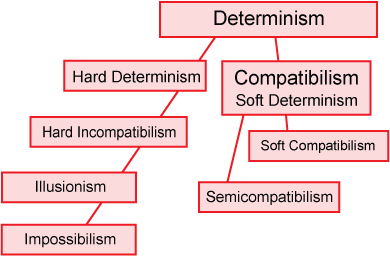
Determinists - Few modern philosophers admit to being "hard" determinists (as William James called them 31), who maintain that there is just one possible future, but all determinists believe in "strict" causality. Some argue that without causality knowledge would be impossible, since we could not be sure of our reasoning process and deduced truths. Note that there are as many kinds of determinists as there are determinisms.
Compatibilists claim that free will is compatible with determinism, since if determinism did not hold, they think that their will could not determine their actions. William James called them "soft" determinists. Though our will is itself caused, these causes include our own character, and this is enough freedom for them, even if our character was itself determined by prior causes. 32
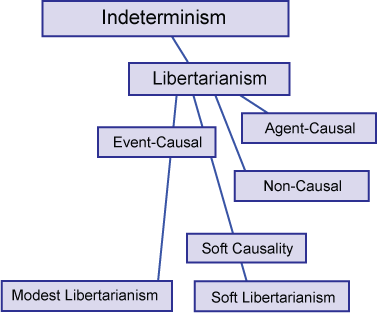
Libertarians argue that free will is incompatible with determinism and thus are called incompatibilists. Many libertarians still hold a dualist view, with Mind able to circumvent causal laws that constrain the Body. Critics call the libertarian view incoherent and unintelligible if it denies determinism and causality, which they take to be a basic requirement for modern science - indeed the basis for logic and reason. And many libertarians admit their unhappiness with chance as the source of freedom. 33
Note that hard determinists are also (with libertarians) called incompatibilists, since they deny free will. We see they also deny chance, arguing, as Aristotle thought his predecessors had argued, that everything must be caused. Some of them admit their discomfort with the implications of quantum mechanical indeterminism, and express hope that quantum mechanics will be found to include hidden variables that restore determinism. 34
Broadly speaking, philosophers after Kant can be divided into four main groups,
Compatibilists (and Determinists)
Georg Wilhelm Friedrich Hegel's greatest contribution to philosophy was to stress the importance of time and process over mechanism, with its implicit predictability. Just as Aristotle was more this-worldly than his mentor Plato, so Hegel brings Kantian ideas down from the timeless noumenal realm into an evolving world. He spoke of an absolute freedom of the individual "in itself," a concept following Kant, the "an sich." But in his dialectical idealism, the individual subject (or being) goes on to see itself in the light of others as objects (the non-being). He calls this the "for itself," Kant's "für sich." The final stage of his "aufhebung" unites these to become the "in and for itself," At this point, Hegel's freedom is a will that is the will of a community (Being). He says, "Freedom and will are for us the unity of subjective and objective." "Freedom also lies neither in indeterminateness nor in determinateness, but in both.” 35 (Philosophy of Right, Introduction, Sects. 5 and 8)
Hegel's idealist colleagues Fichte and Schelling were very enthusiastic about freedom for the individual, the "I," which was Kant's "transcendental subject." They wanted the I to be "unconditioned," an undetermined thing in itself (unbedingtes Ding an sich). For Friedrich Wilhelm Joseph Schelling, this freedom was freedom from both Nature and God. 35
"The defenders of Freedom usually only think of showing the independence of man from nature, which is indeed easy. But they leave alone man's inner independence from God, his Freedom even with respect to God, because this is the most difficult problem.
Arthur Schopenhauer's essay "On the Freedom of the Will" won the prize of the Royal Danish Academy of Sciences in 1839. His description of his predecessors' work (pp. 65-90) is extensive.
He defined absolute freedom - the liberum arbitrium indifferentiae - as not being determined by prior grounds. "Under given external conditions, two diametrically opposed actions are possible." Schopenhauer found this completely unacceptable. "If we do not accept the strict necessity of all that happens by means of a causal chain which connects all events without exception, but allow this chain to be broken in countless places by an absolute freedom, then all foreseeing of the future... becomes...absolutely impossible, and so inconceivable." 36
In the 1820's the great French mathematician Joseph Fourier noticed that statistics on the number of births, deaths, marriages, suicides, and various crimes in the city of Paris had remarkably stable averages from year to year. The mean values in a "normal distribution" (one that follows the bell curve or "law of errors") of statistics took on the prestige of a social law. The Belgian astronomer and statistician Adolphe Quételet did more than anyone to claim these statistical regularities were evidence of determinism.
Individuals might think marriage was their decision, but since the number of total marriages was relatively stable from year to year, Quételet claimed the individuals were determined to marry. Quételet used Auguste Comte's term "social physics, to describe his discovery of "laws of human nature," prompting Comte to rename his theory sociology.
Quételet's argument for determinism in human events is quite illogical. It appears to go something like this:
In England, Henry Thomas Buckle developed the ideas of Quetelet and argued that statistical regularities proved that human free will was nonexistent.
John Stuart Mill (1806-1873) did great work on probability in his System of Logic, but like the continental mathematicians was a confirmed determinist.
Mill's godson Bertrand Russell also had no doubt that causality and determinism were needed to do science. "Where determinism fails, science fails," he said. Russell could not find in himself "any specific occurrence that I could call 'will'." 37
Libertarians
A few thinkers questioned the idea that individual random events were actually determined simply because their statistical averages appeared to be determined. Bernard Bolzano (1781-1848) and Franz Exner (1802-1880) were both professors at Prague in the 1830's and 40's. They had a famous correspondence in which they discussed the possibility of free will. Bolzano, a Catholic priest, was stripped of his teaching post because his ideas were anathema to the Catholic Austrian government that paid his salary. One outcome of the revolution of 1848 was a reform of Austrian education aimed at diminishing the power of the Catholic religion, especially in education. Exner was the principal architect of this curriculum reform, and a central secular tenet was to teach the concept of probability, to encourage students to take responsibility for their own lives.
In France, two thinkers, Charles Renouvier (1815-1903) and Alfred Fouillée (1838-1912), argued for human freedom and based it on the existence of absolute chance. In his Essais de critique générale, Renouvier generally followed Kant, but he moved human freedom from Kant's imaginary noumenal realm into the phenomenal world, which for Renouvier included contingent events. In La Liberté et le déterminisme, Fouillée denied necessity and determinism.
Every philosopher after Charles Darwin's Origin of Species was affected by the explanation of evolution as random variation followed by natural selection. A few embraced it, and found that it gave support to their ideas of human freedom, based on the liberating notion of chance. But few offered a convincing idea of how exactly chance as a cause could be made consistent with moral responsibility.
Charles Sanders Peirce was deeply impressed by chance as a way to bring diversity and "progress" (in the form of increasingly complex organisms) to the world. Obviously modeling his thinking on the work of Charles Darwin, Peirce was unequivocal that chance was a real property of the world. He named it tyche, and made tychism the basis for the evolutionary growth of variety, of irregular departures from an otherwise mechanical universe, including life and Peirce's own original thoughts. But Peirce did not like Darwin's fortuitous variation and natural selection. He falsely associated it with the Social Darwinist thinking of his time and called it a "greed philosophy." Peirce also rejected the deterministic evolution scheme of Herbert Spencer, and proposed his own grand scheme for the evolution of everything including the laws of Nature! He called this synechism, a coined term for continuity, in clear contrast to the random events of his tychism.
[Necessity claims] "that the state of things existing at any time, together with certain immutable laws, completely determine the state of things at every other time (for a limitation to future time is indefensible). Thus, given the state of the universe in the original nebula, and given the laws of mechanics, a sufficiently powerful mind could deduce from these data the precise form of every curlicue of every letter I am now writing." 37a
William James,in The Will to Believe, simply asserted that his will was free. As his first act of freedom, he said, he chose to believe his will was free. He was encouraged to do this by reading Charles Renouvier.
James coined the terms "hard determinism" and "soft determinism" in his lecture on "The Dilemma of Determinism." He described chance as neither of these, but "indeterminism." He said,
"The stronghold of the determinist argument is the antipathy to the idea of chance...This notion of alternative possibility, this admission that any one of several things may come to pass is, after all, only a roundabout name for chance." 38 James was the first thinker to enunciate clearly a two-stage decision process, with chance in a present time of random alternatives, leading to a choice which grants consent to one possibility and transforms an equivocal future into an unalterable and simple past. There are undetermined alternatives followed by determined choices. "What is meant by saying that my choice of which way to walk home after the lecture is ambiguous and matter of chance?...It means that both Divinity Avenue and Oxford Street are called but only one, and that one either one, shall be chosen." 39 (James, The Will to Believe, 1897, p.155)
James very likely had the model of Darwinian evolution in mind. Unlike his colleague Charles Peirce, from whom he learned much about chance, James accepted Darwin's explanation of human evolution.
Henri Bergson, in his "Time and Free Will," argued that time in the mind (he called it dureé or duration) was different from physical time. In particular, because minds were evolving living things with memories of all their past experience, they could not be treated as collections of mechanical atoms with no such memories, so minds were not subject to deterministic laws.
Friedrich Nietzsche knew Darwin and perhaps knew of the debates in the German universities about probability and irreversibility. He may have been impressed by mechanistic explanations for everything including human affairs. His "eternal return" is consistent with microscopic particles (atoms) following deterministic paths that eventually repeat themselves. His aphoristic and polemical writing style makes his real position on free will hard to fathom. Nietzsche both denied the will and even more strongly claimed that as overmen we must choose to make ourselves. This choice has even greater weight because it would be repeated again and again in his vision of an eternal return.
Henri Poincaré describes a two-stage process in mathematical discoveries, in his lectures to the Paris Société de Psychologie around 1907. The first stage is random combinations, which he likens to Epicurus' "hooked atoms" ploughing through space in all directions, like a "swarm of gnats." He apologizes for the crude comparison, but says
"the right combination is to be found by strict calculations [which] demand discipline, will, and consequently consciousness. In the subliminal ego, on the contrary, there reigns what I would call liberty, if one could give this name to the mere absence of discipline and to disorder born of chance." 40In 1937, at the Paris Centre de Synthése, a week of lectures was delivered on inventions of various kinds, including experimental science, mathematics, and poetry. The mathematician Jacques Hadamard described the conference in his book The Psychology of Invention in the Mathematical Field (1949) Hadamard's emphasis was on the discovery or invention of mathematical theories and his main subject was Henri Poincaré. Hadamard assures us that Poincaré's observations do not impute discovery directly to pure chance. He says "Indeed, it is obvious that invention or discovery, be it in mathematics or anywhere else, takes place by combining ideas." "It cannot be avoided that this first operation takes place, to a certain extent, at random, so that the role of chance is hardly doubtful in this first step of the mental process. But we see that the intervention of chance occurs inside the unconscious." The first step is only the beginning of creation, for the following step, says Hadamard, "Invention is discernment, choice...it is clear that no significant discovery or invention can take place without the will of finding." 41 Poincaré is apparently the second thinker, after William James, to see random combinations of ideas in the unconscious mind, followed by willful decisions or choices made consciously.
The Quantum Mechanics Debate
In 1925 Max Born, Werner Heisenberg, and Pascal Jordan, formulated their matrix mechanics version of quantum mechanics as a superior formulation of Neils Bohr's old quantum theory. The matrix mechanics confirmed discrete states and "quantum jumps" of electrons between the energy levels, with emission or absorption of photons.
In 1926, Erwin Schrödinger developed wave mechanics as an alternative formulation of quantum mechanics. Schrödinger disliked the abrupt jumps. His wave mechanics was a continuous theory.
Within months of the new wave mechanics, Max Born showed that while Schrödinger's wave function evolved over time deterministically, it only predicted the positions and velocities of atomic particles probabilistically.
Heisenberg used Schrödinger's wave functions to calculate the "transition probabilities" for electrons to jump from one energy level to another. Schrödinger's wave mechanics was easier to visualize and much easier to calculate than Heisenberg's own matrix mechanics.
In early 1927, Heisenberg announced his indeterminacy principle limiting our knowledge of the simultaneous position and velocity of atomic particles, and declared that the new quantum theory disproved causality. "We cannot - and here is where the causal law breaks down - explain why a particular atom will decay at one moment and not the next, or what causes it to emit an electron in this direction rather than that." 42
More popularly known as the Uncertainty Principle in quantum mechanics, it states that the exact position and momentum of an atomic particle can only be known within certain (sic) limits. The product of the position error and the momentum error is greater than or equal to Planck's constant h/2π.
ΔpΔx ≥ h/2π
Indeterminacy (Unbestimmtheit) was Heisenberg's original name for his principle. It is a better name than the more popular uncertainty, which connotes lack of knowledge. The Heisenberg principle is an ontological as well as epistemic lack of information.
Later in 1927, Bohr announced his complementarity principle and the Copenhagen interpretation of quantum mechanics that argued for a dualist combination of wave and particle aspects for atoms and electrons.
Schrodinger argued vociferously against the random quantum jumps of Bohr and Heisenberg and for a return to his easily visualized deterministic and continuous physics.
Albert Einstein, Max Planck, Schrödinger, and other leading physicists were appalled at Born's assertion that quantum mechanics was probabilistic and Heisenberg's claim that strict causality was no longer tenable. Einstein's famous remark was "The Lord God does not play dice." Planck said, "the assumption of absolute chance in inorganic nature is incompatible with the working principle of physical science." "This means that the postulate of complete determinism is accepted as a necessary condition for the progress of psychological research." 43
Just a few years earlier, in 1919, Schrödinger and his mentor Franz Serafin Exner (son of the 19th-century educator) had been strong disciples of Ludwig Boltzmann. They were convinced that Boltzmann's kinetic theory of gases required a microscopic world of random and chaotic atomic motions. Why did Schrödinger switch from an indeterminist to a determinist philosophy, then adhere to it the rest of his life? Perhaps because his work now put him in the company of Einstein and Planck? Planck stepped down from his chair of theoretical physics at the University of Berlin and gave it to Schrödinger, who won the Nobel prize in 1933. It took nearly thirty more years and another world war before the Nobel committee gave Max Born the prize for his probabilistic interpretation of the wave function.
In his Gifford Lectures of 1927, Arthur Stanley Eddington had described himself as unable "to form a satisfactory conception of any kind of law or causal sequence which shall be other than deterministic." 44 Eddington had already established himself as the leading interpreter of the new relativity and quantum physics. His astronomical measurements of light bending as it passes the sun had confirmed Einstein's general relativity theory.
A year later, in response to Heisenberg's uncertainty principle, Eddington revised his lectures for publication as The Nature of the Physical World. There he announced "It is a consequence of the advent of the quantum theory that physics is no longer pledged to a scheme of deterministic law," 45 and enthusiastically identified indeterminism with freedom of the will.
But Eddington left himself open to the charge since Epicurus' time, that chance could not be identified with freedom. He was apparently unaware of the work of William James or Henri Poincaré to make deliberation a two-stage process - first random possibilities, then a choice. A decade later, in his 1939 book The Philosophy of Physical Science, just a few years before his death, he reluctantly concluded there is no "halfway house" 46 between randomness and determinism - an echo of Hume's "no medium betwixt chance and an absolute necessity."
Niels Bohr mentioned the free will and causality discussions in 1929, but he spoke vaguely, with his vision of complementarity, and likened them to subjective and objective views:
"Just as the freedom of the will is an experiential category of our psychic life, causality may be considered as a mode of perception by which we reduce our sense impressions to order...the feeling of volition and the demand for causality are equally indispensable elements in the relation between subject and object which forms the core of the problem of knowledge." 46a
The German philosopher Ernst Cassirer was close to many of the physicists in this debate and had a profound influence on some of them. Cassirer also influenced the predominantly deterministic views of other philosophers, themselves untrained in physics, who tried to understand the implications of quantum indeterminism for their philosophies. In his 1936 book Determinism and Indeterminism in Modern Physics, Cassirer made the case an ethical one, saying
"all truly ethical action must spring from the unity and persistence of a definite ethical character. This in itself shows us that it would be fatal for ethics to tie itself to and, as it were, fling itself into the arms of a limitless indeterminism." 47
Max Born had been first to see that chance and probability were essential to quantum mechanics, as they had been to the statistical laws of physics since Boltzmann. Unfortunately Born was strongly influenced by Cassirer, the non-scientist philosopher who said "we cannot do away with the guiding concept of determinism." Born concluded somewhat dialectically that free will was just a subjective phenomenon,
"I think that the philosophical treatment of the problem of free will suffers often from an insufficient distinction between the subjective and objective aspect." 48 (Cause and Chance, p. 127).Born approvingly quotes Cassirer, from the last chapter of Determinism and Indeterminism in Modern Physics, "whether causality in nature is regarded in the form of rigorous 'dynamical' laws or of merely statistical laws...In neither way does there remain open that sphere of 'freedom' which is claimed by ethics." 49 (source, Cassirer, p. 209)
Some biologists quickly objected to the idea of physical uncertainty in the human mind because large amounts of matter insure adequate regularity of the statistical laws. 50 (C.G.Darwin, Science, 1931).
But physicist Arthur Holly Compton defended the Eddington suggestion, with the idea of an amplifier that would allow microscopic random events to produce macroscopic random events. 51 Four years earlier, the biologist Ralph Lillie had argued that natural selection was such an amplifier of microscopic randomness. (in Science, 1927, Arthur Holly Compton, Science, 1931).
This naive model for free will came to be known as the massive switch amplifier. It was open to the ancient criticism that we can not take responsibility for random actions caused by chance. Compton defended the amplifier in The Freedom of Man (1935), but like Eddington, later denied he was trying to show that human freedom was a direct consequence of the uncertainty principle. If physics were the sole source of our information, he said (in The Human Meaning of Science, 1940), we should expect men's actions to follow certain (sic) rules of chance. 52
In the Atlantic Monthly of 1957, Compton saw the two-stage process of chance preceding choice.
"When one exercises freedom, by his act of choice he is himself adding a factor not supplied by the [random] physical conditions and is thus himself determining what will occur." 52a
John Eccles, the great neurophysiologist, took Eddington's suggestions seriously and looked for places in the brain where quantum uncertainty might be important. He decided on the synapses, where the axon of one neuron communicates with the dendrite of another neuron across a narrow gap (less than 1000 Angstroms). In his 1953 book The Neurophysiological Basis of Mind, Eccles calculated the positional uncertainty of the tiny synaptic knob. He found it to be 20 Angstroms in 1 second, a relatively tiny but perhaps significant fraction of the synaptic gap or cleft.
One other scientist and sometime philosopher, Henry Margenau, saw quantum uncertainty as necessary for free will, but that there were "more steps" needed to explain freedom. In his Wimmer Lecture of 1968, he said
"Freedom cannot appear in the domains of physiology and psychology if it is not already lodged in physics...embracing the belief that freedom is made possible by indeterminacies in nature will not solve the problem of freedom...it permits only one first step towards its solution." 52a.Ιnstead of Ernst Cassirer's view "that it would be fatal for ethics to tie itself to and, as it were, fling itself into the arms of a limitless indeterminism," Margenau embraced indeterminism as the first step toward a solution of the problem of human freedom.
Margenau lamented that his position "forces us to part company with many distinguished moral philosophers who see the autonomy of ethics threatened when a relation of any sort is assumed to exist between that august discipline and science." Margenau clearly means his longtime mentor.
"Ethics, says Cassirer, should not be forced to build its nests in the gaps of physical causation, but he fails to tell where else it should build them, if at all."
Then in his book Einstein's Space and Van Gogh's Sky of 1982, Margenau condensed his model into a single paragraph, with two components - Compton's chance and choice.
Our thesis is that quantum mechanics leaves our body, our brain, at any moment in a state with numerous (because of its complexity we might say innumerable) possible futures, each with a predetermined probability. Freedom involves two components: chance (existence of a genuine set of alternatives) and choice. Quantum mechanics provides the chance, and we shall argue that only the mind can make the choice by selecting (not energetically enforcing) among the possible future courses.
We note sadly that Margenau does not cite the earlier work of Compton (or the philosopher Karl Popper's adaptation of Compton - see below). Perhaps because free will was not a topic for mainstream scientific journals, he felt no need for rigorous references and scrupulous priority of ideas. But then his own work does not get referred to by later thinkers.
Most other Nobel-prize-winning scientists and their philosophical interpreters could not reconcile quantum mechanics and the uncertainty principle with human freedom, concluding only that strict determinism was certainly not the case for the physical or phenomenal world.
We should mention a few bizarre suggestions by scientists of how some of the more mysterious properties of "quantum reality" might help explain consciousness and free will.
Roger Penrose claims, in his 1989 book The Emperor's New Mind that non-locality and quantum gravity are involved in the mind. Like Eccles, he speculates that single-quantum sensitive neurons are playing an important role deep inside the brain. But he needs large numbers of neurons to cooperate:
"Such co-operation, I am maintaining, must be achieved quantum-mechanically; and the way that this is done is by many different combined arrangements of atoms being 'tried' simultaneously in linear superposition perhaps a little like the quantum computer...The selection of an appropriate (though probably not the best) solution to the minimizing problem must be achieved as the one-graviton criterion (or appropriate alternative) is reached - which would presumably only occur when the physical conditions are right" (p. 437)
David Hodgson extended Penrose's ideas in his 1991 book Mind Matters. He claims that
"My discussion of quantum mechanics has confirmed [the mind's] indeterministic character; and has also suggested that quantum mechanics shows that matter is ultimately 'non-material' and non-local, and that perhaps mind and matter are interdependent." (p.381)
Penrose went further in 1994 in his book Shadows of the Mind, calculating that tens of thousands of neurons could exist in a coherent correlated superposition of states for one-fortieth of a second (the fundamental alpha-rhythm rate). He cites the idea of a dualistic "mind-stuff" influencing the "quantum choices" with its "free will."
"With the possibility that quantum effects might indeed trigger much larger activities within the brain, some people have expressed the hope that, in such circumstances, quantum indeterminacy might be what provides an opening for the mind to influence the physical brain. Here, a dualistic viewpoint would be likely to be adopted, either explicitly or implicitly. Perhaps the 'free will' of an 'external mind' might be able to influence the quantum choices that actually result from such non-deterministic processes. On this view, it is presumably through the action of quantum theory's R-process that the dualist's 'mind-stuff' would have its influence on the behaviour of the brain." (p.349)This resembles Eddington's rough ideas and later remarks by Eccles that since wave functions are neither matter nor energy they are the ideal vehicle for the interaction between non-physical mind and physical matter. Eccles said this idea was suggested by Henry Margenau. Penrose provides considerable evidence for correlated states in the microtubules within the cell's cytoskeleton, then descibes chemical evidence for connecting the microtubules and consciousness in anaesthesia. (p.357-370)
Henry Stapp is another physicist employing quantum strangeness. In his 2003 Mind, Matter, and Quantum Mechanics, Stapp argues that mental intentions and strong "mental efforts" can influence quantum wave functions and produce correlated behaviors over large regions of the brain. Resembling Penrose's arguments (without any reference), Stapp says:
"It should be mentioned here that the actions P are nonlocal: they must act over extended regions, which can, and are expected to, cover large regions of the brain. Each conscious act is associated with a Process I action [collapse of the wave function] that coordinates and integrates activities in diverse parts of the brain. A conscious thought, as represented by the von Neumann Process I, effectively grasps as a whole an entire quasi-stable macroscopic brain activity." (p.252)
In 2009, the neurobiologist and geneticist Martin Heisenberg, son of quantum physicist Werner Heisenberg, found evidence for a combination of random and lawful behavior in animals and unicellular bacteria.
Evidence of randomly generated action — action that is distinct from reaction because it does not depend upon external stimuli — can be found in unicellular organisms. Take the way the bacterium Escherichia coli moves. It has a flagellum that can rotate around its longitudinal axis in either direction: one way drives the bacterium forward, the other causes it to tumble at random so that it ends up facing in a new direction ready for the next phase of forward motion. This ‘random walk’ can be modulated by sensory receptors, enabling the bacterium to find food and the right temperature.In higher organisms, Heisenberg finds that the brain still may include elements that do a random walk among options for action. As with a bacterium’s locomotion, the activation of behavioural modules is based on the interplay between chance and lawfulness in the brain. Insufficiently equipped, insufficiently informed and short of time, animals have to find a module that is adaptive. Their brains, in a kind of random walk, continuously preactivate, discard and reconfigure their options, and evaluate their possible short-term and long-term consequences.This is clearly another example of a two-stage model for "free" followed by "will."
Recent Philosophers who Specialize in the Free Will Problem.
In the late 1950's, Mortimer Adler compiled a massive two-volume history of The Idea of Freedom. It covers at great length ideas of political freedom and freedom from external constraints, as well as the central freedom of the individual will to choose from among possibilities that are not necessary or predictable.
In an attempt to classify types of freedom, Adler invents three categories that he hopes are "dialectically neutral" - the circumstantial freedom of self-realization (freedom from coercion, political end economic freedom, etc.), the acquired freedom of self-perfection (making decisions for moral reasons rather than desires and passions), and the natural freedom of self-determination (the normal freedom of the will). Self-perfection is the idea from Plato to Kant that we are only free when our decisions are for reasons and we are not slaves to our passions. Adler also includes many theologically minded philosophers who argue that man is only free when following a divine moral law. Sinners, they say, do not have free will, which is odd because sinners are presumably responsible for evil in the world despite an omniscient and omnipotent God. Self-determination covers the classic problem of free will. Do we determine our will, or is it simply part of a causal chain? Most of Adler's natural freedoms are compatibilisms. They include Hegel's freedom of a stone falling according to Newton's law of gravity. In his over 1400 pages, Adler devotes only six pages to brief comments on quantum mechanical indeterminism 53 (v.1, p.461-466). Adler depends heavily on the thoughts of Max Planck and Erwin Schrödinger, who along with major thinkers like Einstein, Louis de Broglie, and David Bohm, rejected indeterminism.
The philosopher Karl Popper had a famous collaboration over some decades with the neuroscientist John Eccles. The two were mind/body or mind/brain dualists who hoped to discover the mind to be more than a mere "epiphenomenon" of the material brain. They briefly considered quantum effects, initially to dismiss them, and then to reconsider them.
In their dialogue X, Eccles said, "It is not possible I think to utilize quantum indeterminacy." Popper replied, "I do of course agree that quantum theoretical indeterminacy in a sense cannot help, because this leads merely to probabilistic laws, and we do not wish to say that such things as free decisions are just probabilistic affairs. The trouble with quantum mechanical indeterminacy is twofold. First, it is probabilistic, and this doesn't help much with the free-will problem, which is not just a chance affair. Second, it gives us only indeterminism." 54
To this point, Popper reflects the overall negative reaction of the scientific and philosophical communities to indeterminism. But in his 1965 Arthur Holly Compton memorial lecture Of Clouds and Clocks, Popper celebrated Compton's contributons to the question of human freedom, including the insufficient idea of the quantum uncertainty amplifier. But then he goes on to describe a two-stage decision process modeled on Darwinian natural selection. Can we doubt these were directly inspired by Compton's later remarks and Compton's 1931 references to Ralph Lillie and evolution?
Any intelligible explanation for free will must include both indeterminism and adequate determinism, as does biological evolution.
"New ideas have a striking similarity to genetic mutations," Popper says, "Mutations are, it seems, brought about by quantum theoretical indeterminacy (including radiation effects). On them there subsequently operates natural selection which eliminates inappropriate mutations. Now we could conceive of a similar process with respect to new ideas and to free-will decisions. That is to say, a range of possibilities is brought about by a probabilistic and quantum mechanically characterized set of proposals, as it were - of possibilities brought forward by the brain. On these there operates a kind of selective procedure which eliminates those proposals and those probabilities which are not acceptable to the mind." 55(The Self and its Brain, 1977, pp.539-540)
In 1977 Popper gave the first Darwin Lecture, at Darwin College, Cambridge. He called it Natural Selection and the Emergence of Mind. In it he said he had changed his mind (a rare admission by a philosopher) about two things. First he now thought that natural selection was not a "tautology" that made it an unfalsifiable theory. Second, he had come to accept the random variation and selection of ideas as a model of free will.
The selection of a kind of behavior out of a randomly offered repertoire may be an act of indeterminism; and in discussing indeterminism I have often regretfully pointed out that quantum indeterminacy does not seem to help us; for the amplification of something like, say, radioactive disintegration processes would not lead to human action or even animal action, but only to random movements. I have changed my mind on this issue. A choice process may be a selection process, and the selection may be from some repertoire of random events, without being random in its turn. This seems to me to offer a promising solution to one of our most vexing problems, and one by downward causation.Popper is thus the third thinker (or fourth, if we liberally interpret Compton) to describe a two-stage mental process, after James and Poincaré. He also solves the problem of indeterminism directly causing our decisions. Note Popper's not so subtle shift of the realm of chance to the material body (his "World 1") and the realm of determination to the mind (his "World 2"). The traditional dualism from the ancients to Kant made the material body the realm of phenomenal determinism and the mind or spirit the noumenal realm of freedom, God, and immortality.
The physicist Richard Feynman also proposed a Compton-style Geiger-counter event followed by a bomb explosion. This caught the attention of Wittgenstein scholar Elizabeth Anscombe in her inaugural lecture at Cambridge University, where she said
It has taken the inventions of indeterministic physics to shake the rather common dogmatic conviction that determinism is a presupposition or perhaps a conclusion, of scientific knowledge. Feynman's example of the bomb and Geiger counter smashes this conception; but as far as I can judge it takes time for the lesson to be learned. I find deterministic assumptions more common now among people at large, and among philosophers, than when I was an undergraduate.
In his 1961 landmark essay Freedom and Resentment, Peter Strawson changed the subject from free will itself to the question of moral responsibility.60a Strawson said he could make no sense of the truth or falsity of determinism, indeterminism, or free will. But even if determinism were true, he argued, we would continue to act as if persons were morally responsible and deserving of praise and blame, gratitude and resentment.
Strawson was following David Hume's naturalist arguments that our moral sentiments are simply given facts beyond the skepticism of logic and critical thought. Hume the Naturalist had no problem deriving Ought from Is - something shown logically impossible by Hume the Skeptic.
In 1969 Harry Frankfurt changed the debate on free will and moral responsibility with a famous thought experiment that challenged the existence of alternative possibilities for action. The traditional argument for free will requires alternative possibilities so that an agent could have done otherwise, without which there is no moral responsibility.
Frankfurt posited a counterfactual demon who can intervene in an agent's decisions if the agent is about to do something different from what the demon wants the agent to do. Frankfurt's demon will block any alternative possibilities, but leave the agent to "freely choose" to do the one possibility desired by the demon. Frankfurt claimed the existence of the hypothetical control mechanisms blocking alternative possibilities would be irrelevant to the agent's free choice. This is true when the agent's choice agrees with the demon, but obviously false should the agent disagree. In that case, the demon would have to block the agent's will and the agent would surely notice.
Compatibilists had long been bothered by alternative possibilities, needed in order that agents "could do otherwise. They knew that determinism allows only a single future - one actual causal chain of events - and were delighted to get behind Frankfurt's examples as proofs that alternative possibilities, perhaps generated in part by random events, did not exist. Frankfurt, like Strawson, argued for moral responsibility without libertarian free will.
Note, however, that Frankfurt assumes that genuine alternative possibilities do exist. If not, there is nothing for his counterfactual intervening demon to block. Furthermore, without alternatives, Frankfurt would have to admit that there is only one "actual sequence" of events leading to one possible future. "Alternative sequences" would be ruled out. Since Frankfurt's demon, much like Laplace's demon, has no way of knowing the actual information about future events - such as agent's decisions - until that information comes into existence, such demons are not possible and Frankfurt-style thought experiments, entertaining as they are, can not establish the compatibilist version of free will.
Daniel Dennett, perhaps the leading spokesman for Compatibilism, is a strong critic of any genuine indeterminism in free will. Yet in his book "Brainstorms" in 1978, he proposed an influential "model of decision making" with a two-stage account of free will. In his chapter "On Giving Libertarians What They Say They Want" (p.286), Dennett clearly separates random possibilities from determined choices. 57
But does Dennett, following James, Poincaré, and Popper, see that this solves the problem of indeterminism in free will that has plagued philosophy since Epicurus' "swerve" of the atoms? He says, a bit sarcastically, that his model "puts indeterminism in the right place for the libertarian, if there is a right place at all [my emphasis]." And after giving six excellent reasons why his suggestion is what libertarians are looking for, Dennett then suggests that the randomness generator might as well have been a computer-generated pseudo-random number generator. He says "Isn't it the case that the new improved proposed model for human deliberation can do as well with a random-but-deterministic generation process as with a causally undetermined process?" This completely misses the libertarian's point, which is a randomness that breaks the causal chain of pre-determinism back to the universe origin.! But then Dennett's argument for libertarianism may just be a compatibilist's straw man. He does not pursue it in his later works, such as Elbow Room, The Varieties of Free Will Worth Wanting (Dennett, 1984) or the more recent Freedom Evolves (2003). Dennett's model was inspired by many sources. One was David Wiggins' Towards a resonable libertarianism, which cited Bertrand Russell and Arthur Stanley Eddington as suggesting quantum indeterminism. . Another was Herbert Simon's 1969 two-stage "generate and test" model for creating computer artifacts 59 (Simon, 1969, p.), itself a computer version of Darwin's random variation and natural selection model for biological evolution. Another source was Hadamard's book. Dennett (p.293) quotes the poet Paul Valéry (from Hadamard, p.30), who imagines two agents (in one mind?) "It takes two to invent anything. The one makes up combinations; the other one chooses." 60But as we have seen, this was Poincaré's idea which Valéry picked up at the 1937 conference. Some evidence now exists that Poincaré's work was in fact inspired by William James. They both say that alternative possibilities "present themselves." Nevertheless, Dennett's article is so influential in the philosophical community that two-stage models for free will are sometimes called "Valerian." We discuss Dennett's seminal article, with significant excerpts, in Giving Determinists What They Say They Want. The (politically) Libertarian philosopher Robert Nozick sketched a view of free will in his 1981 book Philosophical Explanations, but admitted he found the problem intractable. Peter van Inwagen, in his 1983 "An Essay on Free Will," caused a stir by arguing that compatibilism is demonstrably false, even admitting Frankfurt's denial of alternative possibilities, in what has come to be called the Consequence Argument. In short, if compatibilism traces the causes of our actions, in the one "actual sequence" of events, back to events before we existed, then our actions are simply the consequences of those earlier events and are "not up to us." Speaking as a logical philosopher, he concludes that "the free-will thesis and determinism are incompatible. That is, incompatibilism is true." "To deny the free-will thesis is to deny the existence of moral responsibility, which is absurd...Therefore, we should reject determinism." 61 This has been obvious to libertarians since Epicurus, and was argued for example by Carl Ginet in 1966. Robert Kane is the leading spokesman for Libertarianism. Before Kane, in the late twentieth century, Anglo-American philosophers had largely dismissed free will as a "pseudo-problem." Although like the others, Kane does not find any libertarian position, including his own, "intelligible," he developed the view that even if most of our actions are determined entirely by our character, these "self-formed actions" can be free if we at times in the past freely created our own character (and if we remain free to change it). This was Aristotle's view and agrees with Buddhist ideas of Karma. In his 1985 book Free Will and Values, aware of earlier proposals by Eccles, Popper, and Dennett, but working independently, proposed an ambitious amplifier model for a quantum randomizer in the brain - a spinning wheel of fortune with probability bubbles corresponding to alternative possibilities, in the massive switch amplifier tradition of Compton and Gomes. Kane says (p.147): "neurological processes must exist corresponding to the randomizing activity of the spinning wheel and the partitioning of the wheel into equiprobable segments (red, blue, etc.) corresponding to the relevant R-alternatives."Kane's model combines free will and values. Kane claimed his free choice is moral and made in accord with Kant's concept of duty. This may be an ethical fallacy. "the succession of random selections among equiprobable alternatives is meant to be a continuing reminder (a mental or neurological representation) of the fact that the reason sets of other persons are to be treated equally."Kane is not satisfied with his solution. He explains that the main reason for failure is "locating the master switch and the mechanism of amplification...We do not know if something similar goes on in the brains of cortically developed creatures like ourselves, but I suspect it must if libertarian theories are to succeed." (p.168)Kane's basic failure is his location of indeterminism in the decision process itself, making chance the direct cause of action. Kane's major accomplishment, however, is to identify "torn" decisions that were made at random, but because there exist equally good reasons whichever way the decisions go, the agent can still claim moral responsibility, against the critics of chance who say that indeterminism necessarily destroys the kind of control needed for moral responsibility.
Kane claims that the major criticism of all indeterminist libertarian models is explaining the power to choose or do otherwise in "exactly the same conditions," something he calls "dual rational self-control." Given that A was the rational choice, how can one defend doing B under exactly the same circumstances? (Kane, 1985, p.59) Kane is concerned that such a "dual power" is arbitrary, capricious, and irrational.
Apart from the fact that information-rich systems with a history are never in the exact same conditions, and ignoring the fact that random alternative possibilities are unlikely to repeat, an adequately determined will would very likely make the same choice, for the same reasons, from the same set of alternate possibilities. But it might on the other hand exercise its irrational prerogative! We humans are unpredictable, which makes us occasionally capricious and arbitrary. Why the problem?
Richard Double, in his 1991 book The Non-Reality of Free Will, agrees with Kane that libertarian free will must have the "dual ability" to choose otherwise with rational control. But he says:
"My conclusion is that the deep reason why no libertarian view can satisfy all three conditions [ability-to-choose-otherwise, control, and rationality] is that the conditions are logically incompatible. Hence, libertarianism, despite its intuitive appeal, turns out to be incoherent." (p.190)
There is a rich history of linguistic and logical quibbles among compatibilists over the ability to do otherwise. G. E. Moore and A. J. Ayer said that one could have done otherwise, if one had chosen to do so, i.e., if things in the past had been different. But since the "fixed past" could never be different (in retrospect) one could not have so chosen, according to compatibilists (and determinists).
In 1987 two classicists, Anthony Long and David Sedley, speculated that Epicurus' swerve of the atoms might be limited to providing undetermined alternative possibilities for action, from which the mind's power of volition could choose in a way that reflects character and values, desires and feelings.
"It does so, we may speculate, not by overriding the laws of physics, but by choosing between the alternative possibilities which the laws of physics leave open."Sedley and Long assume a non-physical (metaphysical) ability of the volition to affect the atoms, which is implausible. But the idea that a physical volition chooses - (consistent with and adequately determined by its character and values and its desires and feelings) from among alternative possibilities provided randomly by atomic indeterminacy - is quite plausible.
Ted Honderich - the major spokesman for "Hard Determinism" - in 1988 published his 750-page The Theory of Determinism, with excursions into quantum mechanics, neuroscience, and consciousness.
Unlike most of his colleagues specializing in free will, Honderich did not succumb to the easy path of Compatibilism, by simply declaring that the free will we have (and should want, say some) is completely consistent with determinism, namely a "voluntarism" in which our will is completely caused by prior events. Nor does he go down the path of Incompatibilism, looking for non-physical substances, dualist forms of agency, or simply identifying freedom with Epicurean chance, as have many scientists with ideas of brain mechanisms amplifying quantum mechanical indeterminism to help with the uncaused "origination" of actions and decisions. Honderich does not claim to have found a solution to the problem of free will or determinism, but he does claim to have confronted the problem of the consequences of determinism. He is "dismayed" because the truth of determinism requires that we give up "origination" with its promise of an open future, restricting - though not eliminating - our "life hopes." Though he is determinism's foremost champion, Honderich characterizes it as a "black thing" and passionately feels the loss when he follows his reason to accept the truth of determinism. Honderich faults the Compatibilists and Incompatibilists on three counts. First, he says that moral responsibility is not all that is at stake, there are personal feelings, reactive attitudes, problems of knowledge, and rationalizing punishment with ideas of limited responsibility. Second, these problems can not be resolved by logical "proofs" nor by linguistic analyses of propositions designed to show "free" and "determined" are logically compatible. And third, he faults their simplistic idea that one or the other of them must be right. And unlike some of his colleagues, Honderich does not competely dismiss indeterminism and considers the suggestion of "near-determinism." He says, "Maybe it should have been called determinism-where-it-matters. It allows that there is or may be some indeterminism but only at what is called the micro-level of our existence, the level of the small particles of our bodies." 63
Albert Mele, in his 1995 book Autonomous Agents, argued, mostly following Dennett, that libertarians should admit that the final stages of deliberation are (adequately) determined and only allow indeterminism in the early stages of the decision process. While he himself has made no commitment to such indeterminism, and wonders how it could be physically possible, he offers the idea to others as a "modest libertarianism." 62 (p.211-220). Mele's model satisfies the temporal sequence requirements for libertarian free will, even if he does not see the possible location of indeterminism in the brain.
Paul Russell, also in 1995, suggested that the location of the break in the causal chain might be put between willings, which might be uncaused, and actions, which would be determined. This goes against the common sense use of the word "will," but Russell correctly puts something "free" before a final "will."
Randolph Clarke assessed the Dennett and Mele suggestions in his 2003 Libertarian Accounts of Free Will and found them inadequate. His work, he says, was carried out by thinking alone and required no specialized knowledge of natural science. At best, he concludes, indeterminism in processes leading to our actions is superfluous, adding nothing of value and possibly detracting from what we want. In a 2000 article called "Modest Libertarianism," he ignores Mele's suggestion and "places indeterminism in the direct production of the decision," as did Kane and Laura Waddell Ekstrom.
Robert Kane, in addition to his work to find some pathway through the "free will labyrinth" to an intelligible account of freedom, in 2002 assembled in one place perhaps the best collection of modern positions on free will, from theology and fatalism to mostly dualist libertarian perspectives. His massive sourcebook, The Oxford Handbook of Free Will, has contributions from over two dozen contemporary philosophers with strong ideas about free will. Sadly most continue to be wordy jargon-laden debates and attempts to logically refute one position or another.
That there is nothing new, that it is mostly compatibilist, and that overall it is dismissive of freedom as either "unintelligible" or "metaphysical," makes the Oxford Handbook an accurate reflection of the current state of the free will problem. Kane cites Anscombe's remark, that determinism is becoming more common, and insightfully notes that "One may legitimately wonder why worries about determinism persist at all in the twenty-first century, when the physical sciences - once the stronghold of determinist thinking - seem to have turned away from determinism." Indeed, today it is determinism that is "metaphysical."64 Then in 2005, Kane published A Contemporary Introduction to Free Will, a comprehensive survey of the recent positions on free will, perhaps the most comprehensive since Mortimer Adler. Kane adds two more freedom classifications to Adler's three categories. Self-control is a variation on Adler's acquired freedom of Self-perfection to include the arguments of the many "New Compatibilists" who are more concerned about moral responsibility than free will, such as Harry Frankfurt and John Martin Fischer. Self-formation is a variation of Adler's Self-determination to include Kane's own "self-forming actions" (SFA) that are a subset of self-determining actions. Kane requires that an SFA is an indeterministic "will-setting action" that helps form our character. Later, other actions can be determined by our character, but we can still assert "ultimate responsibility" (UR) for those actions, because they can be traced back to the SFA.
Besides Kane, a few more recent libertarian philosophers defend "incompatibilism," but cannot agree on an "intelligible" account of how, when, and perhaps most importantly, where indeterminism enters the picture - without making our actions purely random.
They include Randolph Clarke, Laura Waddell Ekstrom, Carl Ginet, Timothy O'Connor, Peter Van Inwagen, and David Wiggins. David Widerker has extended Kane's strong 1985 criticism of Frankfurt-style examples, in defense of incompatibilist libertarian free will.
Unfortunately, their works are full of a dense jargon defining (sometimes obscuring) subtle differences in their views - agent causation, event causation, non-occurrent causation, reasons as causes, intentions, undefeated authorization of preferences as causes, noncausal accounts, dual control, plurality conditions, origination, actual sequences and alternative sequences, source and leeway compatibilism, revisionism, restrictivism, semicompatibilism, and narrow and broad incompatibilism.
See our Glossary of Terms for clarification of this dense jargon.
A few compatibilist/determinist philosophers have, following Peter Strawson, turned the conversation away from the "unintelligible" free will problem to the problem of moral responsibility. Peter's son Galen Strawson is one. He accepts determinism outright on the grounds that a causa sui is simply impossible. Where Sir Peter says that the truth of determinism would not change our attitudes about moral responsibility, his son says it makes moral responsibility impossible.
John Martin Fischer calls his position semicompatibilism. Also included are Derk Pereboom, and Saul Smilansky, followers of Ted Honderich's hard determinism, who define their position as "hard incompatibilism," denying both human freedom and moral responsibility. Fischer says free will may or may not be incompatible with determinism, but his main interest, moral responsibility, is not incompatible. Fischer has recently edited a 4-volume, 46-contributor, 1300+ pages compendium of articles on moral responsibility - entitled Free Will, a reference work in the Critical Concepts in Philosophy series (Routledge 2005). In it, Fischer explains his colleagues setting aside the "unintelligible" problem of free will. Some philosophers do not distinguish between freedom and moral responsibility. Put a bit more carefully, they tend to begin with the notion of moral responsibility, and "work back" to a notion of freedom; this notion of freedom is not given independent content (separate from the analysis of moral responsibility). For such philosophers, "freedom" refers to whatever conditions are involved in choosing or acting in such a way as to be morally responsible. (Vol.1, p.xxiii) Pereboom, Smilansky, Galen Strawson, and the psychologist Daniel Wegner are hard incompatibilists who follow many earlier thinkers and say that free will is merely an illusion. Strawson argues that moral responsibility is impossible. Unlike the others who find it uplifting and therapeutic to disabuse the public of illusions about free will, Saul Smilansky may share the "dismay" that Ted Honderich sees in the apparent loss of control implicit in determinism. Smilansky thinks we need to maintain the public illusion of free will as a contribution to maintaining public morality. Taxonomies of Free Will and Determinism Positions
Determinism is the position that every event has a cause, in a chain of causal events with just one possible future.
"Soft" and "hard" determinism are terms invented by William James who lamented the fact that some determinists were co-opting the term freedom for themselves. He called them "soft" determinists, "because they abhor harsh words, and, repudiating fatality, necessity, and even predetermination, say that its real name is freedom; for freedom is only necessity understood, and bondage to the highest is identical with true freedom."
"Hard" determinists (Honderich) simply deny the existence of free will.
Compatibilism (Dennett) is the most common name used for James's category of soft determinism.
Semicompatibilists (Fischer) are narrow incompatibilists who are agnostic about free will and determinism but claim that moral responsibility is compatible with determinism.
Hard incompatibilists (Pereboom) think both free will and moral responsibility are not compatible with determinism.
Illusionists (Smilansky, Wegner) are hard incompatibilists who say free will is an illusion and usually deny moral responsibility.
Impossibilists (Galen Strawson) are hard incompatibilists who say free will and moral responsibility are impossible.
Let's also look at a taxonomy of indeterministic positions.
Indeterminism is the position that there are random (chance) events in a world with many possible futures.
Libertarians believe that the indeterminism makes free will possible. Note that there many philosophers who admit indeterminism may be true but that it does not provide free will ("hard" indeterminists?). See the standard argument against free will.
Agent-causal indeterminists (O'Connor) are libertarians who think that agents have originating causes for their actions that are not events. Actions do not depend on prior causes. Some call this “metaphysical” freedom.
Non-causal indeterminists (Ginet) simply deny any causes whatsoever for libertarian free will.
Event-causal indeterminists (Kane) generally accept the view that random events (most likely quantum mechanical events) occur in the world. Whether in the physical world, in the biological world (where they are a key driver of genetic mutations), or in the mind, randomness and uncaused events are real. They introduce the possibility of accidents, novelty, and human creativity.
Although random quantum mechanical events break the strictly deterministic causal chain, which has just one possible future, they nevertheless are causes for successive events. They start new unpredictable causal chains. They generate unpredictable futures. They are said to be causa sui. They need not be the direct cause of human actions. While microscopic quantum events are powerful enough to deny determinism, the magnitude of these events is generally so small, especially for large macroscopic objects, that the world is still overwhelmingly deterministic. We call this "adequate determinism." Soft causalists (Doyle) are event-causalists who accept causality but admit some unpredictable events that are causa sui and which start new causal chains. Soft causalists say that indeterministic event acausality should be considered a prerequisite for adequately determined agent causality. Compatibilism and Incompatibilism
We can combine these determinist and indeterminist taxonomies with a taxonomy of incompatibilist positions. The result is a bit complex, because incompatibilists contain both determinists and libertarians, making for a very confused debate by thinkers who are nominally committed to clear concepts as called for by analytic language philosophy.
Incompatibilists who are “hard” determinists (denying free will) have recently assumed extreme positions that they call "hard incompatibilism." Some of them attempt to remain agnostic on free will and determinism, but others are willing to call free will an "illusion" and moral responsibility "impossible."
Incompatibilists who are indeterminists generally accept the view that random events (most likely quantum mechanical events) occur in the world and are important for free will.
Broad incompatibilists think both free will and moral responsibility are incompatible with determinism.
Narrow incompatibilism is the idea that moral responsibility is compatible with determinism, even though free will is not compatible. This is similar to semicompatibilism.
Soft incompatibilism is the idea that both free will and moral responsibility are incompatible with strict determinism (really pre-determinism) but both are compatible with adequate determinism.
Comprehensive compatibilism is a new term proposed by Doyle. It describes his two-stage model that reconciles free will with both a limited determinism and a limited indeterminism. Doyle locates the first-stage indeterminism not in any particular time and place in the brain, but the result of inevitable noise in any information processing system. Noise shows up in the brain as (storage) errors of perception and (retrieval) errors of memory recall.
Another popular effort in recent years has been to invoke mysterious properties of quantum mechanics (beyond simple indeterminism) to explain free will and consciousness. Notable contributors include Roger Penrose, who combines non-local quantum effects with quantum gravity in his Emperor's New Mind. Henry Stapp also invokes non-local quantum mechanics, as does Australian jurist turned philosopher David Hodgson.
John Searle recently wrote in his 2007 Freedom and Neurobiology, "The persistence of the free will problem in philosophy seems to me something of a scandal. After all these centuries of writing about free will, it does not seem to me that we have made very much progress." 65 (p.37) In a breakthrough of sorts, Searle admits that he could never see, until now, the point of introducing quantum mechanics into discussions of consciousness and free will. Now he says we know two things, "First we know that our experiences of free action contain both indeterminism and rationality...Second we know that quantum indeterminacy is the only form of indeterminism that is indisputably established as a fact of nature...it follows that quantum mechanics must enter into the explanation of consciousness." (p.74-75)
Indeed it does. Despite a century of failed attempts, can we convince Searle and other philosophers that indeterminism followed by an adequate if not strict determinism is the right two-stage model for free will? See our Cogito model.
Why have most philosophers been unable for millenia to see that the common sense view of human freedom is correct? It is partly because their logic and language preoccupation likes to say that either determinism or indeterminism is true, and the other must be false.
Determinism and indeterminism are the horns of the dilemma presented as the standard argument against free will, which we can trace back unchanged to the earliest discussions of freedom, determinism, and moral responsibility.
Our physical world includes both, though the determinism we have is only an adequate description for large objects. So any intelligible explanation for free will must include both a limited indeterminism and an adequate determinism, in a temporal sequence that creates information.
For Teachers
Some anthologies on free will, with contributing authors:
Some important quotes on free will.
Aristotle (384-322): "If we are unable to trace conduct back to any other origins than those within ourselves, then actions of which the origins are within us, themselves depend upon us, and are voluntary (ekousia - will). Nichomachean Ethics, III.v.6"
Titus Lucretius Carus (99-55): "If all motion is always one long chain, and new motion arises out of the old in order invariable, and if first-beginnings do not make by swerving a beginning of motion so as to break the decrees of fate, whence comes this free will?" De Rerum Natura, Book II, line 251.
Marcus Tullius Cicero (106-43): "If there is free will, all things do not happen according to fate; if all things do not happen according to fate, there is not a certain order of causes; and if there is not a certain order of causes, neither is there a certain order of things foreknown by God."
Augustine (354-430): "No action would be either a sin or a good deed if it were not performed by the will, and so both punishment and reward would be unjust if human beings had no free will. Therefore, God must needs have given free will to man." On Free Choice of the Will, Book 2, I, 7.
Thomas Aquinas (1225-1274): "Man has free will: otherwise counsels, exhortations, commands, prohibitions, rewards, and punishments would be in vain... (man) acts from free judgment and retains the power of being inclined to various things. For reason in contingent matters may follow opposite courses... for as much as man is rational is it necessary that man have a free will." Summa Theologicae, First part, a, Question 83, Article 1
Giovanni Pico Della Mirandola (1463-1494):
"According to your desires and judgment, you will have and possess whatever place to live, whatever form, and whatever functions you yourself choose. All other things have a limited and fixed nature prescribed and bounded by our laws. You, with no limit or no bound, may choose for yourself the limits and bounds of your nature... To man it is allowed to be whatever he chooses to be!" Oration on the Dignity of Man
Martin Luther (1483-1546): "God foreknows...and does all things according to His immutable, eternal, and infallible will. This thunderbolt throws free will flat and utterly dashes it to pieces." Discourse on Free Will, p.106 (Weimar Ausgabe, 615).
Thomas Hobbes (1588-1679): "That which necessitates and determinates every action...is the sum of all those things which, now being existent [without which] the effect could not be produced. This concourse of causes, whereof every one is determined to be such as it is by a like concourse of former causes, may well be called the decree of God." Of Liberty and Necessity, p.20.
Eddy Nahmias on the Garden of Forking Paths blog counted compatibilist and incompatibilist philosophers in 2006. He found a 2:1 ratio among philosophers specializing in the free will problem, and thinks this is similar to the ratio among philosophers in general.
Compatibilists David Lewis, John Perry, Bill Lycan, Harry Frankfurt, Daniel Dennett, Michael Bratman, Peter Strawson, Gary Watson, Susan Wolf, Hilary Bok, Michael McKenna, Thomas Scanlon, Bernard Berofsky, Gerald Dworkin, Bruce Waller, Jay Wallace, Dana Nelkin, Joe Campbell, Thomas Kapitan, Keith Lehrer, Paul Russell, David Sanford, Phillip Pettit, Michael Smith, Terry Horgan, David Velleman
Incompatibilists
Peter Van Inwagen, Ted A. "Fritz" Warfield, Timothy O’Connor, David Widerker, Randolph Clarke, Carl Ginet, Robert Kane, Laura Ekstrom, David Wiggins, William Rowe, Roderick Chisholm, Richard Taylor
Incompatibilist skeptics
Derk Pereboom, Galen Strawson, Saul Smilansky, Richard Double, Ted Honderich, Thomas NagelIs Eleanor Stump an incompatibilist? For Scholars
Notes:1. Leucippus, quoted by Kirk, G.S., J.E.Raven, and M.Schofield, The Presocratic Philosophers, Second edition, Cambridge, 1983, Fragment 569 (from Fr. 2 Actius I, 25, 4).
2. Aristotle, Physics B4, 196a24. "We often allege chance (τυχη) or spontaneity (ἀυταματον) as causes, saying that something came about 'by chance' or 'spontaneously.'"Metaphysics, 1025a25. "Nor is there any definite cause for an accident (συμβεβηκός), but only chance (τυχη), namely an indefinite (ἀόριστον) cause."Metaphysics, 1065a33. "Causes from which chance results might happen are indeterminate; hence chance is obscure to human reason and is a cause by accident."
3. Cicero, cited by Augustine, City of God, Book V, Ch.9, See also De Divinatione Book II, x 25 si enim provideri nihil potest futurum esse eorum quae casu fiunt, quia esse certa non possunt, divinatio nulla est
4. A.A.Long, Problems in Stoicism 1996, R.Sorabji Necessity, Cause, and Blame 1980, p.70 "In antiquity the Stoics gained the reputation of being strict determinists, and this reputation has generally persisted up to the present day.", Long, p.173.
5. Sambursky, Physics of the Stoics, p.73-76. ...further light is shed on Aristotle's rejection of determinism in his statement on chance: "Causes from which chance results might happen are indeterminate; hence chance is obscure to human calculation and is a cause by accident." Expressed in the language of modern determinism this would mean that according to Aristotle even a Laplacean intelligence could not predict events of the sub-lunar world because they are contingent by their very nature, and may happen thus or otherwise.
6. Sharples 1983, p.8, Long, 1986, p.101, Sharples 1996, p.8. "For Chrysippus argues thus: ' If uncaused motion exists, it will not be the case that every proposition (termed by the logicians an axiom) is either true or false, for a thing not possessing efficient causes will be neither true nor false; but every proposition is either true or false; therefore uncaused motion does not exist. If this is so, all things that take place take place by precedent causes; if this is so, all take place by fate; it therefore follows that all things that take place take place by fate.'" Cicero, De Fato, X, 22
But Long is convinced that Chrysippus thought men were free and that Stoics had a positive conception of freedom, that freedom was the "possibility of determining one's actions." "The Stoics, though removing the possibility of choosing and performing either of two contrary actions, assert that what occurs through our instrumentality (δι ημων) is attributable to (in the power of, εφ ημιω) us. For, they argue, since things and events have different natures ... the result of any individual's action accords with its specific nature." Long, p.180.
7. Sharples 1983. "One crucial point that is however clear is that Alexander's own conception of responsibility is a libertarian one." Sharples, p.21Alexander himself denies the gods have foreknowledge. "To say that it is reasonable that the gods should have foreknowledge of the things that will be, because it is absurd to say that they fail to know anything of the things that will be, and assuming this, to try to establish by means of it that all things come to be of necessity and in accordance with fate — [this] is neither true nor reasonable." Alexander, De Fato, XXX, 1
8. Augustine, On Free Choice of the Will. "God foreknows all the things of which He Himself is the Cause, and yet He is not the Cause of all that He foreknows. He is not the evil cause of these acts, though He justly avenges them. You may understand from this, therefore, how justly God punishes sins; for He does not do the things which He knows will happen.", Book Three, IV, 40
9. Aquinas, Duns Scotus
10. Maimonides, see the Argument from Free Will in the wikipedia. "Does God know or does He not know that a certain individual will be good or bad? If thou sayest 'He knows', then it necessarily follows that [that] man is compelled to act as God knew beforehand he would act, otherwise God's knowledge would be imperfect..."
11. Islam
12. Hinduism, Buddhism
13. Pico della Mirandola, Giordano Bruno
14. Lorenzo Valla, Pietro Pomponazzi
15. Erasmus, Martin Luther
16. Descartes
17. Spinoza
18. Thomas Hobbes
19. John Bramhall
20. George Berkeley
21. John Locke
22. David Hume, A Treatise of Human Nature, p.171. See also the later Enquiries, pp.95-96, where Hume said: ...liberty when opposed to necessity, not to constraint, is the same thing with chance; which is universally allowed to have no existence.
23. Isaac Newton
24. Leibniz
25. Kant
26. Darwin
27. Ludwig Boltzmann
28. Werner Heisenberg, Max Born
29. Bertrand Russell
30. Kurt Gödel
31. William James
32. Thomas Hobbes, William James
33. Libertarian
34. Incompatibilism
35. G.W.F.Hegel
36. Arthur Schopenhauer could do otherwise if we had a different character.
37. Bertrand Russell
38. Charles Sanders Peirce
39. Poincaré, Science and Method, 1914, pp.62-63.
41, Hadamard, 1949, pp.29-31.
43. Planck, 1933, p.154-5.
64. Kane 1985, p.9, and Handbook of Free Will 2002, p.7
|